

190
L. Kumar
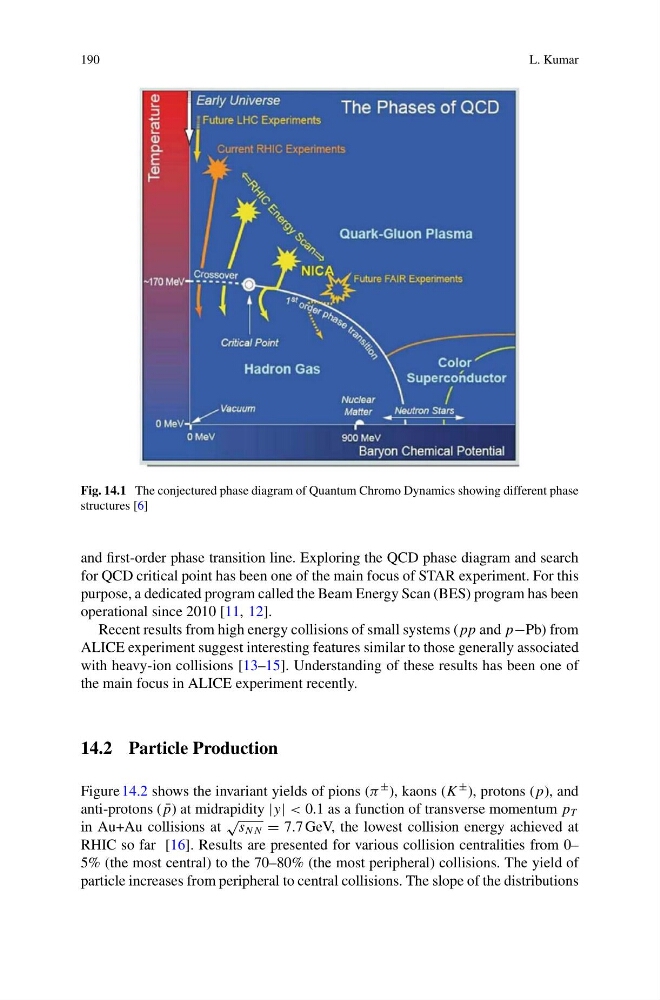
Fig. 14.1 The conjectured phase diagram of Quantum Chromo Dynamics showing different phase
structures [6]
and first-order phase transition line. Exploring the QCD phase diagram and search
for QCD critical point has been one of the main focus of STAR experiment. For this
purpose, a dedicated program called the Beam Energy Scan (BES) program has been
operational since 2010 [11, 12].
Recent results from high energy collisions of small systems ( pp and p−Pb) from
ALICE experiment suggest interesting features similar to those generally associated
with heavy-ion collisions [13–15]. Understanding of these results has been one of
the main focus in ALICE experiment recently.
14.2 Particle Production
Figure 14.2 shows the invariant yields of pions (π
± ), kaons (K
± ), protons ( p), and
anti-protons ( ¯
p) at midrapidity |y| < 0.1 as a function of transverse momentum p T
in Au+Au collisions at
√
s N N = 7.7 GeV, the lowest collision energy achieved at
RHIC so far [16]. Results are presented for various collision centralities from 0–
5% (the most central) to the 70–80% (the most peripheral) collisions. The yield of
particle increases from peripheral to central collisions. The slope of the distributions
L. Kumar
Fig. 14.1 The conjectured phase diagram of Quantum Chromo Dynamics showing different phase
structures [6]
and first-order phase transition line. Exploring the QCD phase diagram and search
for QCD critical point has been one of the main focus of STAR experiment. For this
purpose, a dedicated program called the Beam Energy Scan (BES) program has been
operational since 2010 [11, 12].
Recent results from high energy collisions of small systems ( pp and p−Pb) from
ALICE experiment suggest interesting features similar to those generally associated
with heavy-ion collisions [13–15]. Understanding of these results has been one of
the main focus in ALICE experiment recently.
14.2 Particle Production
Figure 14.2 shows the invariant yields of pions (π
± ), kaons (K
± ), protons ( p), and
anti-protons ( ¯
p) at midrapidity |y| < 0.1 as a function of transverse momentum p T
in Au+Au collisions at
√
s N N = 7.7 GeV, the lowest collision energy achieved at
RHIC so far [16]. Results are presented for various collision centralities from 0–
5% (the most central) to the 70–80% (the most peripheral) collisions. The yield of
particle increases from peripheral to central collisions. The slope of the distributions