

14 Particle Production and Collective Phenomena in Heavy-Ion …
197
the mass of hadron. At energies from
√ s N N = 19.6–62.4 GeV, there is a separation
of baryons and mesons v 2 at intermediate p T but for energies at
√
s N N = 7.7 and
11.5 GeV, there is no separation. This suggests that for energies at 11.5 GeV and
below, the QGP signature is missing and hence there could be no QGP formation.
However, the statistics at lower energies is not very good, so the high-statistics data
which has been planned to be collected in BES phase-II in STAR would be able to
provide conclusive evidence.
14.4 Small Systems
Recently in ALICE, it has been possible to collect high-statistics high energy data
for small systems such as pp and p-Pb [13, 35, 36]. This has allowed for more
differential measurements of the observables in such a small systems. The results
are very interesting in the manner that the same features are observed that have been
generally considered as characteristics of heavy-ion collisions where we expect that
QGP is formed. Some of the observables are discussed here.
The invariant yields of identified particles as a function of transverse momentum
has been obtained for small systems in various multiplicity classes [13, 35, 36].
These spectra show similar behavior as has been observed for heavy-ion collisions.
The slope of the distributions becomes flatter or harder in going from low multiplicity
to higher multiplicity events [13, 35, 36]. The spectra show hardening for more
massive particles [13, 35, 36]. These effects are attributed to radial flow effect in
heavy-ion collisions and hence are quite interesting to observe in small systems. The
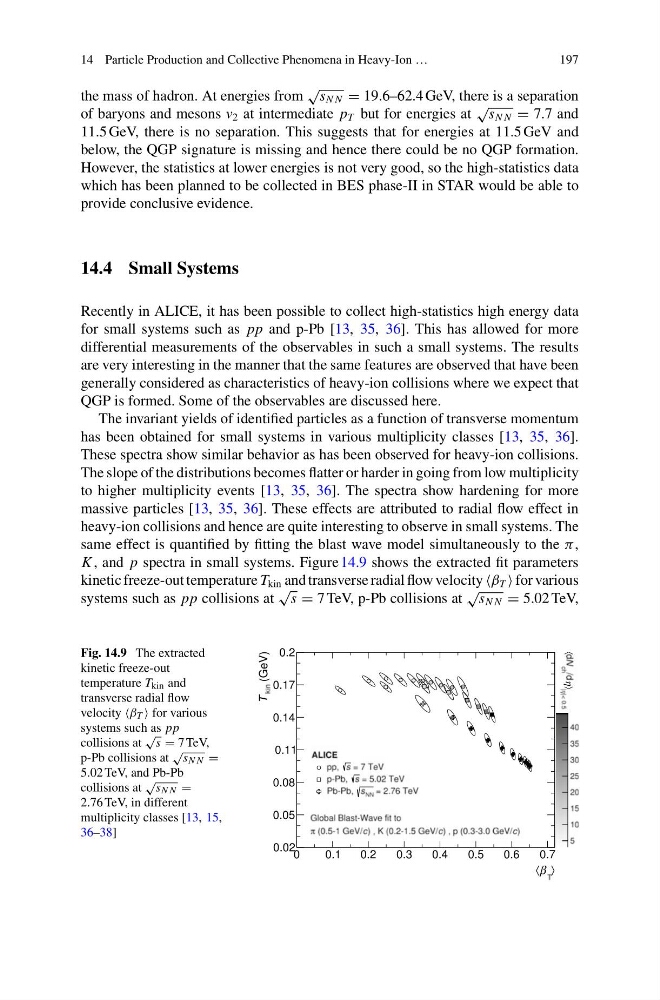
same effect is quantified by fitting the blast wave model simultaneously to the π ,
K , and p spectra in small systems. Figure 14.9 shows the extracted fit parameters
kinetic freeze-out temperature T kin and transverse radial flow velocity T for various
systems such as pp collisions at
√
s = 7 TeV, p-Pb collisions at
√ s N N = 5.02 TeV,
Fig. 14.9 The extracted
kinetic freeze-out
temperature T kin and
transverse radial flow
velocity T for various
systems such as pp
collisions at
√
s = 7 TeV,
p-Pb collisions at
√ s N N =
5.02 TeV, and Pb-Pb
collisions at
√
s N N =
2.76 TeV, in different
multiplicity classes [13, 15,
36–38]
197
the mass of hadron. At energies from
√ s N N = 19.6–62.4 GeV, there is a separation
of baryons and mesons v 2 at intermediate p T but for energies at
√
s N N = 7.7 and
11.5 GeV, there is no separation. This suggests that for energies at 11.5 GeV and
below, the QGP signature is missing and hence there could be no QGP formation.
However, the statistics at lower energies is not very good, so the high-statistics data
which has been planned to be collected in BES phase-II in STAR would be able to
provide conclusive evidence.
14.4 Small Systems
Recently in ALICE, it has been possible to collect high-statistics high energy data
for small systems such as pp and p-Pb [13, 35, 36]. This has allowed for more
differential measurements of the observables in such a small systems. The results
are very interesting in the manner that the same features are observed that have been
generally considered as characteristics of heavy-ion collisions where we expect that
QGP is formed. Some of the observables are discussed here.
The invariant yields of identified particles as a function of transverse momentum
has been obtained for small systems in various multiplicity classes [13, 35, 36].
These spectra show similar behavior as has been observed for heavy-ion collisions.
The slope of the distributions becomes flatter or harder in going from low multiplicity
to higher multiplicity events [13, 35, 36]. The spectra show hardening for more
massive particles [13, 35, 36]. These effects are attributed to radial flow effect in
heavy-ion collisions and hence are quite interesting to observe in small systems. The
same effect is quantified by fitting the blast wave model simultaneously to the π ,
K , and p spectra in small systems. Figure 14.9 shows the extracted fit parameters
kinetic freeze-out temperature T kin and transverse radial flow velocity T for various
systems such as pp collisions at
√
s = 7 TeV, p-Pb collisions at
√ s N N = 5.02 TeV,
Fig. 14.9 The extracted
kinetic freeze-out
temperature T kin and
transverse radial flow
velocity T for various
systems such as pp
collisions at
√
s = 7 TeV,
p-Pb collisions at
√ s N N =
5.02 TeV, and Pb-Pb
collisions at
√
s N N =
2.76 TeV, in different
multiplicity classes [13, 15,
36–38]