

13 Elliptic Flow in Relativistic Heavy-Ion Collisions
175
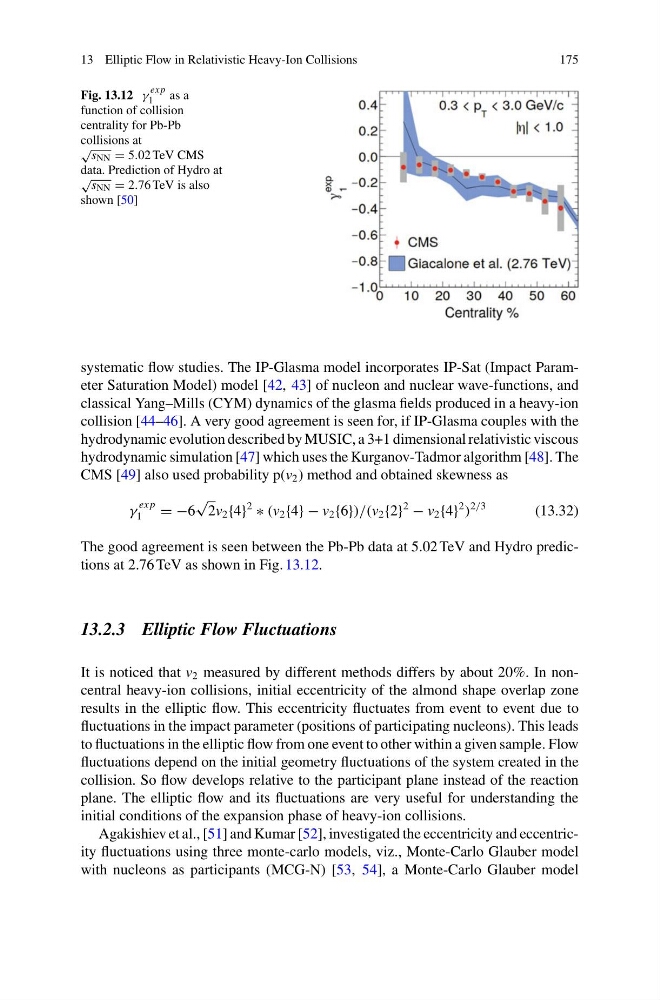
Fig. 13.12 γ
ex p
1
as a
function of collision
centrality for Pb-Pb
collisions at
√
s NN = 5.02 TeV CMS
data. Prediction of Hydro at
√
s NN = 2.76 TeV is also
shown [50]
systematic flow studies. The IP-Glasma model incorporates IP-Sat (Impact Parameter Saturation Model) model [42, 43] of nucleon and nuclear wave-functions, and
classical Yang–Mills (CYM) dynamics of the glasma fields produced in a heavy-ion
collision [44–46]. A very good agreement is seen for, if IP-Glasma couples with the
hydrodynamic evolution described by MUSIC, a 3+1 dimensional relativistic viscous
hydrodynamic simulation [47] which uses the Kurganov-Tadmor algorithm [48]. The
CMS [49] also used probability p(v 2 ) method and obtained skewness as
γ
ex p
1
= −6
√
2v 2 {4}
2
∗ (v 2 {4} − v 2 {6})/(v 2 {2}
2
− v 2 {4}
2
)
2/3
(13.32)
The good agreement is seen between the Pb-Pb data at 5.02 TeV and Hydro predictions at 2.76 TeV as shown in Fig. 13.12.
13.2.3 Elliptic Flow Fluctuations
It is noticed that v 2 measured by different methods differs by about 20%. In noncentral heavy-ion collisions, initial eccentricity of the almond shape overlap zone
results in the elliptic flow. This eccentricity fluctuates from event to event due to
fluctuations in the impact parameter (positions of participating nucleons). This leads
to fluctuations in the elliptic flow from one event to other within a given sample. Flow
fluctuations depend on the initial geometry fluctuations of the system created in the
collision. So flow develops relative to the participant plane instead of the reaction
plane. The elliptic flow and its fluctuations are very useful for understanding the
initial conditions of the expansion phase of heavy-ion collisions.
Agakishiev et al., [51] and Kumar [52], investigated the eccentricity and eccentricity fluctuations using three monte-carlo models, viz., Monte-Carlo Glauber model
with nucleons as participants (MCG-N) [53, 54], a Monte-Carlo Glauber model
175
Fig. 13.12 γ
ex p
1
as a
function of collision
centrality for Pb-Pb
collisions at
√
s NN = 5.02 TeV CMS
data. Prediction of Hydro at
√
s NN = 2.76 TeV is also
shown [50]
systematic flow studies. The IP-Glasma model incorporates IP-Sat (Impact Parameter Saturation Model) model [42, 43] of nucleon and nuclear wave-functions, and
classical Yang–Mills (CYM) dynamics of the glasma fields produced in a heavy-ion
collision [44–46]. A very good agreement is seen for, if IP-Glasma couples with the
hydrodynamic evolution described by MUSIC, a 3+1 dimensional relativistic viscous
hydrodynamic simulation [47] which uses the Kurganov-Tadmor algorithm [48]. The
CMS [49] also used probability p(v 2 ) method and obtained skewness as
γ
ex p
1
= −6
√
2v 2 {4}
2
∗ (v 2 {4} − v 2 {6})/(v 2 {2}
2
− v 2 {4}
2
)
2/3
(13.32)
The good agreement is seen between the Pb-Pb data at 5.02 TeV and Hydro predictions at 2.76 TeV as shown in Fig. 13.12.
13.2.3 Elliptic Flow Fluctuations
It is noticed that v 2 measured by different methods differs by about 20%. In noncentral heavy-ion collisions, initial eccentricity of the almond shape overlap zone
results in the elliptic flow. This eccentricity fluctuates from event to event due to
fluctuations in the impact parameter (positions of participating nucleons). This leads
to fluctuations in the elliptic flow from one event to other within a given sample. Flow
fluctuations depend on the initial geometry fluctuations of the system created in the
collision. So flow develops relative to the participant plane instead of the reaction
plane. The elliptic flow and its fluctuations are very useful for understanding the
initial conditions of the expansion phase of heavy-ion collisions.
Agakishiev et al., [51] and Kumar [52], investigated the eccentricity and eccentricity fluctuations using three monte-carlo models, viz., Monte-Carlo Glauber model
with nucleons as participants (MCG-N) [53, 54], a Monte-Carlo Glauber model