

176
M. M. Aggarwal
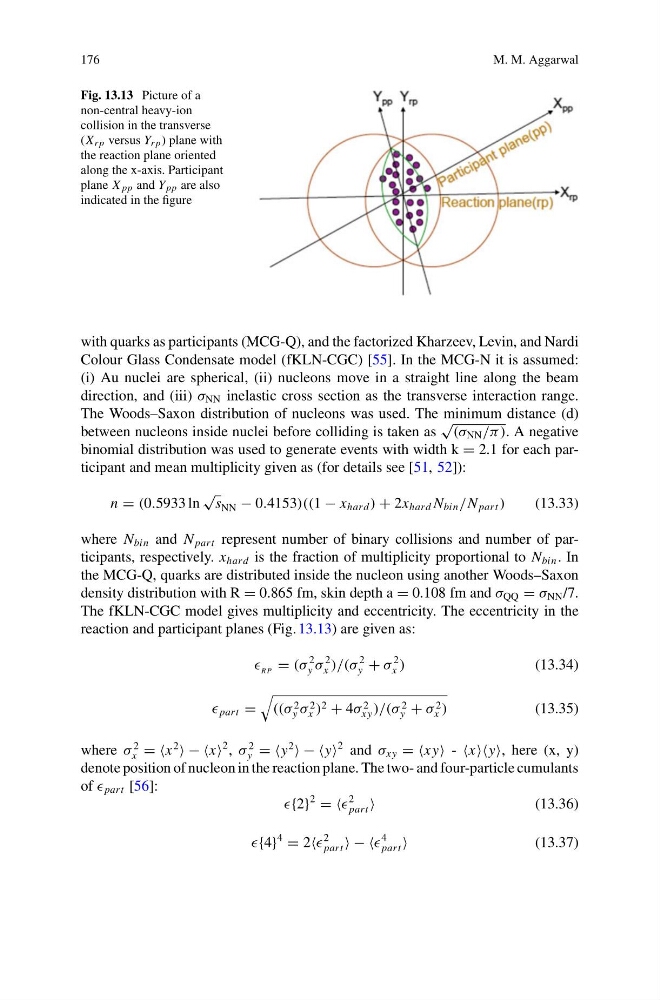
Fig. 13.13 Picture of a
non-central heavy-ion
collision in the transverse
(X r p versus Y r p ) plane with
the reaction plane oriented
along the x-axis. Participant
plane X pp and Y pp are also
indicated in the figure
with quarks as participants (MCG-Q), and the factorized Kharzeev, Levin, and Nardi
Colour Glass Condensate model (fKLN-CGC) [55]. In the MCG-N it is assumed:
(i) Au nuclei are spherical, (ii) nucleons move in a straight line along the beam
direction, and (iii) σ NN inelastic cross section as the transverse interaction range.
The Woods–Saxon distribution of nucleons was used. The minimum distance (d)
between nucleons inside nuclei before colliding is taken as
√
(σ NN /π ). A negative
binomial distribution was used to generate events with width k = 2.1 for each participant and mean multiplicity given as (for details see [51, 52]):
n = (0.5933 ln
√
s NN − 0.4153)((1 − x hard ) + 2x hard N bin /N part )
(13.33)
where N bin and N part represent number of binary collisions and number of participants, respectively. x hard is the fraction of multiplicity proportional to N bin . In
the MCG-Q, quarks are distributed inside the nucleon using another Woods–Saxon
density distribution with R = 0.865 fm, skin depth a = 0.108 fm and σ QQ = σ NN /7.
The fKLN-CGC model gives multiplicity and eccentricity. The eccentricity in the
reaction and participant planes (Fig. 13.13) are given as:
R P = (σ
2
y σ
2
x )/(σ
2
y + σ
2
x )
(13.34)
part =
((σ 2
y σ 2
x ) 2 + 4σ 2
xy )/(σ 2
y + σ 2
x )
(13.35)
where σ
2
x = =x
2
− −x
2 , σ
2
y = =y
2
− −y
2 and σ xy = =x y - xy, here (x, y)
denote position of nucleon in the reaction plane. The two- and four-particle cumulants
of part [56]:
{2}
2
= =
2
part
(13.36)
{4}
4
= 2
2
part − −
4
part
(13.37)
M. M. Aggarwal
Fig. 13.13 Picture of a
non-central heavy-ion
collision in the transverse
(X r p versus Y r p ) plane with
the reaction plane oriented
along the x-axis. Participant
plane X pp and Y pp are also
indicated in the figure
with quarks as participants (MCG-Q), and the factorized Kharzeev, Levin, and Nardi
Colour Glass Condensate model (fKLN-CGC) [55]. In the MCG-N it is assumed:
(i) Au nuclei are spherical, (ii) nucleons move in a straight line along the beam
direction, and (iii) σ NN inelastic cross section as the transverse interaction range.
The Woods–Saxon distribution of nucleons was used. The minimum distance (d)
between nucleons inside nuclei before colliding is taken as
√
(σ NN /π ). A negative
binomial distribution was used to generate events with width k = 2.1 for each participant and mean multiplicity given as (for details see [51, 52]):
n = (0.5933 ln
√
s NN − 0.4153)((1 − x hard ) + 2x hard N bin /N part )
(13.33)
where N bin and N part represent number of binary collisions and number of participants, respectively. x hard is the fraction of multiplicity proportional to N bin . In
the MCG-Q, quarks are distributed inside the nucleon using another Woods–Saxon
density distribution with R = 0.865 fm, skin depth a = 0.108 fm and σ QQ = σ NN /7.
The fKLN-CGC model gives multiplicity and eccentricity. The eccentricity in the
reaction and participant planes (Fig. 13.13) are given as:
R P = (σ
2
y σ
2
x )/(σ
2
y + σ
2
x )
(13.34)
part =
((σ 2
y σ 2
x ) 2 + 4σ 2
xy )/(σ 2
y + σ 2
x )
(13.35)
where σ
2
x = =x
2
− −x
2 , σ
2
y = =y
2
− −y
2 and σ xy = =x y - xy, here (x, y)
denote position of nucleon in the reaction plane. The two- and four-particle cumulants
of part [56]:
{2}
2
= =
2
part
(13.36)
{4}
4
= 2
2
part − −
4
part
(13.37)