

13 Elliptic Flow in Relativistic Heavy-Ion Collisions
171
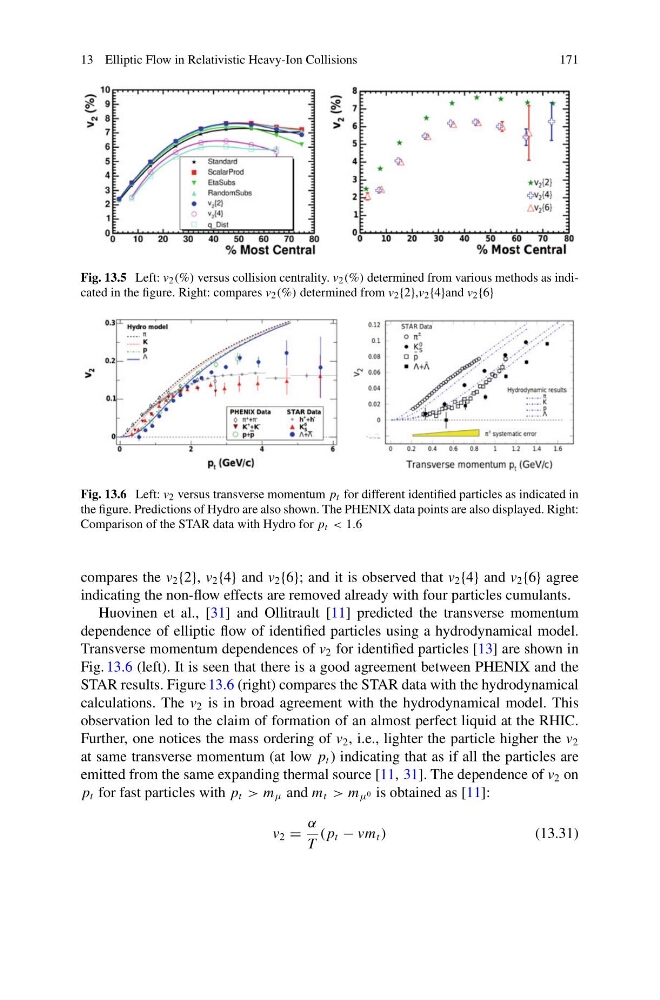
Fig. 13.5 Left: v 2 (%) versus collision centrality. v 2 (%) determined from various methods as indicated in the figure. Right: compares v 2 (%) determined from v 2 {2},v 2 {4}and v 2 {6}
Fig. 13.6 Left: v 2 versus transverse momentum p t for different identified particles as indicated in
the figure. Predictions of Hydro are also shown. The PHENIX data points are also displayed. Right:
Comparison of the STAR data with Hydro for p t < 1.6
compares the v 2 {2}, v 2 {4} and v 2 {6}; and it is observed that v 2 {4} and v 2 {6} agree
indicating the non-flow effects are removed already with four particles cumulants.
Huovinen et al., [31] and Ollitrault [11] predicted the transverse momentum
dependence of elliptic flow of identified particles using a hydrodynamical model.
Transverse momentum dependences of v 2 for identified particles [13] are shown in
Fig. 13.6 (left). It is seen that there is a good agreement between PHENIX and the
STAR results. Figure 13.6 (right) compares the STAR data with the hydrodynamical
calculations. The v 2 is in broad agreement with the hydrodynamical model. This
observation led to the claim of formation of an almost perfect liquid at the RHIC.
Further, one notices the mass ordering of v 2 , i.e., lighter the particle higher the v 2
at same transverse momentum (at low p t ) indicating that as if all the particles are
emitted from the same expanding thermal source [11, 31]. The dependence of v 2 on
p t for fast particles with p t > m μ and m t > m μ 0 is obtained as [11]:
v 2 =
α
T
( p t − vm t )
(13.31)
171
Fig. 13.5 Left: v 2 (%) versus collision centrality. v 2 (%) determined from various methods as indicated in the figure. Right: compares v 2 (%) determined from v 2 {2},v 2 {4}and v 2 {6}
Fig. 13.6 Left: v 2 versus transverse momentum p t for different identified particles as indicated in
the figure. Predictions of Hydro are also shown. The PHENIX data points are also displayed. Right:
Comparison of the STAR data with Hydro for p t < 1.6
compares the v 2 {2}, v 2 {4} and v 2 {6}; and it is observed that v 2 {4} and v 2 {6} agree
indicating the non-flow effects are removed already with four particles cumulants.
Huovinen et al., [31] and Ollitrault [11] predicted the transverse momentum
dependence of elliptic flow of identified particles using a hydrodynamical model.
Transverse momentum dependences of v 2 for identified particles [13] are shown in
Fig. 13.6 (left). It is seen that there is a good agreement between PHENIX and the
STAR results. Figure 13.6 (right) compares the STAR data with the hydrodynamical
calculations. The v 2 is in broad agreement with the hydrodynamical model. This
observation led to the claim of formation of an almost perfect liquid at the RHIC.
Further, one notices the mass ordering of v 2 , i.e., lighter the particle higher the v 2
at same transverse momentum (at low p t ) indicating that as if all the particles are
emitted from the same expanding thermal source [11, 31]. The dependence of v 2 on
p t for fast particles with p t > m μ and m t > m μ 0 is obtained as [11]:
v 2 =
α
T
( p t − vm t )
(13.31)