

172
M. M. Aggarwal
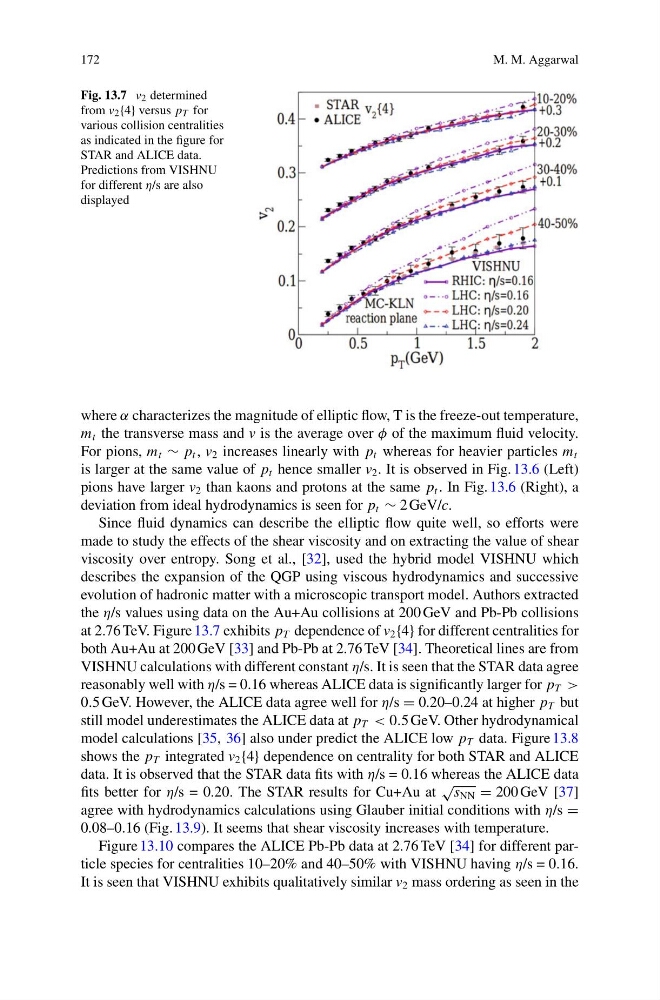
Fig. 13.7 v 2 determined
from v 2 {4} versus p T for
various collision centralities
as indicated in the figure for
STAR and ALICE data.
Predictions from VISHNU
for different η/s are also
displayed
where α characterizes the magnitude of elliptic flow, T is the freeze-out temperature,
m t the transverse mass and v is the average over φ of the maximum fluid velocity.
For pions, m t ∼ p t , v 2 increases linearly with p t whereas for heavier particles m t
is larger at the same value of p t hence smaller v 2 . It is observed in Fig. 13.6 (Left)
pions have larger v 2 than kaons and protons at the same p t . In Fig.13.6 (Right), a
deviation from ideal hydrodynamics is seen for p t ∼ 2 GeV/c.
Since fluid dynamics can describe the elliptic flow quite well, so efforts were
made to study the effects of the shear viscosity and on extracting the value of shear
viscosity over entropy. Song et al., [32], used the hybrid model VISHNU which
describes the expansion of the QGP using viscous hydrodynamics and successive
evolution of hadronic matter with a microscopic transport model. Authors extracted
the η/s values using data on the Au+Au collisions at 200 GeV and Pb-Pb collisions
at 2.76 TeV. Figure 13.7 exhibits p T dependence of v 2 {4} for different centralities for
both Au+Au at 200 GeV [33] and Pb-Pb at 2.76 TeV [34]. Theoretical lines are from
VISHNU calculations with different constant η/s. It is seen that the STAR data agree
reasonably well with η/s = 0.16 whereas ALICE data is significantly larger for p T >
0.5 GeV. However, the ALICE data agree well for η/s = 0.20–0.24 at higher p T but
still model underestimates the ALICE data at p T < 0.5 GeV. Other hydrodynamical
model calculations [35, 36] also under predict the ALICE low p T data. Figure 13.8
shows the p T integrated v 2 {4} dependence on centrality for both STAR and ALICE
data. It is observed that the STAR data fits with η/s = 0.16 whereas the ALICE data
fits better for η/s = 0.20. The STAR results for Cu+Au at
√ s NN = 200 GeV [37]
agree with hydrodynamics calculations using Glauber initial conditions with η/s =
0.08–0.16 (Fig. 13.9). It seems that shear viscosity increases with temperature.
Figure 13.10 compares the ALICE Pb-Pb data at 2.76 TeV [34] for different particle species for centralities 10–20% and 40–50% with VISHNU having η/s = 0.16.
It is seen that VISHNU exhibits qualitatively similar v 2 mass ordering as seen in the
M. M. Aggarwal
Fig. 13.7 v 2 determined
from v 2 {4} versus p T for
various collision centralities
as indicated in the figure for
STAR and ALICE data.
Predictions from VISHNU
for different η/s are also
displayed
where α characterizes the magnitude of elliptic flow, T is the freeze-out temperature,
m t the transverse mass and v is the average over φ of the maximum fluid velocity.
For pions, m t ∼ p t , v 2 increases linearly with p t whereas for heavier particles m t
is larger at the same value of p t hence smaller v 2 . It is observed in Fig. 13.6 (Left)
pions have larger v 2 than kaons and protons at the same p t . In Fig.13.6 (Right), a
deviation from ideal hydrodynamics is seen for p t ∼ 2 GeV/c.
Since fluid dynamics can describe the elliptic flow quite well, so efforts were
made to study the effects of the shear viscosity and on extracting the value of shear
viscosity over entropy. Song et al., [32], used the hybrid model VISHNU which
describes the expansion of the QGP using viscous hydrodynamics and successive
evolution of hadronic matter with a microscopic transport model. Authors extracted
the η/s values using data on the Au+Au collisions at 200 GeV and Pb-Pb collisions
at 2.76 TeV. Figure 13.7 exhibits p T dependence of v 2 {4} for different centralities for
both Au+Au at 200 GeV [33] and Pb-Pb at 2.76 TeV [34]. Theoretical lines are from
VISHNU calculations with different constant η/s. It is seen that the STAR data agree
reasonably well with η/s = 0.16 whereas ALICE data is significantly larger for p T >
0.5 GeV. However, the ALICE data agree well for η/s = 0.20–0.24 at higher p T but
still model underestimates the ALICE data at p T < 0.5 GeV. Other hydrodynamical
model calculations [35, 36] also under predict the ALICE low p T data. Figure 13.8
shows the p T integrated v 2 {4} dependence on centrality for both STAR and ALICE
data. It is observed that the STAR data fits with η/s = 0.16 whereas the ALICE data
fits better for η/s = 0.20. The STAR results for Cu+Au at
√ s NN = 200 GeV [37]
agree with hydrodynamics calculations using Glauber initial conditions with η/s =
0.08–0.16 (Fig. 13.9). It seems that shear viscosity increases with temperature.
Figure 13.10 compares the ALICE Pb-Pb data at 2.76 TeV [34] for different particle species for centralities 10–20% and 40–50% with VISHNU having η/s = 0.16.
It is seen that VISHNU exhibits qualitatively similar v 2 mass ordering as seen in the