

13 Elliptic Flow in Relativistic Heavy-Ion Collisions
163
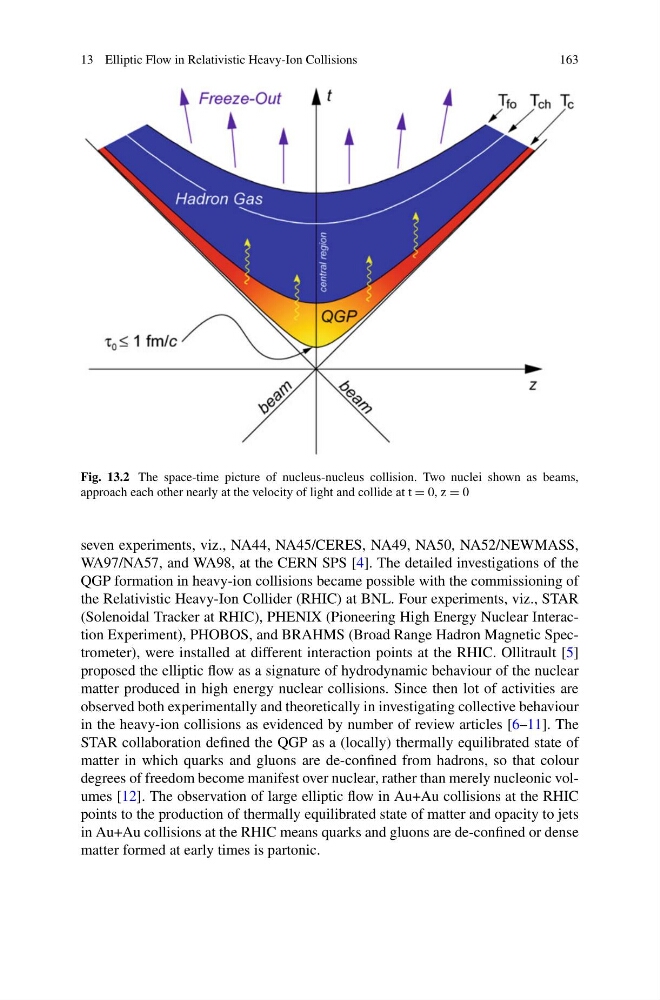
Fig. 13.2 The space-time picture of nucleus-nucleus collision. Two nuclei shown as beams,
approach each other nearly at the velocity of light and collide at t = 0, z = 0
seven experiments, viz., NA44, NA45/CERES, NA49, NA50, NA52/NEWMASS,
WA97/NA57, and WA98, at the CERN SPS [4]. The detailed investigations of the
QGP formation in heavy-ion collisions became possible with the commissioning of
the Relativistic Heavy-Ion Collider (RHIC) at BNL. Four experiments, viz., STAR
(Solenoidal Tracker at RHIC), PHENIX (Pioneering High Energy Nuclear Interaction Experiment), PHOBOS, and BRAHMS (Broad Range Hadron Magnetic Spectrometer), were installed at different interaction points at the RHIC. Ollitrault [5]
proposed the elliptic flow as a signature of hydrodynamic behaviour of the nuclear
matter produced in high energy nuclear collisions. Since then lot of activities are
observed both experimentally and theoretically in investigating collective behaviour
in the heavy-ion collisions as evidenced by number of review articles [6–11]. The
STAR collaboration defined the QGP as a (locally) thermally equilibrated state of
matter in which quarks and gluons are de-confined from hadrons, so that colour
degrees of freedom become manifest over nuclear, rather than merely nucleonic volumes [12]. The observation of large elliptic flow in Au+Au collisions at the RHIC
points to the production of thermally equilibrated state of matter and opacity to jets
in Au+Au collisions at the RHIC means quarks and gluons are de-confined or dense
matter formed at early times is partonic.
163
Fig. 13.2 The space-time picture of nucleus-nucleus collision. Two nuclei shown as beams,
approach each other nearly at the velocity of light and collide at t = 0, z = 0
seven experiments, viz., NA44, NA45/CERES, NA49, NA50, NA52/NEWMASS,
WA97/NA57, and WA98, at the CERN SPS [4]. The detailed investigations of the
QGP formation in heavy-ion collisions became possible with the commissioning of
the Relativistic Heavy-Ion Collider (RHIC) at BNL. Four experiments, viz., STAR
(Solenoidal Tracker at RHIC), PHENIX (Pioneering High Energy Nuclear Interaction Experiment), PHOBOS, and BRAHMS (Broad Range Hadron Magnetic Spectrometer), were installed at different interaction points at the RHIC. Ollitrault [5]
proposed the elliptic flow as a signature of hydrodynamic behaviour of the nuclear
matter produced in high energy nuclear collisions. Since then lot of activities are
observed both experimentally and theoretically in investigating collective behaviour
in the heavy-ion collisions as evidenced by number of review articles [6–11]. The
STAR collaboration defined the QGP as a (locally) thermally equilibrated state of
matter in which quarks and gluons are de-confined from hadrons, so that colour
degrees of freedom become manifest over nuclear, rather than merely nucleonic volumes [12]. The observation of large elliptic flow in Au+Au collisions at the RHIC
points to the production of thermally equilibrated state of matter and opacity to jets
in Au+Au collisions at the RHIC means quarks and gluons are de-confined or dense
matter formed at early times is partonic.