

162
M. M. Aggarwal
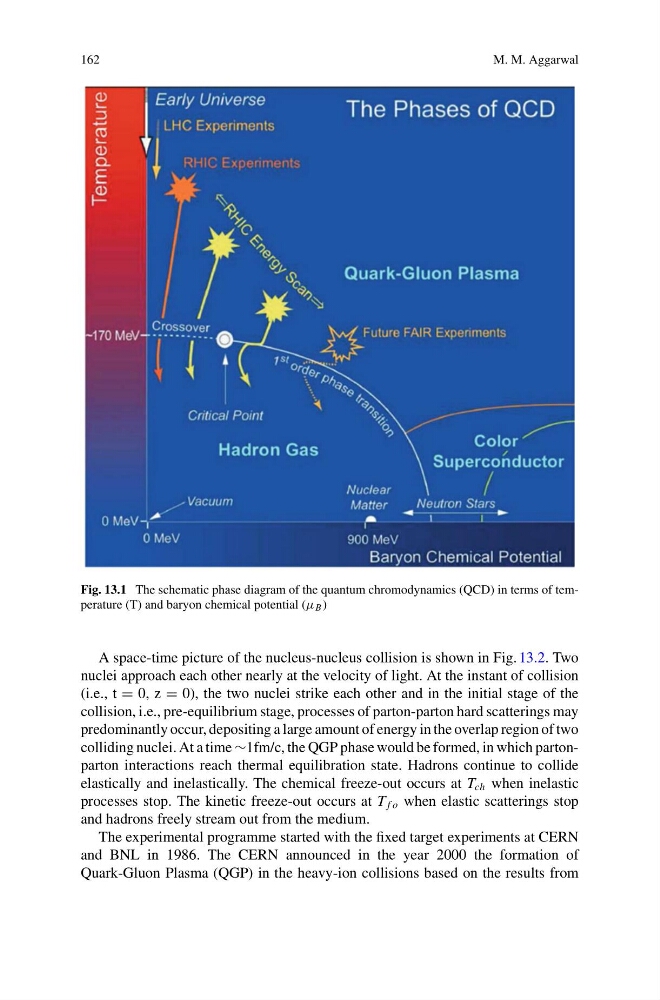
Fig. 13.1 The schematic phase diagram of the quantum chromodynamics (QCD) in terms of temperature (T) and baryon chemical potential (μ B )
A space-time picture of the nucleus-nucleus collision is shown in Fig. 13.2. Two
nuclei approach each other nearly at the velocity of light. At the instant of collision
(i.e., t = 0, z = 0), the two nuclei strike each other and in the initial stage of the
collision, i.e., pre-equilibrium stage, processes of parton-parton hard scatterings may
predominantly occur, depositing a large amount of energy in the overlap region of two
colliding nuclei. At a time ∼1fm/c, the QGP phase would be formed, in which partonparton interactions reach thermal equilibration state. Hadrons continue to collide
elastically and inelastically. The chemical freeze-out occurs at T ch when inelastic
processes stop. The kinetic freeze-out occurs at T f o when elastic scatterings stop
and hadrons freely stream out from the medium.
The experimental programme started with the fixed target experiments at CERN
and BNL in 1986. The CERN announced in the year 2000 the formation of
Quark-Gluon Plasma (QGP) in the heavy-ion collisions based on the results from
M. M. Aggarwal
Fig. 13.1 The schematic phase diagram of the quantum chromodynamics (QCD) in terms of temperature (T) and baryon chemical potential (μ B )
A space-time picture of the nucleus-nucleus collision is shown in Fig. 13.2. Two
nuclei approach each other nearly at the velocity of light. At the instant of collision
(i.e., t = 0, z = 0), the two nuclei strike each other and in the initial stage of the
collision, i.e., pre-equilibrium stage, processes of parton-parton hard scatterings may
predominantly occur, depositing a large amount of energy in the overlap region of two
colliding nuclei. At a time ∼1fm/c, the QGP phase would be formed, in which partonparton interactions reach thermal equilibration state. Hadrons continue to collide
elastically and inelastically. The chemical freeze-out occurs at T ch when inelastic
processes stop. The kinetic freeze-out occurs at T f o when elastic scatterings stop
and hadrons freely stream out from the medium.
The experimental programme started with the fixed target experiments at CERN
and BNL in 1986. The CERN announced in the year 2000 the formation of
Quark-Gluon Plasma (QGP) in the heavy-ion collisions based on the results from