

154
Y. Leifels
or a very stiff density dependence of the symmetry energy could ruled out. These
results have been confirmed by using a different transport code [21]. Nevertheless,
the statistical error bars of the data are rather large, and, therefore, an attempt was
started by the ASY-EOS collaboration to remeasure neutron/proton flow in Au+Au
collisions at an incident energy E beam = 400A MeV.
12.2.1 The ASY-EOS Experiment
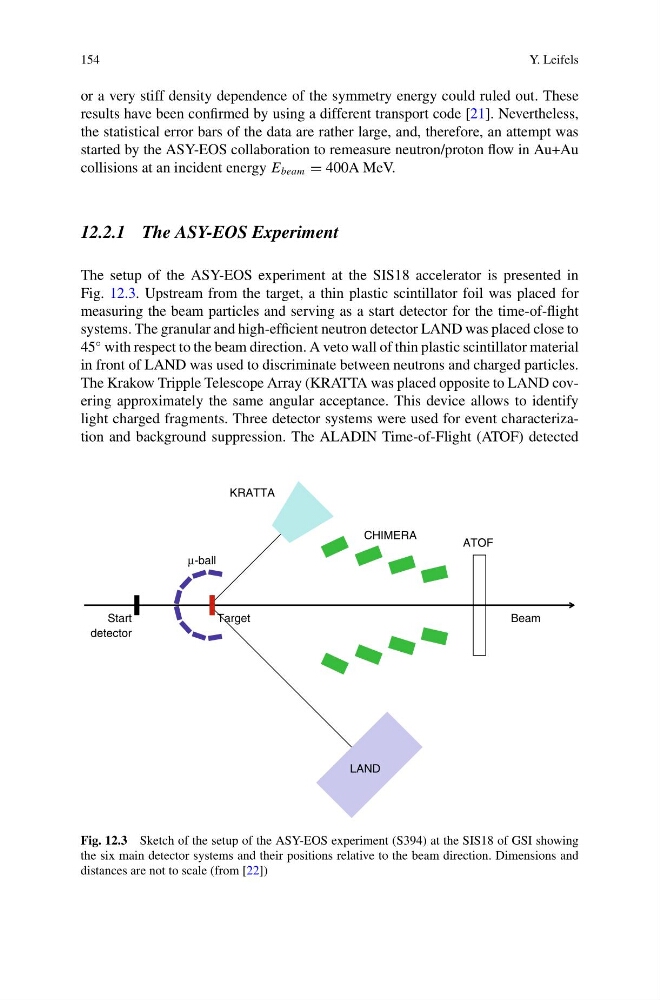
The setup of the ASY-EOS experiment at the SIS18 accelerator is presented in
Fig. 12.3. Upstream from the target, a thin plastic scintillator foil was placed for
measuring the beam particles and serving as a start detector for the time-of-flight
systems. The granular and high-efficient neutron detector LAND was placed close to
45
◦ with respect to the beam direction. A veto wall of thin plastic scintillator material
in front of LAND was used to discriminate between neutrons and charged particles.
The Krakow Tripple Telescope Array (KRATTA was placed opposite to LAND covering approximately the same angular acceptance. This device allows to identify
light charged fragments. Three detector systems were used for event characterization and background suppression. The ALADIN Time-of-Flight (ATOF) detected
Start
detector
Target
Beam
μ-ball
KRATTA
CHIMERA
ATOF
LAND
Fig. 12.3 Sketch of the setup of the ASY-EOS experiment (S394) at the SIS18 of GSI showing
the six main detector systems and their positions relative to the beam direction. Dimensions and
distances are not to scale (from [22])
Y. Leifels
or a very stiff density dependence of the symmetry energy could ruled out. These
results have been confirmed by using a different transport code [21]. Nevertheless,
the statistical error bars of the data are rather large, and, therefore, an attempt was
started by the ASY-EOS collaboration to remeasure neutron/proton flow in Au+Au
collisions at an incident energy E beam = 400A MeV.
12.2.1 The ASY-EOS Experiment
The setup of the ASY-EOS experiment at the SIS18 accelerator is presented in
Fig. 12.3. Upstream from the target, a thin plastic scintillator foil was placed for
measuring the beam particles and serving as a start detector for the time-of-flight
systems. The granular and high-efficient neutron detector LAND was placed close to
45
◦ with respect to the beam direction. A veto wall of thin plastic scintillator material
in front of LAND was used to discriminate between neutrons and charged particles.
The Krakow Tripple Telescope Array (KRATTA was placed opposite to LAND covering approximately the same angular acceptance. This device allows to identify
light charged fragments. Three detector systems were used for event characterization and background suppression. The ALADIN Time-of-Flight (ATOF) detected
Start
detector
Target
Beam
μ-ball
KRATTA
CHIMERA
ATOF
LAND
Fig. 12.3 Sketch of the setup of the ASY-EOS experiment (S394) at the SIS18 of GSI showing
the six main detector systems and their positions relative to the beam direction. Dimensions and
distances are not to scale (from [22])