

12 Nuclear Matter Properties at High Densities…
153
-0.1
-0.05
0
0.05
0.1
0
0.5
1
1.5
E beam (AGeV)
v
2
data
IQMD HM
IQMD SM
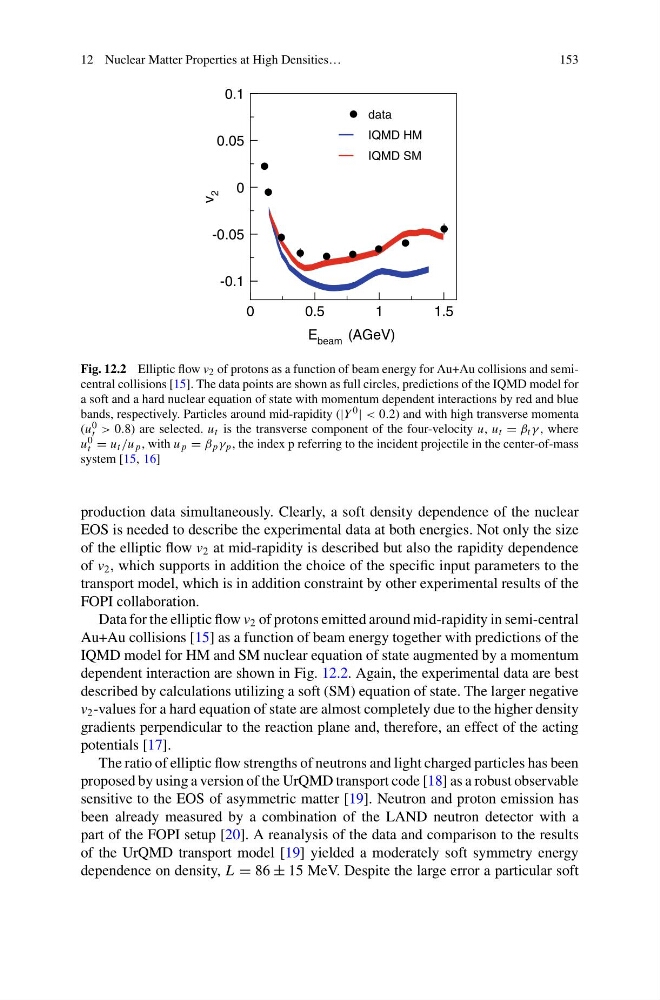
Fig. 12.2 Elliptic flow v 2 of protons as a function of beam energy for Au+Au collisions and semicentral collisions [15]. The data points are shown as full circles, predictions of the IQMD model for
a soft and a hard nuclear equation of state with momentum dependent interactions by red and blue
bands, respectively. Particles around mid-rapidity (|Y 0 | < 0.2) and with high transverse momenta
(u 0
t > 0.8) are selected. u t is the transverse component of the four-velocity u, u t = β t γ , where
u 0
t = u t /u p , with u p = β p γ p , the index p referring to the incident projectile in the center-of-mass
system [15, 16]
production data simultaneously. Clearly, a soft density dependence of the nuclear
EOS is needed to describe the experimental data at both energies. Not only the size
of the elliptic flow v 2 at mid-rapidity is described but also the rapidity dependence
of v 2 , which supports in addition the choice of the specific input parameters to the
transport model, which is in addition constraint by other experimental results of the
FOPI collaboration.
Data for the elliptic flow v 2 of protons emitted around mid-rapidity in semi-central
Au+Au collisions [15] as a function of beam energy together with predictions of the
IQMD model for HM and SM nuclear equation of state augmented by a momentum
dependent interaction are shown in Fig. 12.2. Again, the experimental data are best
described by calculations utilizing a soft (SM) equation of state. The larger negative
v 2 -values for a hard equation of state are almost completely due to the higher density
gradients perpendicular to the reaction plane and, therefore, an effect of the acting
potentials [17].
The ratio of elliptic flow strengths of neutrons and light charged particles has been
proposed by using a version of the UrQMD transport code [18] as a robust observable
sensitive to the EOS of asymmetric matter [19]. Neutron and proton emission has
been already measured by a combination of the LAND neutron detector with a
part of the FOPI setup [20]. A reanalysis of the data and comparison to the results
of the UrQMD transport model [19] yielded a moderately soft symmetry energy
dependence on density, L = 86 ± 15 MeV. Despite the large error a particular soft
153
-0.1
-0.05
0
0.05
0.1
0
0.5
1
1.5
E beam (AGeV)
v
2
data
IQMD HM
IQMD SM
Fig. 12.2 Elliptic flow v 2 of protons as a function of beam energy for Au+Au collisions and semicentral collisions [15]. The data points are shown as full circles, predictions of the IQMD model for
a soft and a hard nuclear equation of state with momentum dependent interactions by red and blue
bands, respectively. Particles around mid-rapidity (|Y 0 | < 0.2) and with high transverse momenta
(u 0
t > 0.8) are selected. u t is the transverse component of the four-velocity u, u t = β t γ , where
u 0
t = u t /u p , with u p = β p γ p , the index p referring to the incident projectile in the center-of-mass
system [15, 16]
production data simultaneously. Clearly, a soft density dependence of the nuclear
EOS is needed to describe the experimental data at both energies. Not only the size
of the elliptic flow v 2 at mid-rapidity is described but also the rapidity dependence
of v 2 , which supports in addition the choice of the specific input parameters to the
transport model, which is in addition constraint by other experimental results of the
FOPI collaboration.
Data for the elliptic flow v 2 of protons emitted around mid-rapidity in semi-central
Au+Au collisions [15] as a function of beam energy together with predictions of the
IQMD model for HM and SM nuclear equation of state augmented by a momentum
dependent interaction are shown in Fig. 12.2. Again, the experimental data are best
described by calculations utilizing a soft (SM) equation of state. The larger negative
v 2 -values for a hard equation of state are almost completely due to the higher density
gradients perpendicular to the reaction plane and, therefore, an effect of the acting
potentials [17].
The ratio of elliptic flow strengths of neutrons and light charged particles has been
proposed by using a version of the UrQMD transport code [18] as a robust observable
sensitive to the EOS of asymmetric matter [19]. Neutron and proton emission has
been already measured by a combination of the LAND neutron detector with a
part of the FOPI setup [20]. A reanalysis of the data and comparison to the results
of the UrQMD transport model [19] yielded a moderately soft symmetry energy
dependence on density, L = 86 ± 15 MeV. Despite the large error a particular soft