

12 Nuclear Matter Properties at High Densities…
155
charged particles and fragments emitted at very small polar angles lab < 7
◦ close
to thebeam. Four double rings of the CHIMERA multidetector consisting out of 352
CsI(Tl) scintillators were placed in forward direction, and the target was surrounded
by four rings with 50 thin CsI(Tl) elements of the Washington University Microball
array. Those detectors provided sufficient granularity and solid angle coverage to
determine the orientation of the reaction plane and the impact parameter. A detailed
description of the setup is available in [22].
12.2.2 Experimental Results
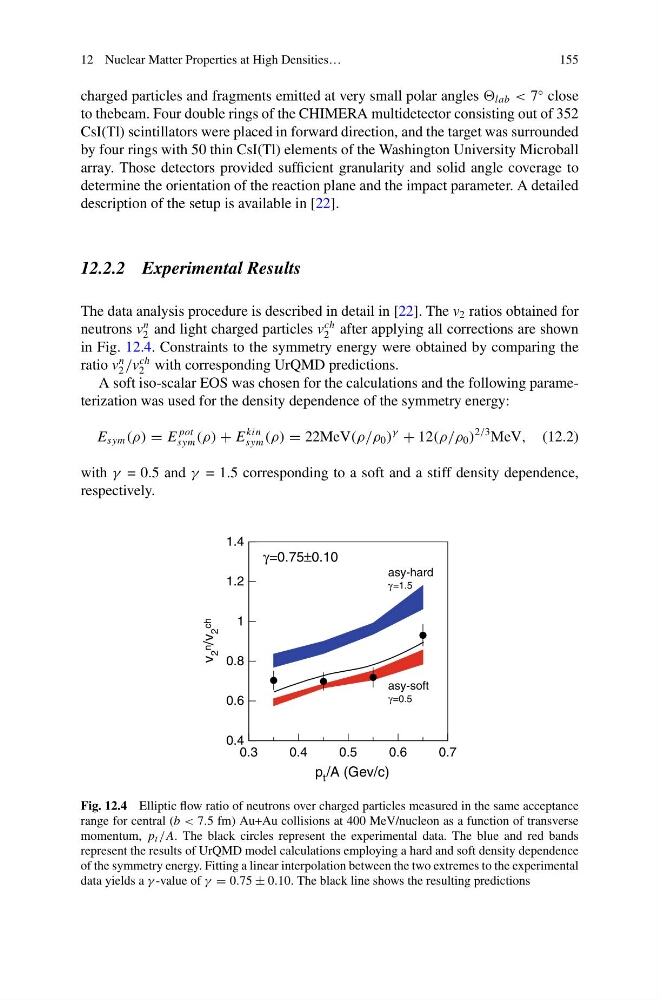
The data analysis procedure is described in detail in [22]. The v 2 ratios obtained for
neutrons v
n
2 and light charged particles v
ch
2 after applying all corrections are shown
in Fig. 12.4. Constraints to the symmetry energy were obtained by comparing the
ratio v
n
2 /v
ch
2 with corresponding UrQMD predictions.
A soft iso-scalar EOS was chosen for the calculations and the following parameterization was used for the density dependence of the symmetry energy:
E sym (ρ) = E
pot
sym (ρ) + E
kin
sym (ρ) = 22MeV(ρ/ρ 0 )
γ
+ 12(ρ/ρ 0 )
2/3 MeV, (12.2)
with γ = 0.5 and γ = 1.5 corresponding to a soft and a stiff density dependence,
respectively.
0.4
0.6
0.8
1
1.2
1.4
0.3
0.4
0.5
0.6
0.7
p t /A (Gev/c)
v
2
n
/v
2
ch
asy-hard
γ =1.5
asy-soft
γ=0.5
γ=0.75±0.10
Fig. 12.4 Elliptic flow ratio of neutrons over charged particles measured in the same acceptance
range for central (b < 7.5 fm) Au+Au collisions at 400 MeV/nucleon as a function of transverse
momentum, p t /A. The black circles represent the experimental data. The blue and red bands
represent the results of UrQMD model calculations employing a hard and soft density dependence
of the symmetry energy. Fitting a linear interpolation between the two extremes to the experimental
data yields a γ -value of γ = 0.75 ± 0.10. The black line shows the resulting predictions
155
charged particles and fragments emitted at very small polar angles lab < 7
◦ close
to thebeam. Four double rings of the CHIMERA multidetector consisting out of 352
CsI(Tl) scintillators were placed in forward direction, and the target was surrounded
by four rings with 50 thin CsI(Tl) elements of the Washington University Microball
array. Those detectors provided sufficient granularity and solid angle coverage to
determine the orientation of the reaction plane and the impact parameter. A detailed
description of the setup is available in [22].
12.2.2 Experimental Results
The data analysis procedure is described in detail in [22]. The v 2 ratios obtained for
neutrons v
n
2 and light charged particles v
ch
2 after applying all corrections are shown
in Fig. 12.4. Constraints to the symmetry energy were obtained by comparing the
ratio v
n
2 /v
ch
2 with corresponding UrQMD predictions.
A soft iso-scalar EOS was chosen for the calculations and the following parameterization was used for the density dependence of the symmetry energy:
E sym (ρ) = E
pot
sym (ρ) + E
kin
sym (ρ) = 22MeV(ρ/ρ 0 )
γ
+ 12(ρ/ρ 0 )
2/3 MeV, (12.2)
with γ = 0.5 and γ = 1.5 corresponding to a soft and a stiff density dependence,
respectively.
0.4
0.6
0.8
1
1.2
1.4
0.3
0.4
0.5
0.6
0.7
p t /A (Gev/c)
v
2
n
/v
2
ch
asy-hard
γ =1.5
asy-soft
γ=0.5
γ=0.75±0.10
Fig. 12.4 Elliptic flow ratio of neutrons over charged particles measured in the same acceptance
range for central (b < 7.5 fm) Au+Au collisions at 400 MeV/nucleon as a function of transverse
momentum, p t /A. The black circles represent the experimental data. The blue and red bands
represent the results of UrQMD model calculations employing a hard and soft density dependence
of the symmetry energy. Fitting a linear interpolation between the two extremes to the experimental
data yields a γ -value of γ = 0.75 ± 0.10. The black line shows the resulting predictions