

140
C. Hartnack et al.
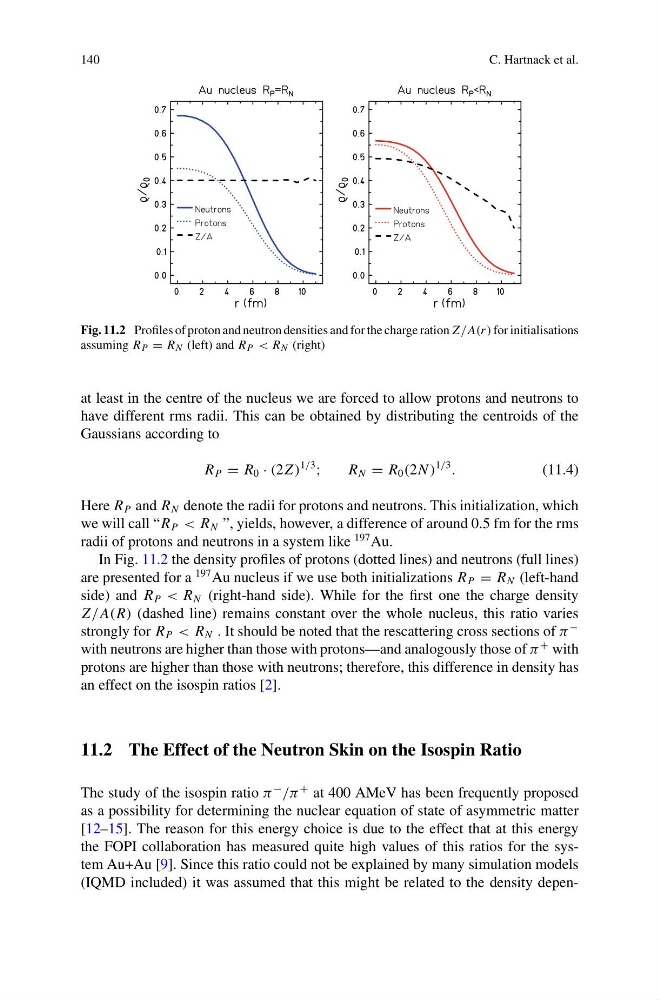
Fig. 11.2 Profiles of proton and neutron densities and for the charge ration Z /A(r ) for initialisations
assuming R P = R N (left) and R P < R N (right)
at least in the centre of the nucleus we are forced to allow protons and neutrons to
have different rms radii. This can be obtained by distributing the centroids of the
Gaussians according to
R P = R 0 · (2Z )
1/3
;
R N = R 0 (2N )
1/3
.
(11.4)
Here R P and R N denote the radii for protons and neutrons. This initialization, which
we will call “R P < R N ”, yields, however, a difference of around 0.5 fm for the rms
radii of protons and neutrons in a system like
197 Au.
In Fig. 11.2 the density profiles of protons (dotted lines) and neutrons (full lines)
are presented for a
197 Au nucleus if we use both initializations R P = R N (left-hand
side) and R P < R N (right-hand side). While for the first one the charge density
Z /A(R) (dashed line) remains constant over the whole nucleus, this ratio varies
strongly for R P < R N . It should be noted that the rescattering cross sections of π
−
with neutrons are higher than those with protons—and analogously those of π
+ with
protons are higher than those with neutrons; therefore, this difference in density has
an effect on the isospin ratios [2].
11.2 The Effect of the Neutron Skin on the Isospin Ratio
The study of the isospin ratio π
−
/π
+ at 400 AMeV has been frequently proposed
as a possibility for determining the nuclear equation of state of asymmetric matter
[12–15]. The reason for this energy choice is due to the effect that at this energy
the FOPI collaboration has measured quite high values of this ratios for the system Au+Au [9]. Since this ratio could not be explained by many simulation models
(IQMD included) it was assumed that this might be related to the density depen-
C. Hartnack et al.
Fig. 11.2 Profiles of proton and neutron densities and for the charge ration Z /A(r ) for initialisations
assuming R P = R N (left) and R P < R N (right)
at least in the centre of the nucleus we are forced to allow protons and neutrons to
have different rms radii. This can be obtained by distributing the centroids of the
Gaussians according to
R P = R 0 · (2Z )
1/3
;
R N = R 0 (2N )
1/3
.
(11.4)
Here R P and R N denote the radii for protons and neutrons. This initialization, which
we will call “R P < R N ”, yields, however, a difference of around 0.5 fm for the rms
radii of protons and neutrons in a system like
197 Au.
In Fig. 11.2 the density profiles of protons (dotted lines) and neutrons (full lines)
are presented for a
197 Au nucleus if we use both initializations R P = R N (left-hand
side) and R P < R N (right-hand side). While for the first one the charge density
Z /A(R) (dashed line) remains constant over the whole nucleus, this ratio varies
strongly for R P < R N . It should be noted that the rescattering cross sections of π
−
with neutrons are higher than those with protons—and analogously those of π
+ with
protons are higher than those with neutrons; therefore, this difference in density has
an effect on the isospin ratios [2].
11.2 The Effect of the Neutron Skin on the Isospin Ratio
The study of the isospin ratio π
−
/π
+ at 400 AMeV has been frequently proposed
as a possibility for determining the nuclear equation of state of asymmetric matter
[12–15]. The reason for this energy choice is due to the effect that at this energy
the FOPI collaboration has measured quite high values of this ratios for the system Au+Au [9]. Since this ratio could not be explained by many simulation models
(IQMD included) it was assumed that this might be related to the density depen-