

11 Influence of the Neutron Skin of Nuclei on Observables
141
dence of the asymmetry potential. A very common description is to scale the density
dependence of the asymmetry potential with an exponent γ . The (classical) linear
dependence thus corresponds to γ = 1, a soft asy-eos to γ < 1 and a hard one to
γ > 1. Here we want to compare its influence with the effect of the neutron skin of
the nucleus and try to disentangle the different contributions.
11.2.1 Centrality Dependence at 400 AMeV
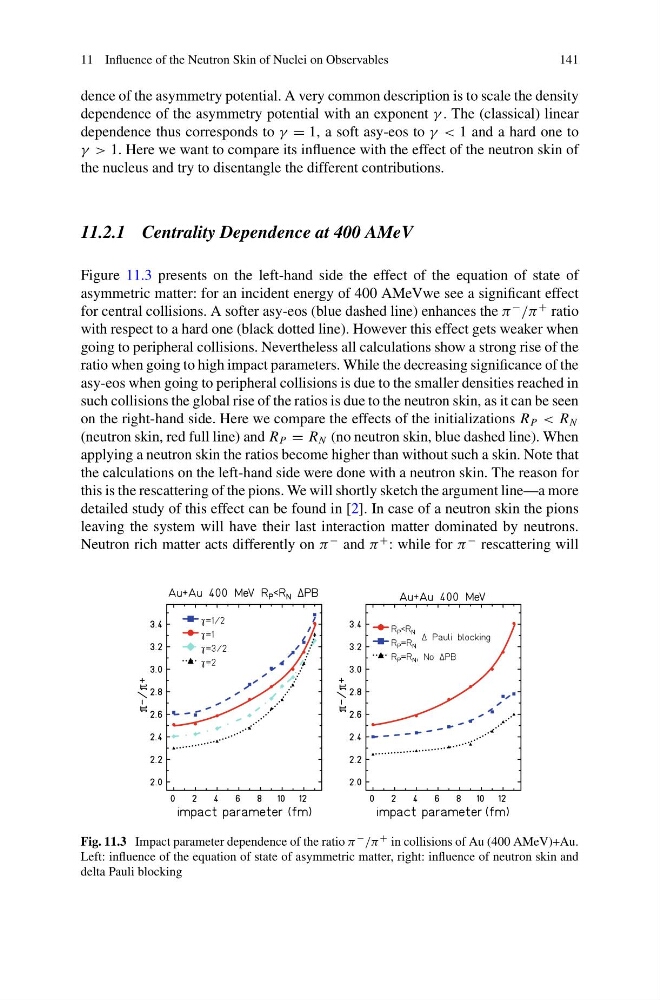
Figure 11.3 presents on the left-hand side the effect of the equation of state of
asymmetric matter: for an incident energy of 400 AMeVwe see a significant effect
for central collisions. A softer asy-eos (blue dashed line) enhances the π
−
/π
+ ratio
with respect to a hard one (black dotted line). However this effect gets weaker when
going to peripheral collisions. Nevertheless all calculations show a strong rise of the
ratio when going to high impact parameters. While the decreasing significance of the
asy-eos when going to peripheral collisions is due to the smaller densities reached in
such collisions the global rise of the ratios is due to the neutron skin, as it can be seen
on the right-hand side. Here we compare the effects of the initializations R P < R N
(neutron skin, red full line) and R P = R N (no neutron skin, blue dashed line). When
applying a neutron skin the ratios become higher than without such a skin. Note that
the calculations on the left-hand side were done with a neutron skin. The reason for
this is the rescattering of the pions. We will shortly sketch the argument line—a more
detailed study of this effect can be found in [2]. In case of a neutron skin the pions
leaving the system will have their last interaction matter dominated by neutrons.
Neutron rich matter acts differently on π
− and π
+ : while for π
− rescattering will
Fig. 11.3 Impact parameter dependence of the ratio π − /π + in collisions of Au (400 AMeV)+Au.
Left: influence of the equation of state of asymmetric matter, right: influence of neutron skin and
delta Pauli blocking
141
dence of the asymmetry potential. A very common description is to scale the density
dependence of the asymmetry potential with an exponent γ . The (classical) linear
dependence thus corresponds to γ = 1, a soft asy-eos to γ < 1 and a hard one to
γ > 1. Here we want to compare its influence with the effect of the neutron skin of
the nucleus and try to disentangle the different contributions.
11.2.1 Centrality Dependence at 400 AMeV
Figure 11.3 presents on the left-hand side the effect of the equation of state of
asymmetric matter: for an incident energy of 400 AMeVwe see a significant effect
for central collisions. A softer asy-eos (blue dashed line) enhances the π
−
/π
+ ratio
with respect to a hard one (black dotted line). However this effect gets weaker when
going to peripheral collisions. Nevertheless all calculations show a strong rise of the
ratio when going to high impact parameters. While the decreasing significance of the
asy-eos when going to peripheral collisions is due to the smaller densities reached in
such collisions the global rise of the ratios is due to the neutron skin, as it can be seen
on the right-hand side. Here we compare the effects of the initializations R P < R N
(neutron skin, red full line) and R P = R N (no neutron skin, blue dashed line). When
applying a neutron skin the ratios become higher than without such a skin. Note that
the calculations on the left-hand side were done with a neutron skin. The reason for
this is the rescattering of the pions. We will shortly sketch the argument line—a more
detailed study of this effect can be found in [2]. In case of a neutron skin the pions
leaving the system will have their last interaction matter dominated by neutrons.
Neutron rich matter acts differently on π
− and π
+ : while for π
− rescattering will
Fig. 11.3 Impact parameter dependence of the ratio π − /π + in collisions of Au (400 AMeV)+Au.
Left: influence of the equation of state of asymmetric matter, right: influence of neutron skin and
delta Pauli blocking