

11 Influence of the Neutron Skin of Nuclei on Observables
139
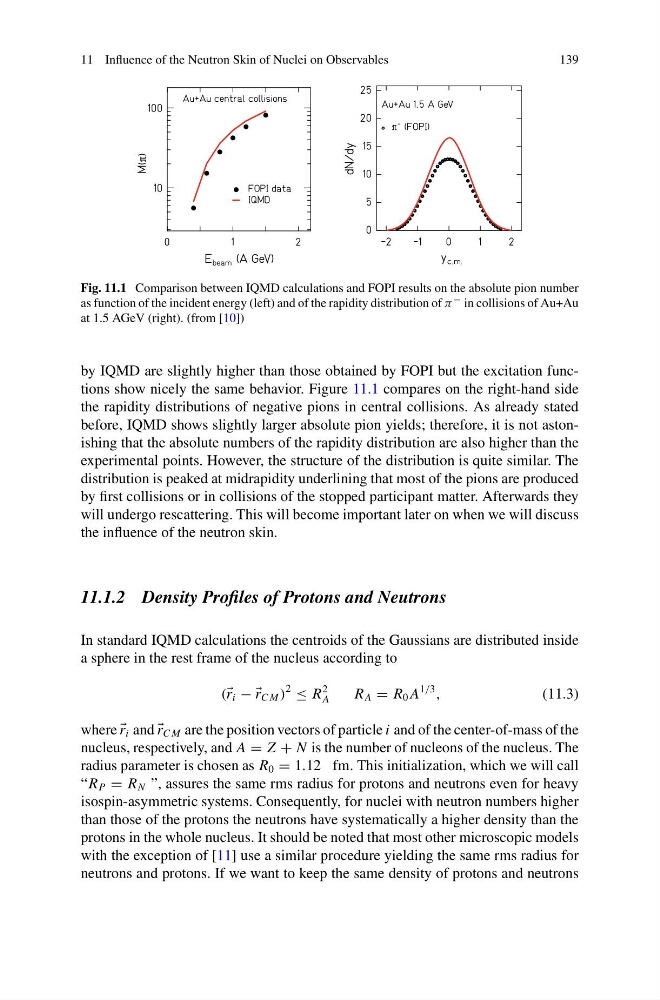
Fig. 11.1 Comparison between IQMD calculations and FOPI results on the absolute pion number
as function of the incident energy (left) and of the rapidity distribution of π − in collisions of Au+Au
at 1.5 AGeV (right). (from [10])
by IQMD are slightly higher than those obtained by FOPI but the excitation functions show nicely the same behavior. Figure 11.1 compares on the right-hand side
the rapidity distributions of negative pions in central collisions. As already stated
before, IQMD shows slightly larger absolute pion yields; therefore, it is not astonishing that the absolute numbers of the rapidity distribution are also higher than the
experimental points. However, the structure of the distribution is quite similar. The
distribution is peaked at midrapidity underlining that most of the pions are produced
by first collisions or in collisions of the stopped participant matter. Afterwards they
will undergo rescattering. This will become important later on when we will discuss
the influence of the neutron skin.
11.1.2 Density Profiles of Protons and Neutrons
In standard IQMD calculations the centroids of the Gaussians are distributed inside
a sphere in the rest frame of the nucleus according to
( r i − −
r C M )
2 ≤ R
2
A
R A = R 0 A
1/3
,
(11.3)
where
r i and
r C M are the position vectors of particle i and of the center-of-mass of the
nucleus, respectively, and A = Z + N is the number of nucleons of the nucleus. The
radius parameter is chosen as R 0 = 1.12 fm. This initialization, which we will call
“R P = R N ”, assures the same rms radius for protons and neutrons even for heavy
isospin-asymmetric systems. Consequently, for nuclei with neutron numbers higher
than those of the protons the neutrons have systematically a higher density than the
protons in the whole nucleus. It should be noted that most other microscopic models
with the exception of [11] use a similar procedure yielding the same rms radius for
neutrons and protons. If we want to keep the same density of protons and neutrons
139
Fig. 11.1 Comparison between IQMD calculations and FOPI results on the absolute pion number
as function of the incident energy (left) and of the rapidity distribution of π − in collisions of Au+Au
at 1.5 AGeV (right). (from [10])
by IQMD are slightly higher than those obtained by FOPI but the excitation functions show nicely the same behavior. Figure 11.1 compares on the right-hand side
the rapidity distributions of negative pions in central collisions. As already stated
before, IQMD shows slightly larger absolute pion yields; therefore, it is not astonishing that the absolute numbers of the rapidity distribution are also higher than the
experimental points. However, the structure of the distribution is quite similar. The
distribution is peaked at midrapidity underlining that most of the pions are produced
by first collisions or in collisions of the stopped participant matter. Afterwards they
will undergo rescattering. This will become important later on when we will discuss
the influence of the neutron skin.
11.1.2 Density Profiles of Protons and Neutrons
In standard IQMD calculations the centroids of the Gaussians are distributed inside
a sphere in the rest frame of the nucleus according to
( r i − −
r C M )
2 ≤ R
2
A
R A = R 0 A
1/3
,
(11.3)
where
r i and
r C M are the position vectors of particle i and of the center-of-mass of the
nucleus, respectively, and A = Z + N is the number of nucleons of the nucleus. The
radius parameter is chosen as R 0 = 1.12 fm. This initialization, which we will call
“R P = R N ”, assures the same rms radius for protons and neutrons even for heavy
isospin-asymmetric systems. Consequently, for nuclei with neutron numbers higher
than those of the protons the neutrons have systematically a higher density than the
protons in the whole nucleus. It should be noted that most other microscopic models
with the exception of [11] use a similar procedure yielding the same rms radius for
neutrons and protons. If we want to keep the same density of protons and neutrons