

10 PHSD—A Microscopic Transport Approach for Strongly Interacting Systems
131
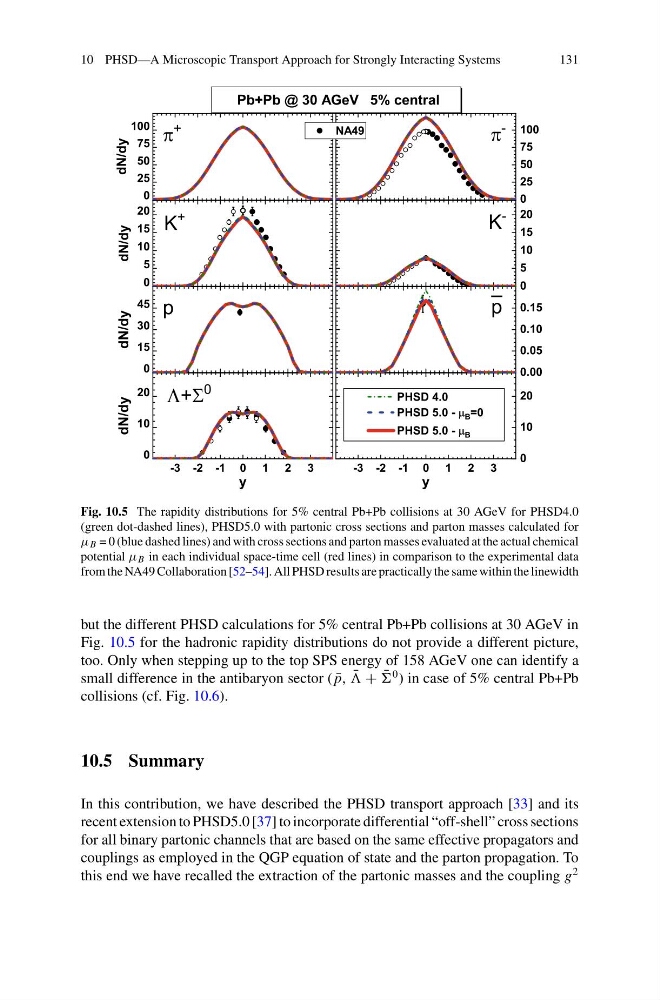
Fig. 10.5 The rapidity distributions for 5% central Pb+Pb collisions at 30 AGeV for PHSD4.0
(green dot-dashed lines), PHSD5.0 with partonic cross sections and parton masses calculated for
μ B = 0 (blue dashed lines) and with cross sections and parton masses evaluated at the actual chemical
potential μ B in each individual space-time cell (red lines) in comparison to the experimental data
from the NA49 Collaboration [52–54]. All PHSD results are practically the same within the linewidth
but the different PHSD calculations for 5% central Pb+Pb collisions at 30 AGeV in
Fig. 10.5 for the hadronic rapidity distributions do not provide a different picture,
too. Only when stepping up to the top SPS energy of 158 AGeV one can identify a
small difference in the antibaryon sector ( ¯
p, ¯
+ ¯
0 ) in case of 5% central Pb+Pb
collisions (cf. Fig. 10.6).
10.5 Summary
In this contribution, we have described the PHSD transport approach [33] and its
recent extension to PHSD5.0 [37] to incorporate differential “off-shell” cross sections
for all binary partonic channels that are based on the same effective propagators and
couplings as employed in the QGP equation of state and the parton propagation. To
this end we have recalled the extraction of the partonic masses and the coupling g
2
131
Fig. 10.5 The rapidity distributions for 5% central Pb+Pb collisions at 30 AGeV for PHSD4.0
(green dot-dashed lines), PHSD5.0 with partonic cross sections and parton masses calculated for
μ B = 0 (blue dashed lines) and with cross sections and parton masses evaluated at the actual chemical
potential μ B in each individual space-time cell (red lines) in comparison to the experimental data
from the NA49 Collaboration [52–54]. All PHSD results are practically the same within the linewidth
but the different PHSD calculations for 5% central Pb+Pb collisions at 30 AGeV in
Fig. 10.5 for the hadronic rapidity distributions do not provide a different picture,
too. Only when stepping up to the top SPS energy of 158 AGeV one can identify a
small difference in the antibaryon sector ( ¯
p, ¯
+ ¯
0 ) in case of 5% central Pb+Pb
collisions (cf. Fig. 10.6).
10.5 Summary
In this contribution, we have described the PHSD transport approach [33] and its
recent extension to PHSD5.0 [37] to incorporate differential “off-shell” cross sections
for all binary partonic channels that are based on the same effective propagators and
couplings as employed in the QGP equation of state and the parton propagation. To
this end we have recalled the extraction of the partonic masses and the coupling g
2