

130
E. L. Bratkovskaya et al.
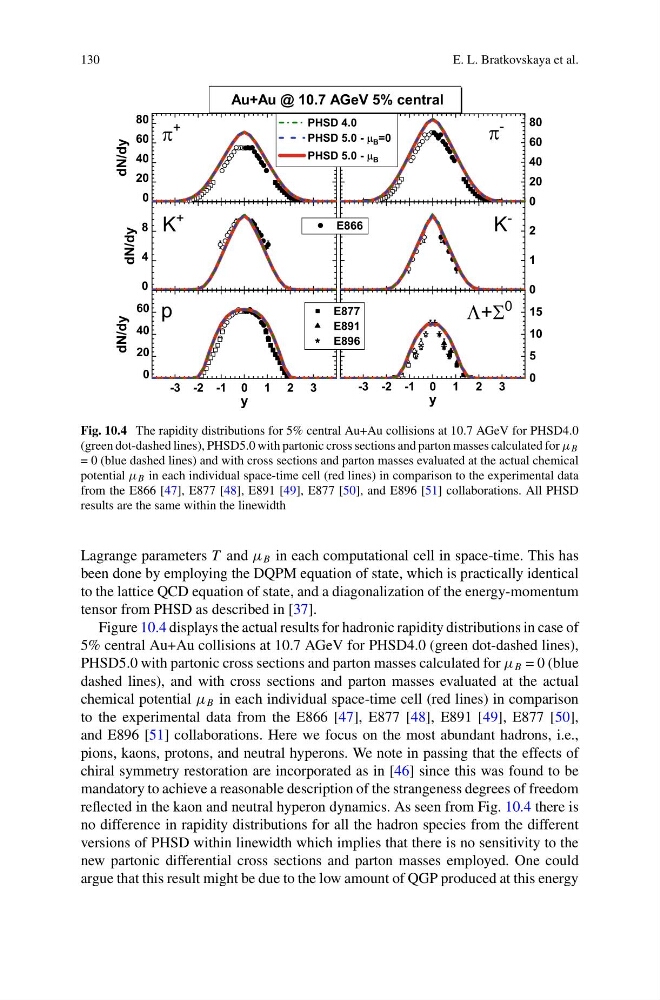
Fig. 10.4 The rapidity distributions for 5% central Au+Au collisions at 10.7 AGeV for PHSD4.0
(green dot-dashed lines), PHSD5.0 with partonic cross sections and parton masses calculated for μ B
= 0 (blue dashed lines) and with cross sections and parton masses evaluated at the actual chemical
potential μ B in each individual space-time cell (red lines) in comparison to the experimental data
from the E866 [47], E877 [48], E891 [49], E877 [50], and E896 [51] collaborations. All PHSD
results are the same within the linewidth
Lagrange parameters T and μ B in each computational cell in space-time. This has
been done by employing the DQPM equation of state, which is practically identical
to the lattice QCD equation of state, and a diagonalization of the energy-momentum
tensor from PHSD as described in [37].
Figure 10.4 displays the actual results for hadronic rapidity distributions in case of
5% central Au+Au collisions at 10.7 AGeV for PHSD4.0 (green dot-dashed lines),
PHSD5.0 with partonic cross sections and parton masses calculated for μ B = 0 (blue
dashed lines), and with cross sections and parton masses evaluated at the actual
chemical potential μ B in each individual space-time cell (red lines) in comparison
to the experimental data from the E866 [47], E877 [48], E891 [49], E877 [50],
and E896 [51] collaborations. Here we focus on the most abundant hadrons, i.e.,
pions, kaons, protons, and neutral hyperons. We note in passing that the effects of
chiral symmetry restoration are incorporated as in [46] since this was found to be
mandatory to achieve a reasonable description of the strangeness degrees of freedom
reflected in the kaon and neutral hyperon dynamics. As seen from Fig. 10.4 there is
no difference in rapidity distributions for all the hadron species from the different
versions of PHSD within linewidth which implies that there is no sensitivity to the
new partonic differential cross sections and parton masses employed. One could
argue that this result might be due to the low amount of QGP produced at this energy
E. L. Bratkovskaya et al.
Fig. 10.4 The rapidity distributions for 5% central Au+Au collisions at 10.7 AGeV for PHSD4.0
(green dot-dashed lines), PHSD5.0 with partonic cross sections and parton masses calculated for μ B
= 0 (blue dashed lines) and with cross sections and parton masses evaluated at the actual chemical
potential μ B in each individual space-time cell (red lines) in comparison to the experimental data
from the E866 [47], E877 [48], E891 [49], E877 [50], and E896 [51] collaborations. All PHSD
results are the same within the linewidth
Lagrange parameters T and μ B in each computational cell in space-time. This has
been done by employing the DQPM equation of state, which is practically identical
to the lattice QCD equation of state, and a diagonalization of the energy-momentum
tensor from PHSD as described in [37].
Figure 10.4 displays the actual results for hadronic rapidity distributions in case of
5% central Au+Au collisions at 10.7 AGeV for PHSD4.0 (green dot-dashed lines),
PHSD5.0 with partonic cross sections and parton masses calculated for μ B = 0 (blue
dashed lines), and with cross sections and parton masses evaluated at the actual
chemical potential μ B in each individual space-time cell (red lines) in comparison
to the experimental data from the E866 [47], E877 [48], E891 [49], E877 [50],
and E896 [51] collaborations. Here we focus on the most abundant hadrons, i.e.,
pions, kaons, protons, and neutral hyperons. We note in passing that the effects of
chiral symmetry restoration are incorporated as in [46] since this was found to be
mandatory to achieve a reasonable description of the strangeness degrees of freedom
reflected in the kaon and neutral hyperon dynamics. As seen from Fig. 10.4 there is
no difference in rapidity distributions for all the hadron species from the different
versions of PHSD within linewidth which implies that there is no sensitivity to the
new partonic differential cross sections and parton masses employed. One could
argue that this result might be due to the low amount of QGP produced at this energy