

10 PHSD—A Microscopic Transport Approach for Strongly Interacting Systems
129
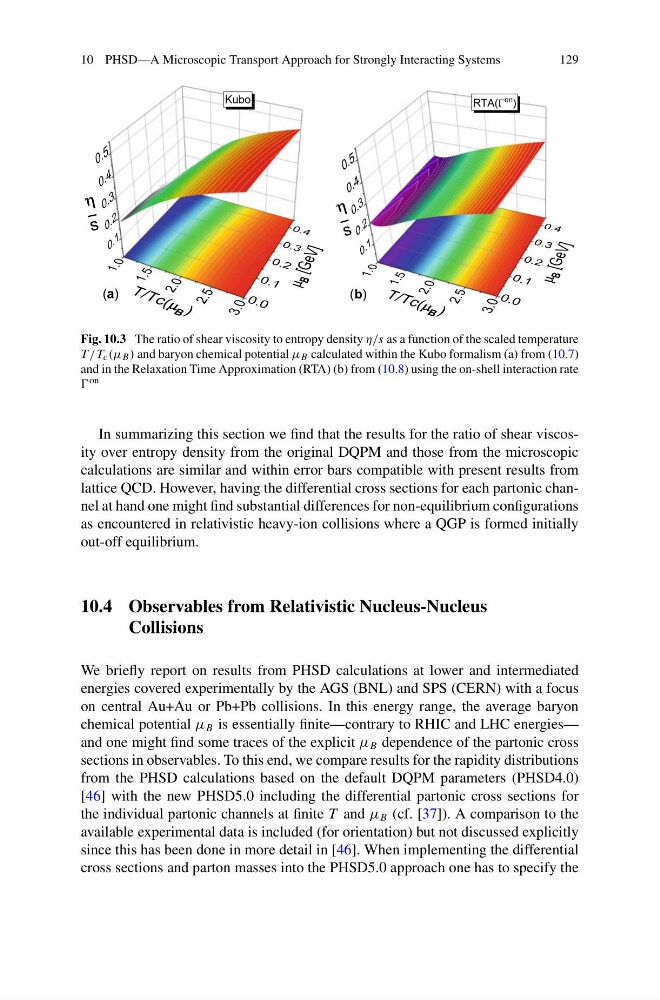
Fig. 10.3 The ratio of shear viscosity to entropy density η/s as a function of the scaled temperature
T /T c (μ B ) and baryon chemical potential μ B calculated within the Kubo formalism (a) from (10.7)
and in the Relaxation Time Approximation (RTA) (b) from (10.8) using the on-shell interaction rate
on
In summarizing this section we find that the results for the ratio of shear viscosity over entropy density from the original DQPM and those from the microscopic
calculations are similar and within error bars compatible with present results from
lattice QCD. However, having the differential cross sections for each partonic channel at hand one might find substantial differences for non-equilibrium configurations
as encountered in relativistic heavy-ion collisions where a QGP is formed initially
out-off equilibrium.
10.4 Observables from Relativistic Nucleus-Nucleus
Collisions
We briefly report on results from PHSD calculations at lower and intermediated
energies covered experimentally by the AGS (BNL) and SPS (CERN) with a focus
on central Au+Au or Pb+Pb collisions. In this energy range, the average baryon
chemical potential μ B is essentially finite—contrary to RHIC and LHC energies—
and one might find some traces of the explicit μ B dependence of the partonic cross
sections in observables. To this end, we compare results for the rapidity distributions
from the PHSD calculations based on the default DQPM parameters (PHSD4.0)
[46] with the new PHSD5.0 including the differential partonic cross sections for
the individual partonic channels at finite T and μ B (cf. [37]). A comparison to the
available experimental data is included (for orientation) but not discussed explicitly
since this has been done in more detail in [46]. When implementing the differential
cross sections and parton masses into the PHSD5.0 approach one has to specify the
129
Fig. 10.3 The ratio of shear viscosity to entropy density η/s as a function of the scaled temperature
T /T c (μ B ) and baryon chemical potential μ B calculated within the Kubo formalism (a) from (10.7)
and in the Relaxation Time Approximation (RTA) (b) from (10.8) using the on-shell interaction rate
on
In summarizing this section we find that the results for the ratio of shear viscosity over entropy density from the original DQPM and those from the microscopic
calculations are similar and within error bars compatible with present results from
lattice QCD. However, having the differential cross sections for each partonic channel at hand one might find substantial differences for non-equilibrium configurations
as encountered in relativistic heavy-ion collisions where a QGP is formed initially
out-off equilibrium.
10.4 Observables from Relativistic Nucleus-Nucleus
Collisions
We briefly report on results from PHSD calculations at lower and intermediated
energies covered experimentally by the AGS (BNL) and SPS (CERN) with a focus
on central Au+Au or Pb+Pb collisions. In this energy range, the average baryon
chemical potential μ B is essentially finite—contrary to RHIC and LHC energies—
and one might find some traces of the explicit μ B dependence of the partonic cross
sections in observables. To this end, we compare results for the rapidity distributions
from the PHSD calculations based on the default DQPM parameters (PHSD4.0)
[46] with the new PHSD5.0 including the differential partonic cross sections for
the individual partonic channels at finite T and μ B (cf. [37]). A comparison to the
available experimental data is included (for orientation) but not discussed explicitly
since this has been done in more detail in [46]. When implementing the differential
cross sections and parton masses into the PHSD5.0 approach one has to specify the