

128
E. L. Bratkovskaya et al.
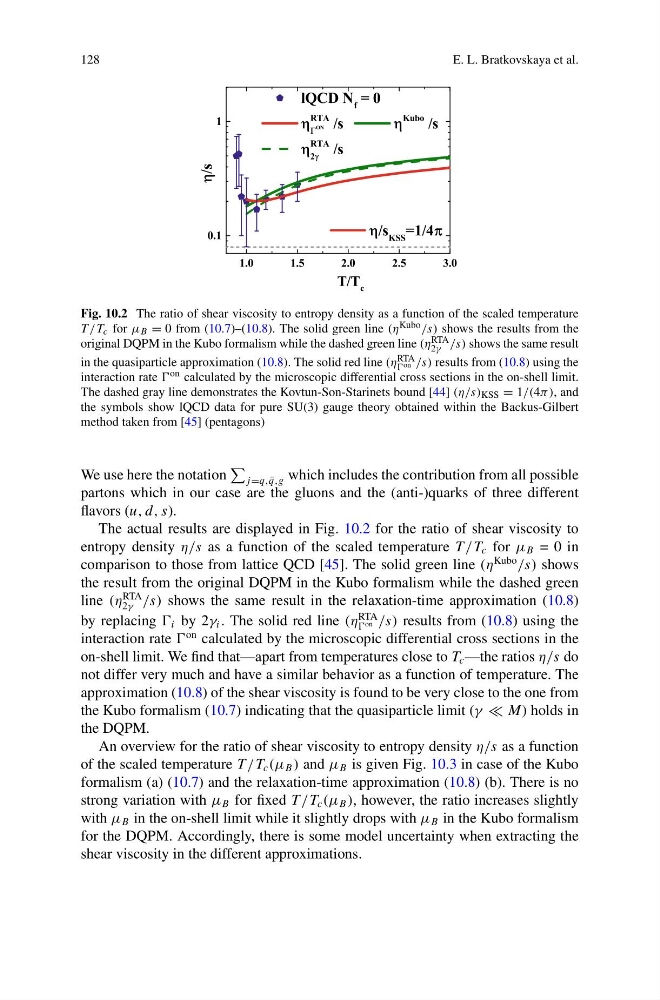
Fig. 10.2 The ratio of shear viscosity to entropy density as a function of the scaled temperature
T /T c for μ B = 0 from (10.7)–(10.8). The solid green line (η Kubo /s) shows the results from the
original DQPM in the Kubo formalism while the dashed green line (η RTA
2γ /s) shows the same result
in the quasiparticle approximation (10.8). The solid red line (η RTA
on /s) results from (10.8) using the
interaction rate on calculated by the microscopic differential cross sections in the on-shell limit.
The dashed gray line demonstrates the Kovtun-Son-Starinets bound [44] (η/s) KSS = 1/(4π), and
the symbols show lQCD data for pure SU(3) gauge theory obtained within the Backus-Gilbert
method taken from [45] (pentagons)
We use here the notation
j=q, ¯
q,g which includes the contribution from all possible
partons which in our case are the gluons and the (anti-)quarks of three different
flavors (u, d, s).
The actual results are displayed in Fig. 10.2 for the ratio of shear viscosity to
entropy density η/s as a function of the scaled temperature T /T c for μ B = 0 in
comparison to those from lattice QCD [45]. The solid green line (η
Kubo
/s) shows
the result from the original DQPM in the Kubo formalism while the dashed green
line (η
RTA
2γ /s) shows the same result in the relaxation-time approximation (10.8)
by replacing i by 2γ i . The solid red line (η
RTA
on /s) results from (10.8) using the
interaction rate
on calculated by the microscopic differential cross sections in the
on-shell limit. We find that—apart from temperatures close to T c —the ratios η/s do
not differ very much and have a similar behavior as a function of temperature. The
approximation (10.8) of the shear viscosity is found to be very close to the one from
the Kubo formalism (10.7) indicating that the quasiparticle limit (γ M) holds in
the DQPM.
An overview for the ratio of shear viscosity to entropy density η/s as a function
of the scaled temperature T /T c (μ B ) and μ B is given Fig. 10.3 in case of the Kubo
formalism (a) (10.7) and the relaxation-time approximation (10.8) (b). There is no
strong variation with μ B for fixed T /T c (μ B ), however, the ratio increases slightly
with μ B in the on-shell limit while it slightly drops with μ B in the Kubo formalism
for the DQPM. Accordingly, there is some model uncertainty when extracting the
shear viscosity in the different approximations.
E. L. Bratkovskaya et al.
Fig. 10.2 The ratio of shear viscosity to entropy density as a function of the scaled temperature
T /T c for μ B = 0 from (10.7)–(10.8). The solid green line (η Kubo /s) shows the results from the
original DQPM in the Kubo formalism while the dashed green line (η RTA
2γ /s) shows the same result
in the quasiparticle approximation (10.8). The solid red line (η RTA
on /s) results from (10.8) using the
interaction rate on calculated by the microscopic differential cross sections in the on-shell limit.
The dashed gray line demonstrates the Kovtun-Son-Starinets bound [44] (η/s) KSS = 1/(4π), and
the symbols show lQCD data for pure SU(3) gauge theory obtained within the Backus-Gilbert
method taken from [45] (pentagons)
We use here the notation
j=q, ¯
q,g which includes the contribution from all possible
partons which in our case are the gluons and the (anti-)quarks of three different
flavors (u, d, s).
The actual results are displayed in Fig. 10.2 for the ratio of shear viscosity to
entropy density η/s as a function of the scaled temperature T /T c for μ B = 0 in
comparison to those from lattice QCD [45]. The solid green line (η
Kubo
/s) shows
the result from the original DQPM in the Kubo formalism while the dashed green
line (η
RTA
2γ /s) shows the same result in the relaxation-time approximation (10.8)
by replacing i by 2γ i . The solid red line (η
RTA
on /s) results from (10.8) using the
interaction rate
on calculated by the microscopic differential cross sections in the
on-shell limit. We find that—apart from temperatures close to T c —the ratios η/s do
not differ very much and have a similar behavior as a function of temperature. The
approximation (10.8) of the shear viscosity is found to be very close to the one from
the Kubo formalism (10.7) indicating that the quasiparticle limit (γ M) holds in
the DQPM.
An overview for the ratio of shear viscosity to entropy density η/s as a function
of the scaled temperature T /T c (μ B ) and μ B is given Fig. 10.3 in case of the Kubo
formalism (a) (10.7) and the relaxation-time approximation (10.8) (b). There is no
strong variation with μ B for fixed T /T c (μ B ), however, the ratio increases slightly
with μ B in the on-shell limit while it slightly drops with μ B in the Kubo formalism
for the DQPM. Accordingly, there is some model uncertainty when extracting the
shear viscosity in the different approximations.