

132
E. L. Bratkovskaya et al.
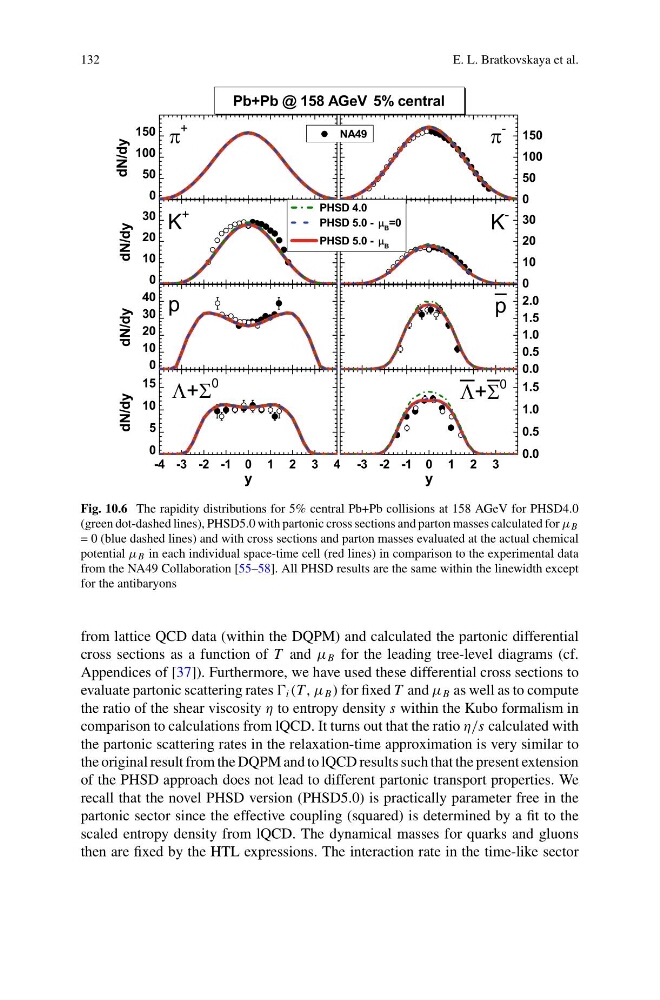
Fig. 10.6 The rapidity distributions for 5% central Pb+Pb collisions at 158 AGeV for PHSD4.0
(green dot-dashed lines), PHSD5.0 with partonic cross sections and parton masses calculated for μ B
= 0 (blue dashed lines) and with cross sections and parton masses evaluated at the actual chemical
potential μ B in each individual space-time cell (red lines) in comparison to the experimental data
from the NA49 Collaboration [55–58]. All PHSD results are the same within the linewidth except
for the antibaryons
from lattice QCD data (within the DQPM) and calculated the partonic differential
cross sections as a function of T and μ B for the leading tree-level diagrams (cf.
Appendices of [37]). Furthermore, we have used these differential cross sections to
evaluate partonic scattering rates i (T, μ B ) for fixed T and μ B as well as to compute
the ratio of the shear viscosity η to entropy density s within the Kubo formalism in
comparison to calculations from lQCD. It turns out that the ratio η/s calculated with
the partonic scattering rates in the relaxation-time approximation is very similar to
the original result from the DQPM and to lQCD results such that the present extension
of the PHSD approach does not lead to different partonic transport properties. We
recall that the novel PHSD version (PHSD5.0) is practically parameter free in the
partonic sector since the effective coupling (squared) is determined by a fit to the
scaled entropy density from lQCD. The dynamical masses for quarks and gluons
then are fixed by the HTL expressions. The interaction rate in the time-like sector
E. L. Bratkovskaya et al.
Fig. 10.6 The rapidity distributions for 5% central Pb+Pb collisions at 158 AGeV for PHSD4.0
(green dot-dashed lines), PHSD5.0 with partonic cross sections and parton masses calculated for μ B
= 0 (blue dashed lines) and with cross sections and parton masses evaluated at the actual chemical
potential μ B in each individual space-time cell (red lines) in comparison to the experimental data
from the NA49 Collaboration [55–58]. All PHSD results are the same within the linewidth except
for the antibaryons
from lattice QCD data (within the DQPM) and calculated the partonic differential
cross sections as a function of T and μ B for the leading tree-level diagrams (cf.
Appendices of [37]). Furthermore, we have used these differential cross sections to
evaluate partonic scattering rates i (T, μ B ) for fixed T and μ B as well as to compute
the ratio of the shear viscosity η to entropy density s within the Kubo formalism in
comparison to calculations from lQCD. It turns out that the ratio η/s calculated with
the partonic scattering rates in the relaxation-time approximation is very similar to
the original result from the DQPM and to lQCD results such that the present extension
of the PHSD approach does not lead to different partonic transport properties. We
recall that the novel PHSD version (PHSD5.0) is practically parameter free in the
partonic sector since the effective coupling (squared) is determined by a fit to the
scaled entropy density from lQCD. The dynamical masses for quarks and gluons
then are fixed by the HTL expressions. The interaction rate in the time-like sector