

10 PHSD—A Microscopic Transport Approach for Strongly Interacting Systems
123
and simulate momentum distributions of colliding systems at high relative momentum. The results for the effective parameters M and γ , which correspond to the timedependent pole mass and width of the propagator (10.1), indicate that the quasiparticle properties—except for the very early off-equilibrium configuration—are close
to the equilibrium mass and width even though the phase-space distribution of the
particles is far from equilibrium (cf. Figs. 8 to 10 in [32]). Accordingly, we will adopt
the equilibrium quasiparticle properties also for phase-space configurations out of
equilibrium as appearing in relativistic heavy-ion collisions. The reader has to keep
in mind that this approximation is well motivated, however, not fully equivalent to
the exact solution.
On the hadronic side PHSD includes explicitly the baryon and antibaryon octet
and decouplet, the 0
− - and 1
− -meson nonets as well as selected higher resonances
as in HSD [12]. Hadrons of higher masses (> 1.5 GeV in case of baryons and >
1.3 GeV in case of mesons) are treated as “strings” (color-dipoles) that decay to the
known (low-mass) hadrons according to the JETSET algorithm [10]. We discard an
explicit recapitulation of the string formation and decay and refer the reader to the
original work [10].
10.2.1 Hadronization
Whereas the dynamics of partonic as well as hadronic systems is fixed by the DQPM
or HSD, respectively, the change in the degrees of freedom has to be specified in
line with the lattice QCD equation of state. The hadronization, i.e., the transition
from partonic to hadronic degrees of freedom, has been introduced in [29, 34] and
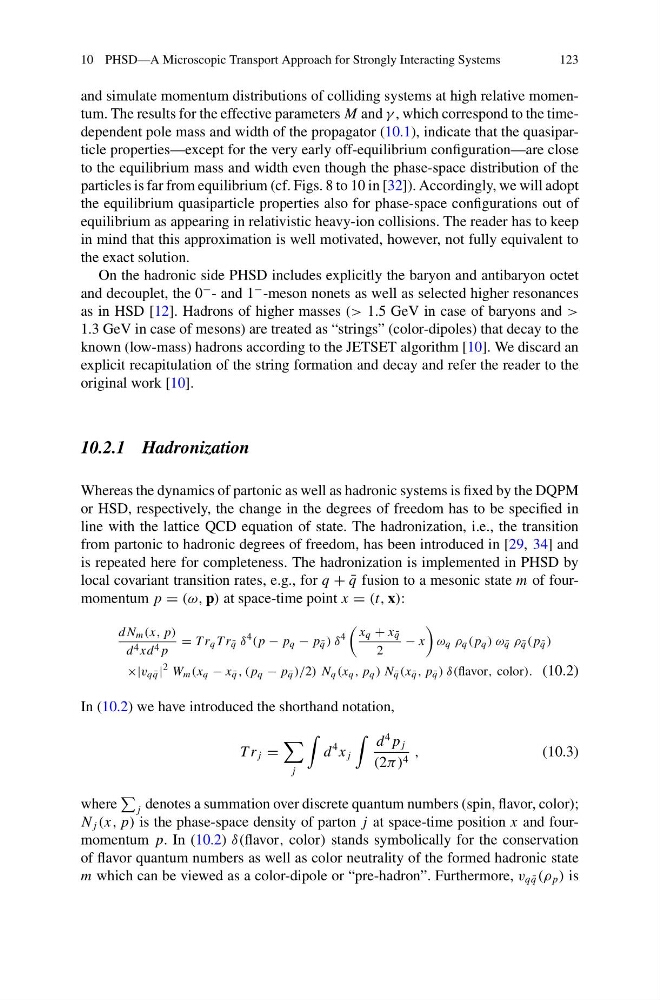
is repeated here for completeness. The hadronization is implemented in PHSD by
local covariant transition rates, e.g., for q + ¯
q fusion to a mesonic state m of fourmomentum p = (ω, p) at space-time point x = (t, x):
d N m (x, p)
d 4 xd 4 p
= T r q T r ¯
q δ
4 ( p − p q − p ¯
q ) δ
4
x q + x ¯
q
2
− x
ω q ρ q ( p q ) ω ¯
q ρ ¯
q ( p ¯
q )
×|v q ¯
q |
2 W m (x q − x ¯
q , (p q − p ¯
q )/2) N q (x q , p q ) N ¯
q (x ¯
q , p ¯
q ) δ(flavor, color). (10.2)
In (10.2) we have introduced the shorthand notation,
T r j =
j
d
4 x j
d
4 p j
(2π) 4 ,
(10.3)
where
j denotes a summation over discrete quantum numbers (spin, flavor, color);
N j (x, p) is the phase-space density of parton j at space-time position x and fourmomentum p. In (10.2) δ(flavor, color) stands symbolically for the conservation
of flavor quantum numbers as well as color neutrality of the formed hadronic state
m which can be viewed as a color-dipole or “pre-hadron”. Furthermore, v q ¯
q (ρ p ) is
123
and simulate momentum distributions of colliding systems at high relative momentum. The results for the effective parameters M and γ , which correspond to the timedependent pole mass and width of the propagator (10.1), indicate that the quasiparticle properties—except for the very early off-equilibrium configuration—are close
to the equilibrium mass and width even though the phase-space distribution of the
particles is far from equilibrium (cf. Figs. 8 to 10 in [32]). Accordingly, we will adopt
the equilibrium quasiparticle properties also for phase-space configurations out of
equilibrium as appearing in relativistic heavy-ion collisions. The reader has to keep
in mind that this approximation is well motivated, however, not fully equivalent to
the exact solution.
On the hadronic side PHSD includes explicitly the baryon and antibaryon octet
and decouplet, the 0
− - and 1
− -meson nonets as well as selected higher resonances
as in HSD [12]. Hadrons of higher masses (> 1.5 GeV in case of baryons and >
1.3 GeV in case of mesons) are treated as “strings” (color-dipoles) that decay to the
known (low-mass) hadrons according to the JETSET algorithm [10]. We discard an
explicit recapitulation of the string formation and decay and refer the reader to the
original work [10].
10.2.1 Hadronization
Whereas the dynamics of partonic as well as hadronic systems is fixed by the DQPM
or HSD, respectively, the change in the degrees of freedom has to be specified in
line with the lattice QCD equation of state. The hadronization, i.e., the transition
from partonic to hadronic degrees of freedom, has been introduced in [29, 34] and
is repeated here for completeness. The hadronization is implemented in PHSD by
local covariant transition rates, e.g., for q + ¯
q fusion to a mesonic state m of fourmomentum p = (ω, p) at space-time point x = (t, x):
d N m (x, p)
d 4 xd 4 p
= T r q T r ¯
q δ
4 ( p − p q − p ¯
q ) δ
4
x q + x ¯
q
2
− x
ω q ρ q ( p q ) ω ¯
q ρ ¯
q ( p ¯
q )
×|v q ¯
q |
2 W m (x q − x ¯
q , (p q − p ¯
q )/2) N q (x q , p q ) N ¯
q (x ¯
q , p ¯
q ) δ(flavor, color). (10.2)
In (10.2) we have introduced the shorthand notation,
T r j =
j
d
4 x j
d
4 p j
(2π) 4 ,
(10.3)
where
j denotes a summation over discrete quantum numbers (spin, flavor, color);
N j (x, p) is the phase-space density of parton j at space-time position x and fourmomentum p. In (10.2) δ(flavor, color) stands symbolically for the conservation
of flavor quantum numbers as well as color neutrality of the formed hadronic state
m which can be viewed as a color-dipole or “pre-hadron”. Furthermore, v q ¯
q (ρ p ) is