

124
E. L. Bratkovskaya et al.
the effective quark-antiquark interaction from the DQPM (displayed in Fig. 10 of
[31]) as a function of the local parton (q + ¯
q + g) density ρ p (or energy density).
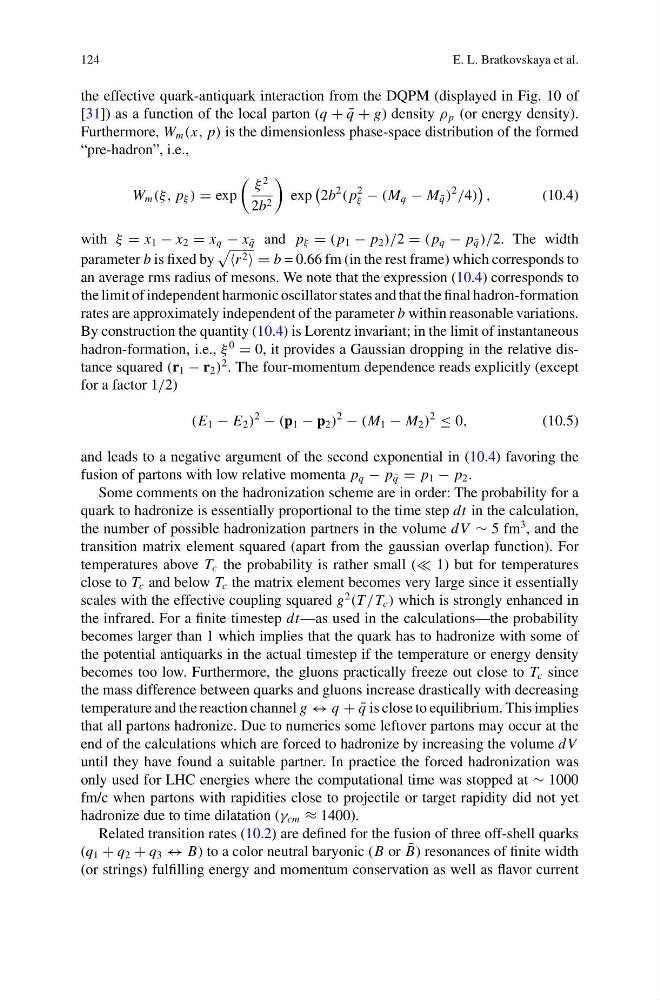
Furthermore, W m (x, p) is the dimensionless phase-space distribution of the formed
“pre-hadron”, i.e.,
W m (ξ, p ξ ) = exp
ξ
2
2b 2
exp
2b
2
( p
2
ξ − (M q − M ¯
q )
2
/4)
,
(10.4)
with ξ = x 1 − x 2 = x q − x ¯
q and p ξ = ( p 1 − p 2 )/2 = ( p q − p ¯
q )/2. The width
parameter b is fixed by
r 2 = b = 0.66 fm (in the rest frame) which corresponds to
an average rms radius of mesons. We note that the expression (10.4) corresponds to
the limit of independent harmonic oscillator states and that the final hadron-formation
rates are approximately independent of the parameter b within reasonable variations.
By construction the quantity (10.4) is Lorentz invariant; in the limit of instantaneous
hadron-formation, i.e., ξ
0
= 0, it provides a Gaussian dropping in the relative distance squared (r 1 − r 2 )
2 . The four-momentum dependence reads explicitly (except
for a factor 1/2)
(E 1 − E 2 )
2
− (p 1 − p 2 )
2
− (M 1 − M 2 )
2
≤ 0,
(10.5)
and leads to a negative argument of the second exponential in (10.4) favoring the
fusion of partons with low relative momenta p q − p ¯
q = p 1 − p 2 .
Some comments on the hadronization scheme are in order: The probability for a
quark to hadronize is essentially proportional to the time step dt in the calculation,
the number of possible hadronization partners in the volume dV ∼ 5 fm
3 , and the
transition matrix element squared (apart from the gaussian overlap function). For
temperatures above T c the probability is rather small ( 1) but for temperatures
close to T c and below T c the matrix element becomes very large since it essentially
scales with the effective coupling squared g
2
(T /T c ) which is strongly enhanced in
the infrared. For a finite timestep dt—as used in the calculations—the probability
becomes larger than 1 which implies that the quark has to hadronize with some of
the potential antiquarks in the actual timestep if the temperature or energy density
becomes too low. Furthermore, the gluons practically freeze out close to T c since
the mass difference between quarks and gluons increase drastically with decreasing
temperature and the reaction channel g ↔ q + ¯
q is close to equilibrium. This implies
that all partons hadronize. Due to numerics some leftover partons may occur at the
end of the calculations which are forced to hadronize by increasing the volume dV
until they have found a suitable partner. In practice the forced hadronization was
only used for LHC energies where the computational time was stopped at ∼ 1000
fm/c when partons with rapidities close to projectile or target rapidity did not yet
hadronize due to time dilatation (γ cm ≈ 1400).
Related transition rates (10.2) are defined for the fusion of three off-shell quarks
(q 1 + q 2 + q 3 ↔ B) to a color neutral baryonic (B or ¯
B) resonances of finite width
(or strings) fulfilling energy and momentum conservation as well as flavor current
E. L. Bratkovskaya et al.
the effective quark-antiquark interaction from the DQPM (displayed in Fig. 10 of
[31]) as a function of the local parton (q + ¯
q + g) density ρ p (or energy density).
Furthermore, W m (x, p) is the dimensionless phase-space distribution of the formed
“pre-hadron”, i.e.,
W m (ξ, p ξ ) = exp
ξ
2
2b 2
exp
2b
2
( p
2
ξ − (M q − M ¯
q )
2
/4)
,
(10.4)
with ξ = x 1 − x 2 = x q − x ¯
q and p ξ = ( p 1 − p 2 )/2 = ( p q − p ¯
q )/2. The width
parameter b is fixed by
r 2 = b = 0.66 fm (in the rest frame) which corresponds to
an average rms radius of mesons. We note that the expression (10.4) corresponds to
the limit of independent harmonic oscillator states and that the final hadron-formation
rates are approximately independent of the parameter b within reasonable variations.
By construction the quantity (10.4) is Lorentz invariant; in the limit of instantaneous
hadron-formation, i.e., ξ
0
= 0, it provides a Gaussian dropping in the relative distance squared (r 1 − r 2 )
2 . The four-momentum dependence reads explicitly (except
for a factor 1/2)
(E 1 − E 2 )
2
− (p 1 − p 2 )
2
− (M 1 − M 2 )
2
≤ 0,
(10.5)
and leads to a negative argument of the second exponential in (10.4) favoring the
fusion of partons with low relative momenta p q − p ¯
q = p 1 − p 2 .
Some comments on the hadronization scheme are in order: The probability for a
quark to hadronize is essentially proportional to the time step dt in the calculation,
the number of possible hadronization partners in the volume dV ∼ 5 fm
3 , and the
transition matrix element squared (apart from the gaussian overlap function). For
temperatures above T c the probability is rather small ( 1) but for temperatures
close to T c and below T c the matrix element becomes very large since it essentially
scales with the effective coupling squared g
2
(T /T c ) which is strongly enhanced in
the infrared. For a finite timestep dt—as used in the calculations—the probability
becomes larger than 1 which implies that the quark has to hadronize with some of
the potential antiquarks in the actual timestep if the temperature or energy density
becomes too low. Furthermore, the gluons practically freeze out close to T c since
the mass difference between quarks and gluons increase drastically with decreasing
temperature and the reaction channel g ↔ q + ¯
q is close to equilibrium. This implies
that all partons hadronize. Due to numerics some leftover partons may occur at the
end of the calculations which are forced to hadronize by increasing the volume dV
until they have found a suitable partner. In practice the forced hadronization was
only used for LHC energies where the computational time was stopped at ∼ 1000
fm/c when partons with rapidities close to projectile or target rapidity did not yet
hadronize due to time dilatation (γ cm ≈ 1400).
Related transition rates (10.2) are defined for the fusion of three off-shell quarks
(q 1 + q 2 + q 3 ↔ B) to a color neutral baryonic (B or ¯
B) resonances of finite width
(or strings) fulfilling energy and momentum conservation as well as flavor current