

122
E. L. Bratkovskaya et al.
a temperature-dependent effective coupling (squared) g
2
(T /T c ), where T c denotes
the critical temperature for the phase transition from hadrons to partons. This transition at low baryon chemical potential was found to be a crossover and the critical
temperature T c could be extracted from the lQCD data. In fact, the DQPM allows
for a simple and transparent interpretation of lattice QCD results for thermodynamic
quantities as well as correlators and leads to effective strongly interacting partonic
quasiparticles with broad spectral functions. For a review on off-shell transport theory and results from the DQPM in comparison to lQCD we refer the reader to [32,
33].
Now a consistent dynamical approach—valid also for strongly interacting
systems—could be formulated on the basis of Kadanoff–Baym (KB) equations [17]
or off-shell transport equations in phase-space representation, respectively [17–19].
In the KB theory the field quanta are described in terms of dressed propagators with
complex selfenergies (as in the DQPM). Whereas the real part of the selfenergies
can be related to mean-field potentials (of Lorentz scalar, vector or tensor type), the
imaginary parts provide information about the lifetime and/or reaction rates of timelike particles [32]. Once the proper (complex) selfenergies of the degrees of freedom
are known the time evolution of the system is fully governed by off-shell transport
equations (as described in [17, 32]).
10.2 The PHSD Approach
The Parton–Hadron–String-Dynamics approach is a microscopic covariant transport
model that incorporates effective partonic as well as hadronic degrees of freedom
and involves a dynamical description of the hadronization process from partonic to
hadronic matter. Whereas the hadronic part is essentially equivalent to the conventional HSD approach [12] the partonic dynamics is based on the Dynamical Quasiparticle Model [30, 31] which describes QCD properties in terms of single-particle
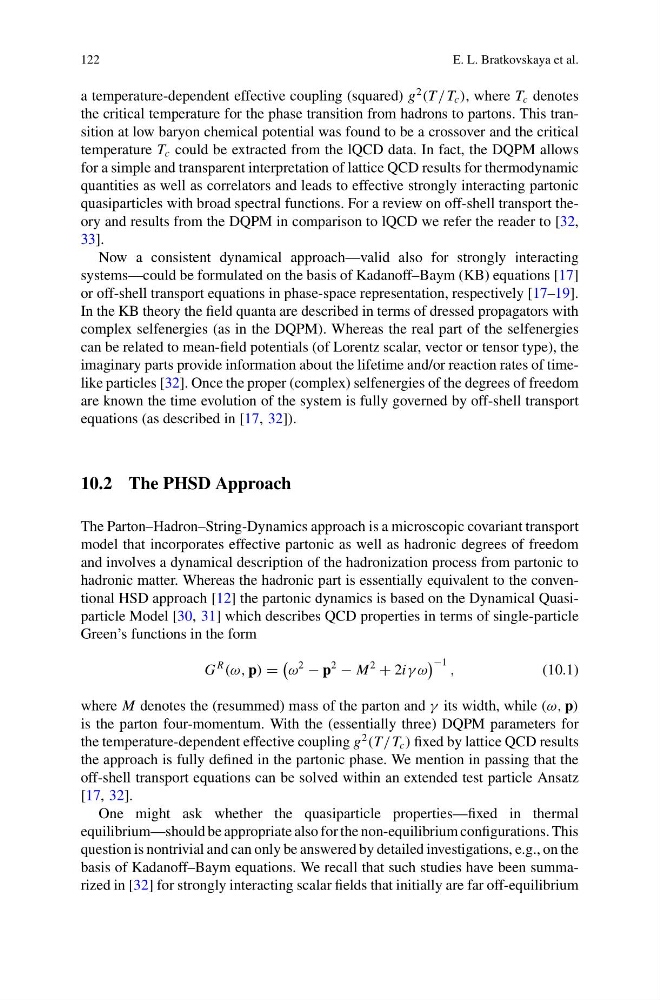
Green’s functions in the form
G
R
(ω, p) =
ω
2
− p
2
− M
2
+ 2iγ ω
−1 ,
(10.1)
where M denotes the (resummed) mass of the parton and γ its width, while (ω, p)
is the parton four-momentum. With the (essentially three) DQPM parameters for
the temperature-dependent effective coupling g
2
(T /T c ) fixed by lattice QCD results
the approach is fully defined in the partonic phase. We mention in passing that the
off-shell transport equations can be solved within an extended test particle Ansatz
[17, 32].
One might ask whether the quasiparticle properties—fixed in thermal
equilibrium—should be appropriate also for the non-equilibrium configurations. This
question is nontrivial and can only be answered by detailed investigations, e.g., on the
basis of Kadanoff–Baym equations. We recall that such studies have been summarized in [32] for strongly interacting scalar fields that initially are far off-equilibrium
E. L. Bratkovskaya et al.
a temperature-dependent effective coupling (squared) g
2
(T /T c ), where T c denotes
the critical temperature for the phase transition from hadrons to partons. This transition at low baryon chemical potential was found to be a crossover and the critical
temperature T c could be extracted from the lQCD data. In fact, the DQPM allows
for a simple and transparent interpretation of lattice QCD results for thermodynamic
quantities as well as correlators and leads to effective strongly interacting partonic
quasiparticles with broad spectral functions. For a review on off-shell transport theory and results from the DQPM in comparison to lQCD we refer the reader to [32,
33].
Now a consistent dynamical approach—valid also for strongly interacting
systems—could be formulated on the basis of Kadanoff–Baym (KB) equations [17]
or off-shell transport equations in phase-space representation, respectively [17–19].
In the KB theory the field quanta are described in terms of dressed propagators with
complex selfenergies (as in the DQPM). Whereas the real part of the selfenergies
can be related to mean-field potentials (of Lorentz scalar, vector or tensor type), the
imaginary parts provide information about the lifetime and/or reaction rates of timelike particles [32]. Once the proper (complex) selfenergies of the degrees of freedom
are known the time evolution of the system is fully governed by off-shell transport
equations (as described in [17, 32]).
10.2 The PHSD Approach
The Parton–Hadron–String-Dynamics approach is a microscopic covariant transport
model that incorporates effective partonic as well as hadronic degrees of freedom
and involves a dynamical description of the hadronization process from partonic to
hadronic matter. Whereas the hadronic part is essentially equivalent to the conventional HSD approach [12] the partonic dynamics is based on the Dynamical Quasiparticle Model [30, 31] which describes QCD properties in terms of single-particle
Green’s functions in the form
G
R
(ω, p) =
ω
2
− p
2
− M
2
+ 2iγ ω
−1 ,
(10.1)
where M denotes the (resummed) mass of the parton and γ its width, while (ω, p)
is the parton four-momentum. With the (essentially three) DQPM parameters for
the temperature-dependent effective coupling g
2
(T /T c ) fixed by lattice QCD results
the approach is fully defined in the partonic phase. We mention in passing that the
off-shell transport equations can be solved within an extended test particle Ansatz
[17, 32].
One might ask whether the quasiparticle properties—fixed in thermal
equilibrium—should be appropriate also for the non-equilibrium configurations. This
question is nontrivial and can only be answered by detailed investigations, e.g., on the
basis of Kadanoff–Baym equations. We recall that such studies have been summarized in [32] for strongly interacting scalar fields that initially are far off-equilibrium