

8 Reaction Dynamics for Stable and Halo Nuclei Reactions at Intermediate Energies
101
greater contribution from participant region and lesser from spectator region for
former compared to later (Fig. 8.4). This can be understood as following: the greater
value of radius for halo nucleus causes lesser value of momentum of its constituting
nucleons (compared to what stable nucleus nucleon have). Therefore, when the two
nuclei collide the nucleons have enough time to interact and loose its energy and
thermalize. Thus, the fragments do not have large rapidity values for halo nuclei
reactions compared to stable nuclei reactions. Contrary to it, at 150 MeV/nucleon
the nucleons have lesser time to thermalize and also, the loose structure of halo
nuclei makes them more transparent to each other. This leads to cause greater share
of fragments from spectator (lesser interacting nucleons). That is also clear from
the figure, where for halo nuclei reactions one has two peaks at projectile and target
regions. For stable nuclei reactions one has greater contribution for participant region.
For hard equation of state at 20 and 150 MeV/nucleon the role of halo structure have
similar effects on rapidity of fragments. Similarly for SMD and HMD equation
of states, we also see the difference in the origin of fragments for stable and halo
nuclei reactions. Here, we see the fragments have different origins for stable and halo
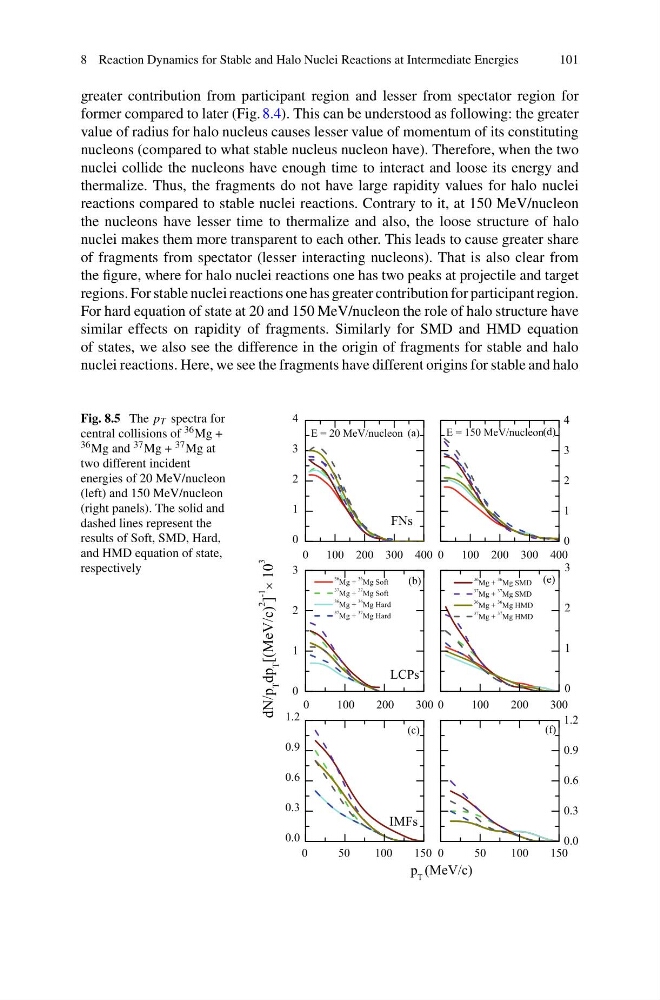
Fig. 8.5 The p T spectra for
central collisions of 36 Mg +
36 Mg and 37 Mg + 37 Mg at
two different incident
energies of 20 MeV/nucleon
(left) and 150 MeV/nucleon
(right panels). The solid and
dashed lines represent the
results of Soft, SMD, Hard,
and HMD equation of state,
respectively
101
greater contribution from participant region and lesser from spectator region for
former compared to later (Fig. 8.4). This can be understood as following: the greater
value of radius for halo nucleus causes lesser value of momentum of its constituting
nucleons (compared to what stable nucleus nucleon have). Therefore, when the two
nuclei collide the nucleons have enough time to interact and loose its energy and
thermalize. Thus, the fragments do not have large rapidity values for halo nuclei
reactions compared to stable nuclei reactions. Contrary to it, at 150 MeV/nucleon
the nucleons have lesser time to thermalize and also, the loose structure of halo
nuclei makes them more transparent to each other. This leads to cause greater share
of fragments from spectator (lesser interacting nucleons). That is also clear from
the figure, where for halo nuclei reactions one has two peaks at projectile and target
regions. For stable nuclei reactions one has greater contribution for participant region.
For hard equation of state at 20 and 150 MeV/nucleon the role of halo structure have
similar effects on rapidity of fragments. Similarly for SMD and HMD equation
of states, we also see the difference in the origin of fragments for stable and halo
nuclei reactions. Here, we see the fragments have different origins for stable and halo
Fig. 8.5 The p T spectra for
central collisions of 36 Mg +
36 Mg and 37 Mg + 37 Mg at
two different incident
energies of 20 MeV/nucleon
(left) and 150 MeV/nucleon
(right panels). The solid and
dashed lines represent the
results of Soft, SMD, Hard,
and HMD equation of state,
respectively