

100
Sucheta et al.
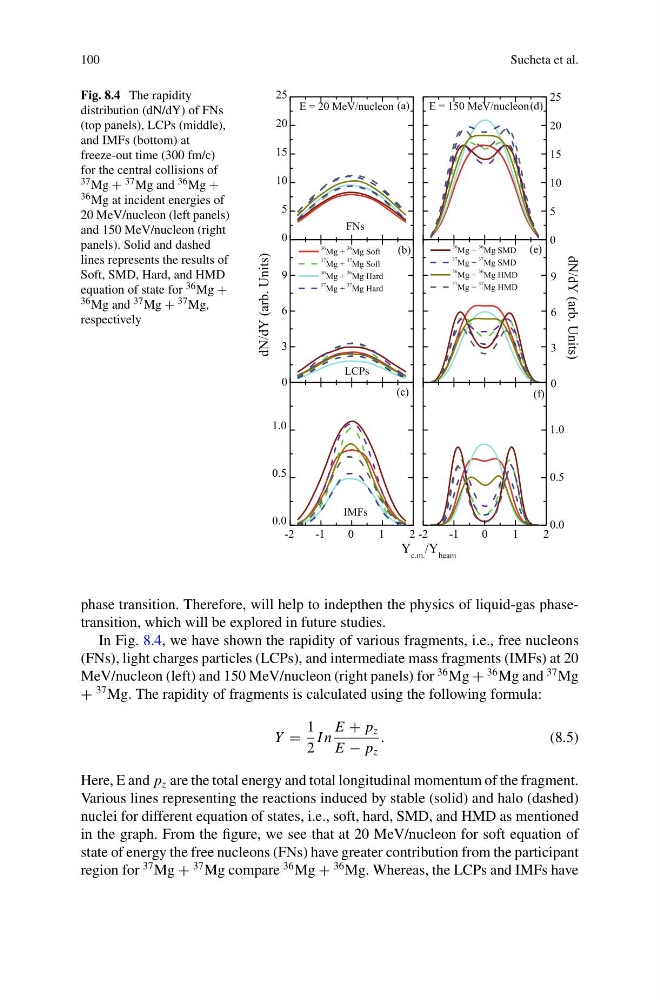
Fig. 8.4 The rapidity
distribution (dN/dY) of FNs
(top panels), LCPs (middle),
and IMFs (bottom) at
freeze-out time (300 fm/c)
for the central collisions of
37 Mg + 37 Mg and 36 Mg +
36 Mg at incident energies of
20 MeV/nucleon (left panels)
and 150 MeV/nucleon (right
panels). Solid and dashed
lines represents the results of
Soft, SMD, Hard, and HMD
equation of state for 36 Mg +
36 Mg and 37 Mg + 37 Mg,
respectively
phase transition. Therefore, will help to indepthen the physics of liquid-gas phasetransition, which will be explored in future studies.
In Fig. 8.4, we have shown the rapidity of various fragments, i.e., free nucleons
(FNs), light charges particles (LCPs), and intermediate mass fragments (IMFs) at 20
MeV/nucleon (left) and 150 MeV/nucleon (right panels) for
36 Mg +
36 Mg and
37 Mg
+
37 Mg. The rapidity of fragments is calculated using the following formula:
Y =
1
2
I n
E + p z
E − p z
.
(8.5)
Here, E and p z are the total energy and total longitudinal momentum of the fragment.
Various lines representing the reactions induced by stable (solid) and halo (dashed)
nuclei for different equation of states, i.e., soft, hard, SMD, and HMD as mentioned
in the graph. From the figure, we see that at 20 MeV/nucleon for soft equation of
state of energy the free nucleons (FNs) have greater contribution from the participant
region for
37 Mg +
37 Mg compare
36 Mg +
36 Mg. Whereas, the LCPs and IMFs have
Sucheta et al.
Fig. 8.4 The rapidity
distribution (dN/dY) of FNs
(top panels), LCPs (middle),
and IMFs (bottom) at
freeze-out time (300 fm/c)
for the central collisions of
37 Mg + 37 Mg and 36 Mg +
36 Mg at incident energies of
20 MeV/nucleon (left panels)
and 150 MeV/nucleon (right
panels). Solid and dashed
lines represents the results of
Soft, SMD, Hard, and HMD
equation of state for 36 Mg +
36 Mg and 37 Mg + 37 Mg,
respectively
phase transition. Therefore, will help to indepthen the physics of liquid-gas phasetransition, which will be explored in future studies.
In Fig. 8.4, we have shown the rapidity of various fragments, i.e., free nucleons
(FNs), light charges particles (LCPs), and intermediate mass fragments (IMFs) at 20
MeV/nucleon (left) and 150 MeV/nucleon (right panels) for
36 Mg +
36 Mg and
37 Mg
+
37 Mg. The rapidity of fragments is calculated using the following formula:
Y =
1
2
I n
E + p z
E − p z
.
(8.5)
Here, E and p z are the total energy and total longitudinal momentum of the fragment.
Various lines representing the reactions induced by stable (solid) and halo (dashed)
nuclei for different equation of states, i.e., soft, hard, SMD, and HMD as mentioned
in the graph. From the figure, we see that at 20 MeV/nucleon for soft equation of
state of energy the free nucleons (FNs) have greater contribution from the participant
region for
37 Mg +
37 Mg compare
36 Mg +
36 Mg. Whereas, the LCPs and IMFs have