

8 Reaction Dynamics for Stable and Halo Nuclei Reactions at Intermediate Energies
99
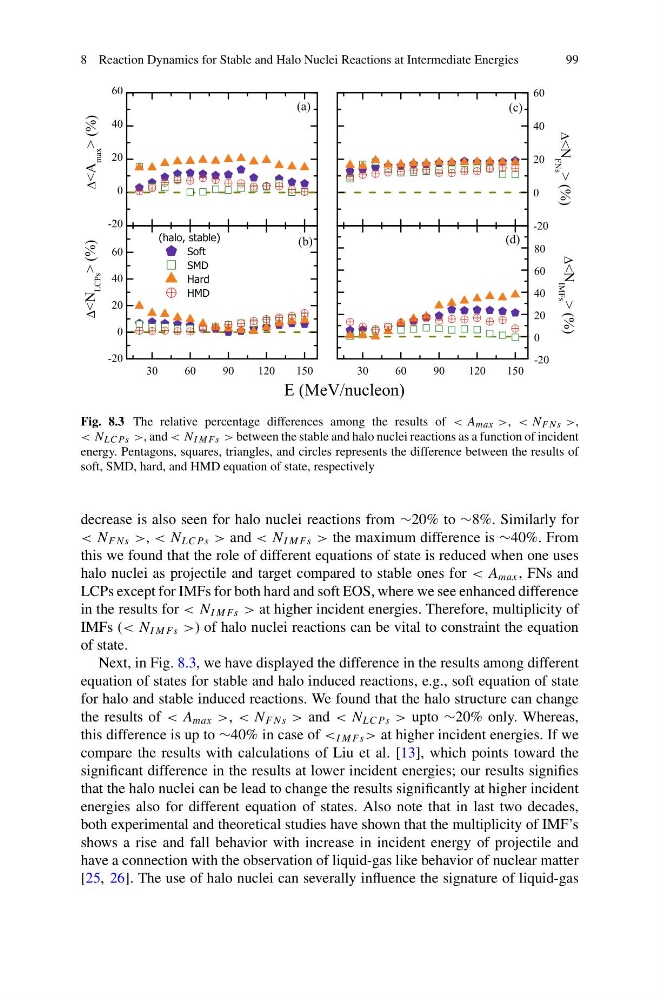
Fig. 8.3 The relative percentage differences among the results of < A max >, < N F Ns >,
< N LC Ps >, and < N I M Fs > between the stable and halo nuclei reactions as a function of incident
energy. Pentagons, squares, triangles, and circles represents the difference between the results of
soft, SMD, hard, and HMD equation of state, respectively
decrease is also seen for halo nuclei reactions from ∼20% to ∼8%. Similarly for
< N F Ns >, < N LC Ps > and < N I M Fs > the maximum difference is ∼40%. From
this we found that the role of different equations of state is reduced when one uses
halo nuclei as projectile and target compared to stable ones for < A max , FNs and
LCPs except for IMFs for both hard and soft EOS, where we see enhanced difference
in the results for < N I M Fs > at higher incident energies. Therefore, multiplicity of
IMFs (< N I M Fs >) of halo nuclei reactions can be vital to constraint the equation
of state.
Next, in Fig. 8.3, we have displayed the difference in the results among different
equation of states for stable and halo induced reactions, e.g., soft equation of state
for halo and stable induced reactions. We found that the halo structure can change
the results of < A max >, < N F Ns > and < N LC Ps > upto ∼20% only. Whereas,
this difference is up to ∼40% in case of < I M Fs > at higher incident energies. If we
compare the results with calculations of Liu et al. [13], which points toward the
significant difference in the results at lower incident energies; our results signifies
that the halo nuclei can be lead to change the results significantly at higher incident
energies also for different equation of states. Also note that in last two decades,
both experimental and theoretical studies have shown that the multiplicity of IMF’s
shows a rise and fall behavior with increase in incident energy of projectile and
have a connection with the observation of liquid-gas like behavior of nuclear matter
[25, 26]. The use of halo nuclei can severally influence the signature of liquid-gas
99
Fig. 8.3 The relative percentage differences among the results of < A max >, < N F Ns >,
< N LC Ps >, and < N I M Fs > between the stable and halo nuclei reactions as a function of incident
energy. Pentagons, squares, triangles, and circles represents the difference between the results of
soft, SMD, hard, and HMD equation of state, respectively
decrease is also seen for halo nuclei reactions from ∼20% to ∼8%. Similarly for
< N F Ns >, < N LC Ps > and < N I M Fs > the maximum difference is ∼40%. From
this we found that the role of different equations of state is reduced when one uses
halo nuclei as projectile and target compared to stable ones for < A max , FNs and
LCPs except for IMFs for both hard and soft EOS, where we see enhanced difference
in the results for < N I M Fs > at higher incident energies. Therefore, multiplicity of
IMFs (< N I M Fs >) of halo nuclei reactions can be vital to constraint the equation
of state.
Next, in Fig. 8.3, we have displayed the difference in the results among different
equation of states for stable and halo induced reactions, e.g., soft equation of state
for halo and stable induced reactions. We found that the halo structure can change
the results of < A max >, < N F Ns > and < N LC Ps > upto ∼20% only. Whereas,
this difference is up to ∼40% in case of < I M Fs > at higher incident energies. If we
compare the results with calculations of Liu et al. [13], which points toward the
significant difference in the results at lower incident energies; our results signifies
that the halo nuclei can be lead to change the results significantly at higher incident
energies also for different equation of states. Also note that in last two decades,
both experimental and theoretical studies have shown that the multiplicity of IMF’s
shows a rise and fall behavior with increase in incident energy of projectile and
have a connection with the observation of liquid-gas like behavior of nuclear matter
[25, 26]. The use of halo nuclei can severally influence the signature of liquid-gas