

98
Sucheta et al.
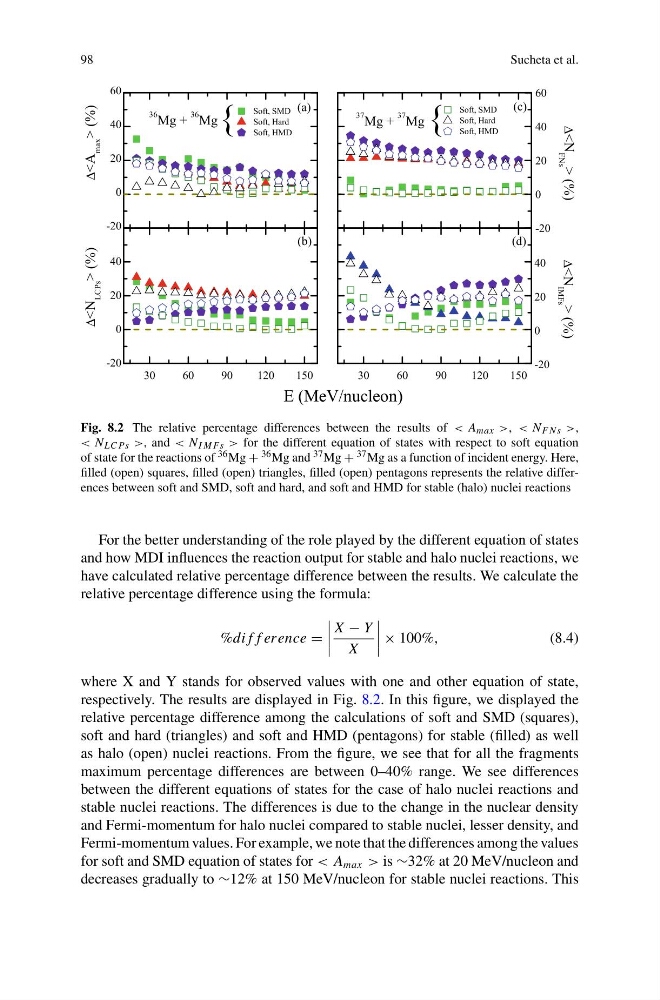
Fig. 8.2 The relative percentage differences between the results of < A max >, < N F Ns >,
< N LC Ps >, and < N I M Fs > for the different equation of states with respect to soft equation
of state for the reactions of 36 Mg + 36 Mg and 37 Mg + 37 Mg as a function of incident energy. Here,
filled (open) squares, filled (open) triangles, filled (open) pentagons represents the relative differences between soft and SMD, soft and hard, and soft and HMD for stable (halo) nuclei reactions
For the better understanding of the role played by the different equation of states
and how MDI influences the reaction output for stable and halo nuclei reactions, we
have calculated relative percentage difference between the results. We calculate the
relative percentage difference using the formula:
%di f f erence =
X − Y
X
× 100%,
(8.4)
where X and Y stands for observed values with one and other equation of state,
respectively. The results are displayed in Fig. 8.2. In this figure, we displayed the
relative percentage difference among the calculations of soft and SMD (squares),
soft and hard (triangles) and soft and HMD (pentagons) for stable (filled) as well
as halo (open) nuclei reactions. From the figure, we see that for all the fragments
maximum percentage differences are between 0–40% range. We see differences
between the different equations of states for the case of halo nuclei reactions and
stable nuclei reactions. The differences is due to the change in the nuclear density
and Fermi-momentum for halo nuclei compared to stable nuclei, lesser density, and
Fermi-momentum values. For example, we note that the differences among the values
for soft and SMD equation of states for < A max > is ∼32% at 20 MeV/nucleon and
decreases gradually to ∼12% at 150 MeV/nucleon for stable nuclei reactions. This
Sucheta et al.
Fig. 8.2 The relative percentage differences between the results of < A max >, < N F Ns >,
< N LC Ps >, and < N I M Fs > for the different equation of states with respect to soft equation
of state for the reactions of 36 Mg + 36 Mg and 37 Mg + 37 Mg as a function of incident energy. Here,
filled (open) squares, filled (open) triangles, filled (open) pentagons represents the relative differences between soft and SMD, soft and hard, and soft and HMD for stable (halo) nuclei reactions
For the better understanding of the role played by the different equation of states
and how MDI influences the reaction output for stable and halo nuclei reactions, we
have calculated relative percentage difference between the results. We calculate the
relative percentage difference using the formula:
%di f f erence =
X − Y
X
× 100%,
(8.4)
where X and Y stands for observed values with one and other equation of state,
respectively. The results are displayed in Fig. 8.2. In this figure, we displayed the
relative percentage difference among the calculations of soft and SMD (squares),
soft and hard (triangles) and soft and HMD (pentagons) for stable (filled) as well
as halo (open) nuclei reactions. From the figure, we see that for all the fragments
maximum percentage differences are between 0–40% range. We see differences
between the different equations of states for the case of halo nuclei reactions and
stable nuclei reactions. The differences is due to the change in the nuclear density
and Fermi-momentum for halo nuclei compared to stable nuclei, lesser density, and
Fermi-momentum values. For example, we note that the differences among the values
for soft and SMD equation of states for < A max > is ∼32% at 20 MeV/nucleon and
decreases gradually to ∼12% at 150 MeV/nucleon for stable nuclei reactions. This