

8 Reaction Dynamics for Stable and Halo Nuclei Reactions at Intermediate Energies
97
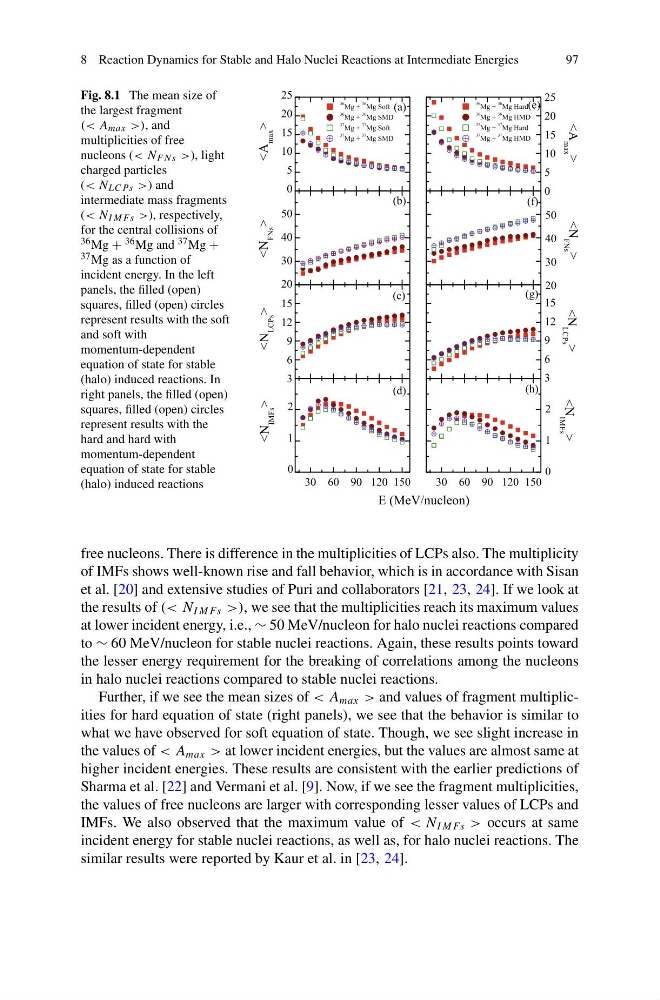
Fig. 8.1 The mean size of
the largest fragment
(< A max >), and
multiplicities of free
nucleons (< N F Ns >), light
charged particles
(< N LC Ps >) and
intermediate mass fragments
(< N I M Fs >), respectively,
for the central collisions of
36 Mg + 36 Mg and 37 Mg +
37 Mg as a function of
incident energy. In the left
panels, the filled (open)
squares, filled (open) circles
represent results with the soft
and soft with
momentum-dependent
equation of state for stable
(halo) induced reactions. In
right panels, the filled (open)
squares, filled (open) circles
represent results with the
hard and hard with
momentum-dependent
equation of state for stable
(halo) induced reactions
free nucleons. There is difference in the multiplicities of LCPs also. The multiplicity
of IMFs shows well-known rise and fall behavior, which is in accordance with Sisan
et al. [20] and extensive studies of Puri and collaborators [21, 23, 24]. If we look at
the results of (< N I M Fs >), we see that the multiplicities reach its maximum values
at lower incident energy, i.e., ∼ 50 MeV/nucleon for halo nuclei reactions compared
to ∼ 60 MeV/nucleon for stable nuclei reactions. Again, these results points toward
the lesser energy requirement for the breaking of correlations among the nucleons
in halo nuclei reactions compared to stable nuclei reactions.
Further, if we see the mean sizes of < A max > and values of fragment multiplicities for hard equation of state (right panels), we see that the behavior is similar to
what we have observed for soft equation of state. Though, we see slight increase in
the values of < A max > at lower incident energies, but the values are almost same at
higher incident energies. These results are consistent with the earlier predictions of
Sharma et al. [22] and Vermani et al. [9]. Now, if we see the fragment multiplicities,
the values of free nucleons are larger with corresponding lesser values of LCPs and
IMFs. We also observed that the maximum value of < N I M Fs > occurs at same
incident energy for stable nuclei reactions, as well as, for halo nuclei reactions. The
similar results were reported by Kaur et al. in [23, 24].
97
Fig. 8.1 The mean size of
the largest fragment
(< A max >), and
multiplicities of free
nucleons (< N F Ns >), light
charged particles
(< N LC Ps >) and
intermediate mass fragments
(< N I M Fs >), respectively,
for the central collisions of
36 Mg + 36 Mg and 37 Mg +
37 Mg as a function of
incident energy. In the left
panels, the filled (open)
squares, filled (open) circles
represent results with the soft
and soft with
momentum-dependent
equation of state for stable
(halo) induced reactions. In
right panels, the filled (open)
squares, filled (open) circles
represent results with the
hard and hard with
momentum-dependent
equation of state for stable
(halo) induced reactions
free nucleons. There is difference in the multiplicities of LCPs also. The multiplicity
of IMFs shows well-known rise and fall behavior, which is in accordance with Sisan
et al. [20] and extensive studies of Puri and collaborators [21, 23, 24]. If we look at
the results of (< N I M Fs >), we see that the multiplicities reach its maximum values
at lower incident energy, i.e., ∼ 50 MeV/nucleon for halo nuclei reactions compared
to ∼ 60 MeV/nucleon for stable nuclei reactions. Again, these results points toward
the lesser energy requirement for the breaking of correlations among the nucleons
in halo nuclei reactions compared to stable nuclei reactions.
Further, if we see the mean sizes of < A max > and values of fragment multiplicities for hard equation of state (right panels), we see that the behavior is similar to
what we have observed for soft equation of state. Though, we see slight increase in
the values of < A max > at lower incident energies, but the values are almost same at
higher incident energies. These results are consistent with the earlier predictions of
Sharma et al. [22] and Vermani et al. [9]. Now, if we see the fragment multiplicities,
the values of free nucleons are larger with corresponding lesser values of LCPs and
IMFs. We also observed that the maximum value of < N I M Fs > occurs at same
incident energy for stable nuclei reactions, as well as, for halo nuclei reactions. The
similar results were reported by Kaur et al. in [23, 24].