

96
Sucheta et al.
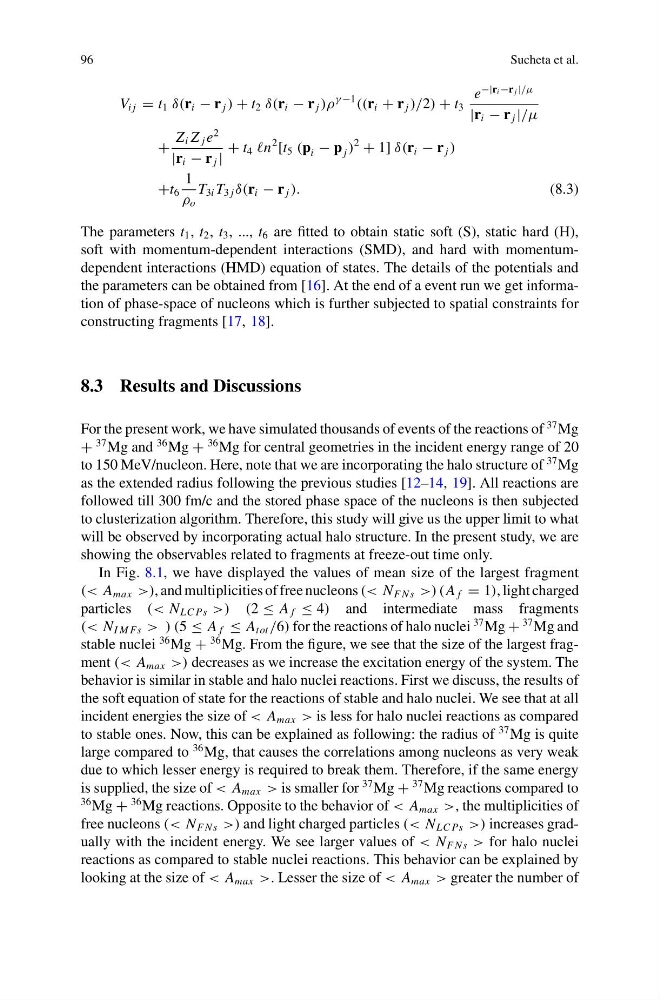
V i j = t 1 δ(r i − r j ) + t 2 δ(r i − r j )ρ
γ −1
((r i + r j )/2) + t 3
e
−|r i −r j |/μ
|r i − r j |/μ
+
Z i Z j e
2
|r i − r j |
+ t 4 n
2
[t 5 (p i − p j )
2
+ 1] δ(r i − r j )
+t 6
1
ρ o
T 3i T 3 j δ(r i − r j ).
(8.3)
The parameters t 1 , t 2 , t 3 , ..., t 6 are fitted to obtain static soft (S), static hard (H),
soft with momentum-dependent interactions (SMD), and hard with momentumdependent interactions (HMD) equation of states. The details of the potentials and
the parameters can be obtained from [16]. At the end of a event run we get information of phase-space of nucleons which is further subjected to spatial constraints for
constructing fragments [17, 18].
8.3 Results and Discussions
For the present work, we have simulated thousands of events of the reactions of
37 Mg
+
37 Mg and
36 Mg +
36 Mg for central geometries in the incident energy range of 20
to 150 MeV/nucleon. Here, note that we are incorporating the halo structure of
37 Mg
as the extended radius following the previous studies [12–14, 19]. All reactions are
followed till 300 fm/c and the stored phase space of the nucleons is then subjected
to clusterization algorithm. Therefore, this study will give us the upper limit to what
will be observed by incorporating actual halo structure. In the present study, we are
showing the observables related to fragments at freeze-out time only.
In Fig. 8.1, we have displayed the values of mean size of the largest fragment
(< A max >), and multiplicities of free nucleons (< N F Ns >) (A f = 1), light charged
particles (< N LC Ps >) (2 ≤ A f ≤ 4) and intermediate mass fragments
(< N I M Fs > ) (5 ≤ A f ≤ A tot /6) for the reactions of halo nuclei
37 Mg +
37 Mg and
stable nuclei
36 Mg +
36 Mg. From the figure, we see that the size of the largest fragment (< A max >) decreases as we increase the excitation energy of the system. The
behavior is similar in stable and halo nuclei reactions. First we discuss, the results of
the soft equation of state for the reactions of stable and halo nuclei. We see that at all
incident energies the size of < A max > is less for halo nuclei reactions as compared
to stable ones. Now, this can be explained as following: the radius of
37 Mg is quite
large compared to
36 Mg, that causes the correlations among nucleons as very weak
due to which lesser energy is required to break them. Therefore, if the same energy
is supplied, the size of < A max > is smaller for
37 Mg +
37 Mg reactions compared to
36 Mg +
36 Mg reactions. Opposite to the behavior of < A max >, the multiplicities of
free nucleons (< N F Ns >) and light charged particles (< N LC Ps >) increases gradually with the incident energy. We see larger values of < N F Ns > for halo nuclei
reactions as compared to stable nuclei reactions. This behavior can be explained by
looking at the size of < A max >. Lesser the size of < A max > greater the number of
Sucheta et al.
V i j = t 1 δ(r i − r j ) + t 2 δ(r i − r j )ρ
γ −1
((r i + r j )/2) + t 3
e
−|r i −r j |/μ
|r i − r j |/μ
+
Z i Z j e
2
|r i − r j |
+ t 4 n
2
[t 5 (p i − p j )
2
+ 1] δ(r i − r j )
+t 6
1
ρ o
T 3i T 3 j δ(r i − r j ).
(8.3)
The parameters t 1 , t 2 , t 3 , ..., t 6 are fitted to obtain static soft (S), static hard (H),
soft with momentum-dependent interactions (SMD), and hard with momentumdependent interactions (HMD) equation of states. The details of the potentials and
the parameters can be obtained from [16]. At the end of a event run we get information of phase-space of nucleons which is further subjected to spatial constraints for
constructing fragments [17, 18].
8.3 Results and Discussions
For the present work, we have simulated thousands of events of the reactions of
37 Mg
+
37 Mg and
36 Mg +
36 Mg for central geometries in the incident energy range of 20
to 150 MeV/nucleon. Here, note that we are incorporating the halo structure of
37 Mg
as the extended radius following the previous studies [12–14, 19]. All reactions are
followed till 300 fm/c and the stored phase space of the nucleons is then subjected
to clusterization algorithm. Therefore, this study will give us the upper limit to what
will be observed by incorporating actual halo structure. In the present study, we are
showing the observables related to fragments at freeze-out time only.
In Fig. 8.1, we have displayed the values of mean size of the largest fragment
(< A max >), and multiplicities of free nucleons (< N F Ns >) (A f = 1), light charged
particles (< N LC Ps >) (2 ≤ A f ≤ 4) and intermediate mass fragments
(< N I M Fs > ) (5 ≤ A f ≤ A tot /6) for the reactions of halo nuclei
37 Mg +
37 Mg and
stable nuclei
36 Mg +
36 Mg. From the figure, we see that the size of the largest fragment (< A max >) decreases as we increase the excitation energy of the system. The
behavior is similar in stable and halo nuclei reactions. First we discuss, the results of
the soft equation of state for the reactions of stable and halo nuclei. We see that at all
incident energies the size of < A max > is less for halo nuclei reactions as compared
to stable ones. Now, this can be explained as following: the radius of
37 Mg is quite
large compared to
36 Mg, that causes the correlations among nucleons as very weak
due to which lesser energy is required to break them. Therefore, if the same energy
is supplied, the size of < A max > is smaller for
37 Mg +
37 Mg reactions compared to
36 Mg +
36 Mg reactions. Opposite to the behavior of < A max >, the multiplicities of
free nucleons (< N F Ns >) and light charged particles (< N LC Ps >) increases gradually with the incident energy. We see larger values of < N F Ns > for halo nuclei
reactions as compared to stable nuclei reactions. This behavior can be explained by
looking at the size of < A max >. Lesser the size of < A max > greater the number of