

8 Reaction Dynamics for Stable and Halo Nuclei Reactions at Intermediate Energies
95
the various properties of
37 Mg were examined from extended density distribution.
The above-cited studies presented that the halo nuclei reactions can be very rich
source of information for the understanding of nuclear matter properties.
Using isospin-dependent quantum molecular dynamics (IQMD) model, we carry
out the calculations by comparing the reactions of halo nuclei
37 Mg +
37 Mg and
stable nuclei
36 Mg +
36 Mg. It is indicated in the experimental measurement that
there exists a neutron halo structure in
37 Mg [15]. In the present study, we plan
to look for enhancement or reduction of fragmentation toward different equation
of states. The obtained behavior will also be compared with the nearly mass stable
nuclei reactions for better understanding. Note that, though the previous studies have
investigated the different equation of states for stable nuclei reactions but none study
reported for halo nuclei induced reactions. The chapter is structured as following: In
Sect. 8.2, we will present the details of the IQMD model. Section 8.3 is dedicated to
results and discussion followed by the conclusions in Sect. 8.4.
8.2 Isospin-Dependent Quantum Molecular Dynamics
(IQMD) Model
The isospin-dependent quantum molecular dynamics (IQMD) model [16] is an
n-body model which follows heavy-ion reactions on nucleonic level. This model
generates the information of the reaction in the form of phase-space information of
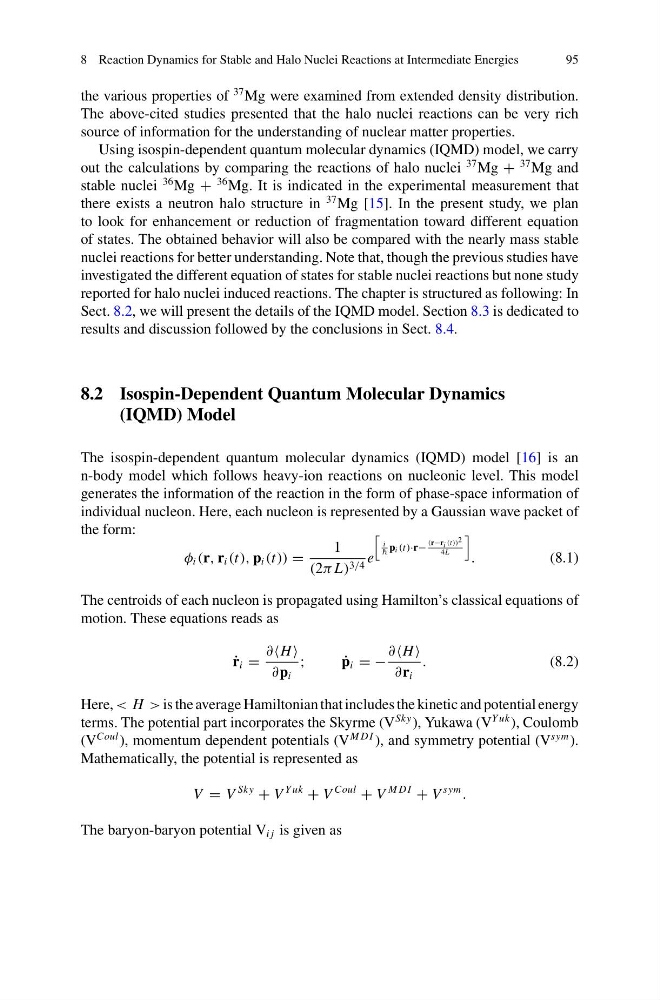
individual nucleon. Here, each nucleon is represented by a Gaussian wave packet of
the form:
φ i (r, r i (t), p i (t)) =
1
(2π L) 3/4 e
i
p i (t)·r−
(r−r i (t)) 2
4L
.
(8.1)
The centroids of each nucleon is propagated using Hamilton’s classical equations of
motion. These equations reads as
˙
r i =
∂H
∂p i
;
˙
p i = −
∂H
∂r i
.
(8.2)
Here, < H > is the average Hamiltonian that includes the kinetic and potential energy
terms. The potential part incorporates the Skyrme (V
Sky ), Yukawa (V
Y uk ), Coulomb
(V
Coul ), momentum dependent potentials (V
M DI ), and symmetry potential (V
sym ).
Mathematically, the potential is represented as
V = V
Sky
+ V
Y uk
+ V
Coul
+ V
M DI
+ V
sym
.
The baryon-baryon potential V i j is given as
95
the various properties of
37 Mg were examined from extended density distribution.
The above-cited studies presented that the halo nuclei reactions can be very rich
source of information for the understanding of nuclear matter properties.
Using isospin-dependent quantum molecular dynamics (IQMD) model, we carry
out the calculations by comparing the reactions of halo nuclei
37 Mg +
37 Mg and
stable nuclei
36 Mg +
36 Mg. It is indicated in the experimental measurement that
there exists a neutron halo structure in
37 Mg [15]. In the present study, we plan
to look for enhancement or reduction of fragmentation toward different equation
of states. The obtained behavior will also be compared with the nearly mass stable
nuclei reactions for better understanding. Note that, though the previous studies have
investigated the different equation of states for stable nuclei reactions but none study
reported for halo nuclei induced reactions. The chapter is structured as following: In
Sect. 8.2, we will present the details of the IQMD model. Section 8.3 is dedicated to
results and discussion followed by the conclusions in Sect. 8.4.
8.2 Isospin-Dependent Quantum Molecular Dynamics
(IQMD) Model
The isospin-dependent quantum molecular dynamics (IQMD) model [16] is an
n-body model which follows heavy-ion reactions on nucleonic level. This model
generates the information of the reaction in the form of phase-space information of
individual nucleon. Here, each nucleon is represented by a Gaussian wave packet of
the form:
φ i (r, r i (t), p i (t)) =
1
(2π L) 3/4 e
i
p i (t)·r−
(r−r i (t)) 2
4L
.
(8.1)
The centroids of each nucleon is propagated using Hamilton’s classical equations of
motion. These equations reads as
˙
r i =
∂H
∂p i
;
˙
p i = −
∂H
∂r i
.
(8.2)
Here, < H > is the average Hamiltonian that includes the kinetic and potential energy
terms. The potential part incorporates the Skyrme (V
Sky ), Yukawa (V
Y uk ), Coulomb
(V
Coul ), momentum dependent potentials (V
M DI ), and symmetry potential (V
sym ).
Mathematically, the potential is represented as
V = V
Sky
+ V
Y uk
+ V
Coul
+ V
M DI
+ V
sym
.
The baryon-baryon potential V i j is given as