

544
16 Scientific Instrument Technology of Lunar Lander
16.5.4 Calibration and Special Testing of EUV Camera
1. Tests
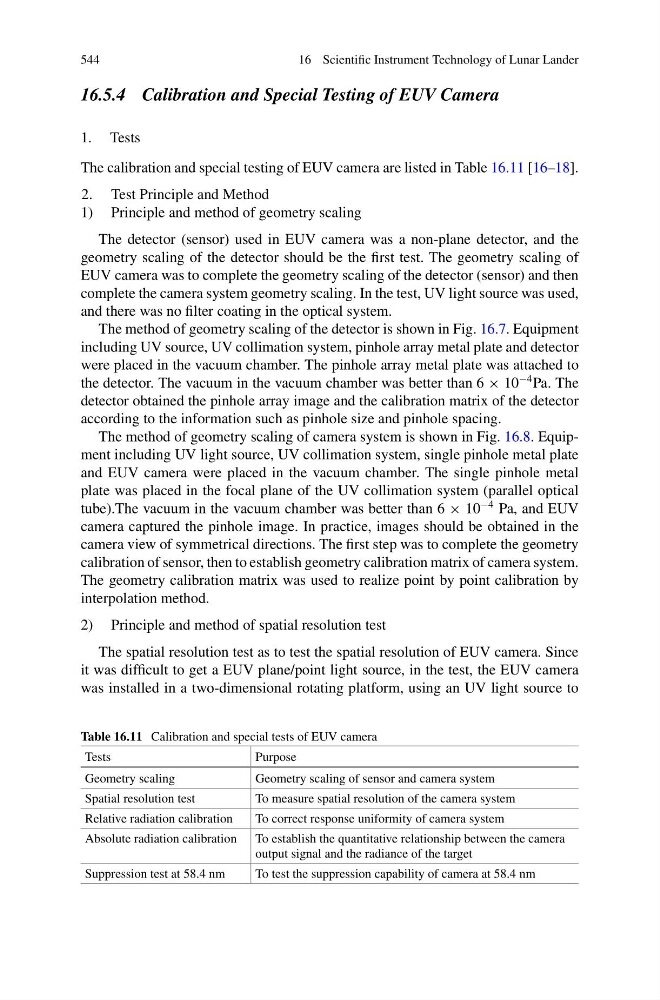
The calibration and special testing of EUV camera are listed in Table 16.11 [16–18].
2. Test Principle and Method
1) Principle and method of geometry scaling
The detector (sensor) used in EUV camera was a non-plane detector, and the
geometry scaling of the detector should be the first test. The geometry scaling of
EUV camera was to complete the geometry scaling of the detector (sensor) and then
complete the camera system geometry scaling. In the test, UV light source was used,
and there was no filter coating in the optical system.
The method of geometry scaling of the detector is shown in Fig. 16.7. Equipment
including UV source, UV collimation system, pinhole array metal plate and detector
were placed in the vacuum chamber. The pinhole array metal plate was attached to
the detector. The vacuum in the vacuum chamber was better than 6 × 10
−4 Pa. The
detector obtained the pinhole array image and the calibration matrix of the detector
according to the information such as pinhole size and pinhole spacing.
The method of geometry scaling of camera system is shown in Fig. 16.8. Equipment including UV light source, UV collimation system, single pinhole metal plate
and EUV camera were placed in the vacuum chamber. The single pinhole metal
plate was placed in the focal plane of the UV collimation system (parallel optical
tube).The vacuum in the vacuum chamber was better than 6 × 10
−4 Pa, and EUV
camera captured the pinhole image. In practice, images should be obtained in the
camera view of symmetrical directions. The first step was to complete the geometry
calibration of sensor, then to establish geometry calibration matrix of camera system.
The geometry calibration matrix was used to realize point by point calibration by
interpolation method.
2) Principle and method of spatial resolution test
The spatial resolution test as to test the spatial resolution of EUV camera. Since
it was difficult to get a EUV plane/point light source, in the test, the EUV camera
was installed in a two-dimensional rotating platform, using an UV light source to
Table 16.11 Calibration and special tests of EUV camera
Tests
Purpose
Geometry scaling
Geometry scaling of sensor and camera system
Spatial resolution test
To measure spatial resolution of the camera system
Relative radiation calibration
To correct response uniformity of camera system
Absolute radiation calibration To establish the quantitative relationship between the camera
output signal and the radiance of the target
Suppression test at 58.4 nm
To test the suppression capability of camera at 58.4 nm
16 Scientific Instrument Technology of Lunar Lander
16.5.4 Calibration and Special Testing of EUV Camera
1. Tests
The calibration and special testing of EUV camera are listed in Table 16.11 [16–18].
2. Test Principle and Method
1) Principle and method of geometry scaling
The detector (sensor) used in EUV camera was a non-plane detector, and the
geometry scaling of the detector should be the first test. The geometry scaling of
EUV camera was to complete the geometry scaling of the detector (sensor) and then
complete the camera system geometry scaling. In the test, UV light source was used,
and there was no filter coating in the optical system.
The method of geometry scaling of the detector is shown in Fig. 16.7. Equipment
including UV source, UV collimation system, pinhole array metal plate and detector
were placed in the vacuum chamber. The pinhole array metal plate was attached to
the detector. The vacuum in the vacuum chamber was better than 6 × 10
−4 Pa. The
detector obtained the pinhole array image and the calibration matrix of the detector
according to the information such as pinhole size and pinhole spacing.
The method of geometry scaling of camera system is shown in Fig. 16.8. Equipment including UV light source, UV collimation system, single pinhole metal plate
and EUV camera were placed in the vacuum chamber. The single pinhole metal
plate was placed in the focal plane of the UV collimation system (parallel optical
tube).The vacuum in the vacuum chamber was better than 6 × 10
−4 Pa, and EUV
camera captured the pinhole image. In practice, images should be obtained in the
camera view of symmetrical directions. The first step was to complete the geometry
calibration of sensor, then to establish geometry calibration matrix of camera system.
The geometry calibration matrix was used to realize point by point calibration by
interpolation method.
2) Principle and method of spatial resolution test
The spatial resolution test as to test the spatial resolution of EUV camera. Since
it was difficult to get a EUV plane/point light source, in the test, the EUV camera
was installed in a two-dimensional rotating platform, using an UV light source to
Table 16.11 Calibration and special tests of EUV camera
Tests
Purpose
Geometry scaling
Geometry scaling of sensor and camera system
Spatial resolution test
To measure spatial resolution of the camera system
Relative radiation calibration
To correct response uniformity of camera system
Absolute radiation calibration To establish the quantitative relationship between the camera
output signal and the radiance of the target
Suppression test at 58.4 nm
To test the suppression capability of camera at 58.4 nm