

536
16 Scientific Instrument Technology of Lunar Lander
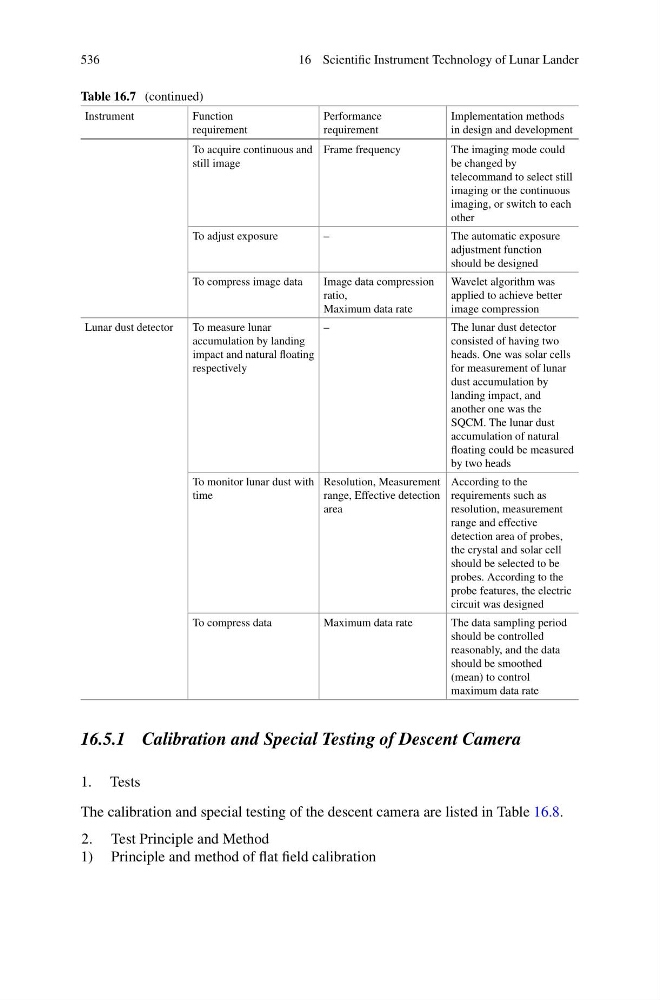
Table 16.7 (continued)
Instrument
Function
requirement
Performance
requirement
Implementation methods
in design and development
To acquire continuous and
still image
Frame frequency
The imaging mode could
be changed by
telecommand to select still
imaging or the continuous
imaging, or switch to each
other
To adjust exposure
–
The automatic exposure
adjustment function
should be designed
To compress image data
Image data compression
ratio,
Maximum data rate
Wavelet algorithm was
applied to achieve better
image compression
Lunar dust detector
To measure lunar
accumulation by landing
impact and natural floating
respectively
–
The lunar dust detector
consisted of having two
heads. One was solar cells
for measurement of lunar
dust accumulation by
landing impact, and
another one was the
SQCM. The lunar dust
accumulation of natural
floating could be measured
by two heads
To monitor lunar dust with
time
Resolution, Measurement
range, Effective detection
area
According to the
requirements such as
resolution, measurement
range and effective
detection area of probes,
the crystal and solar cell
should be selected to be
probes. According to the
probe features, the electric
circuit was designed
To compress data
Maximum data rate
The data sampling period
should be controlled
reasonably, and the data
should be smoothed
(mean) to control
maximum data rate
16.5.1 Calibration and Special Testing of Descent Camera
1. Tests
The calibration and special testing of the descent camera are listed in Table 16.8.
2. Test Principle and Method
1) Principle and method of flat field calibration
16 Scientific Instrument Technology of Lunar Lander
Table 16.7 (continued)
Instrument
Function
requirement
Performance
requirement
Implementation methods
in design and development
To acquire continuous and
still image
Frame frequency
The imaging mode could
be changed by
telecommand to select still
imaging or the continuous
imaging, or switch to each
other
To adjust exposure
–
The automatic exposure
adjustment function
should be designed
To compress image data
Image data compression
ratio,
Maximum data rate
Wavelet algorithm was
applied to achieve better
image compression
Lunar dust detector
To measure lunar
accumulation by landing
impact and natural floating
respectively
–
The lunar dust detector
consisted of having two
heads. One was solar cells
for measurement of lunar
dust accumulation by
landing impact, and
another one was the
SQCM. The lunar dust
accumulation of natural
floating could be measured
by two heads
To monitor lunar dust with
time
Resolution, Measurement
range, Effective detection
area
According to the
requirements such as
resolution, measurement
range and effective
detection area of probes,
the crystal and solar cell
should be selected to be
probes. According to the
probe features, the electric
circuit was designed
To compress data
Maximum data rate
The data sampling period
should be controlled
reasonably, and the data
should be smoothed
(mean) to control
maximum data rate
16.5.1 Calibration and Special Testing of Descent Camera
1. Tests
The calibration and special testing of the descent camera are listed in Table 16.8.
2. Test Principle and Method
1) Principle and method of flat field calibration