

16.5 Calibration and Special Testing
535
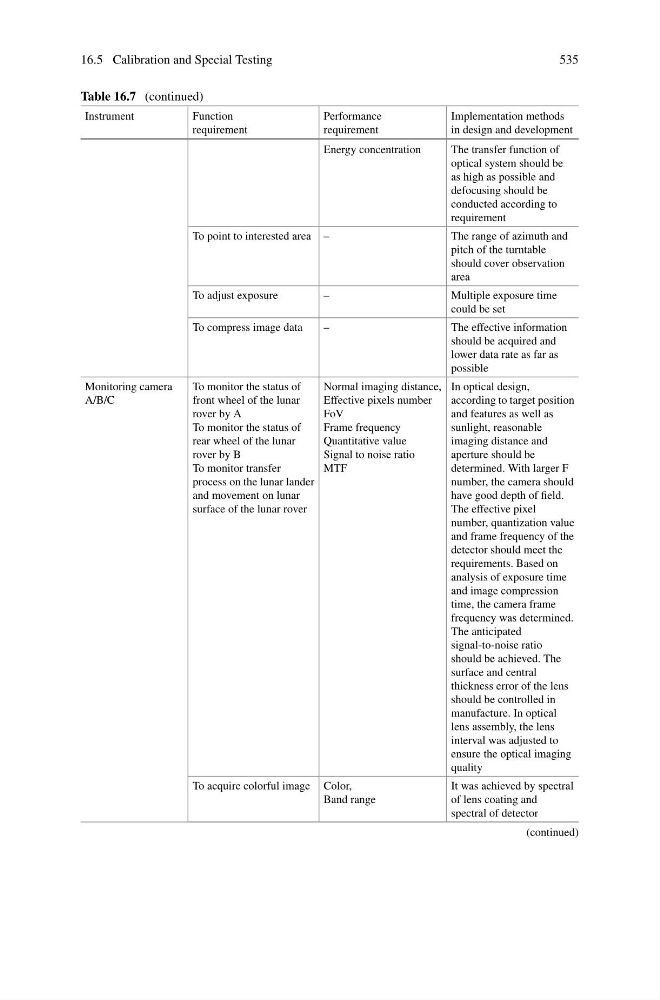
Table 16.7 (continued)
Instrument
Function
requirement
Performance
requirement
Implementation methods
in design and development
Energy concentration
The transfer function of
optical system should be
as high as possible and
defocusing should be
conducted according to
requirement
To point to interested area –
The range of azimuth and
pitch of the turntable
should cover observation
area
To adjust exposure
–
Multiple exposure time
could be set
To compress image data
–
The effective information
should be acquired and
lower data rate as far as
possible
Monitoring camera
A/B/C
To monitor the status of
front wheel of the lunar
rover by A
To monitor the status of
rear wheel of the lunar
rover by B
To monitor transfer
process on the lunar lander
and movement on lunar
surface of the lunar rover
Normal imaging distance,
Effective pixels number
FoV
Frame frequency
Quantitative value
Signal to noise ratio
MTF
In optical design,
according to target position
and features as well as
sunlight, reasonable
imaging distance and
aperture should be
determined. With larger F
number, the camera should
have good depth of field.
The effective pixel
number, quantization value
and frame frequency of the
detector should meet the
requirements. Based on
analysis of exposure time
and image compression
time, the camera frame
frequency was determined.
The anticipated
signal-to-noise ratio
should be achieved. The
surface and central
thickness error of the lens
should be controlled in
manufacture. In optical
lens assembly, the lens
interval was adjusted to
ensure the optical imaging
quality
To acquire colorful image Color,
Band range
It was achieved by spectral
of lens coating and
spectral of detector
(continued)
535
Table 16.7 (continued)
Instrument
Function
requirement
Performance
requirement
Implementation methods
in design and development
Energy concentration
The transfer function of
optical system should be
as high as possible and
defocusing should be
conducted according to
requirement
To point to interested area –
The range of azimuth and
pitch of the turntable
should cover observation
area
To adjust exposure
–
Multiple exposure time
could be set
To compress image data
–
The effective information
should be acquired and
lower data rate as far as
possible
Monitoring camera
A/B/C
To monitor the status of
front wheel of the lunar
rover by A
To monitor the status of
rear wheel of the lunar
rover by B
To monitor transfer
process on the lunar lander
and movement on lunar
surface of the lunar rover
Normal imaging distance,
Effective pixels number
FoV
Frame frequency
Quantitative value
Signal to noise ratio
MTF
In optical design,
according to target position
and features as well as
sunlight, reasonable
imaging distance and
aperture should be
determined. With larger F
number, the camera should
have good depth of field.
The effective pixel
number, quantization value
and frame frequency of the
detector should meet the
requirements. Based on
analysis of exposure time
and image compression
time, the camera frame
frequency was determined.
The anticipated
signal-to-noise ratio
should be achieved. The
surface and central
thickness error of the lens
should be controlled in
manufacture. In optical
lens assembly, the lens
interval was adjusted to
ensure the optical imaging
quality
To acquire colorful image Color,
Band range
It was achieved by spectral
of lens coating and
spectral of detector
(continued)