

16.3 Requirements
525
16.3.3 Analysis of Target Feature
The descent camera was designed to take images for acquisition of lunar surface
information during powered descent, which could show terrain and geological feature
of lunar surface at landing site. The major target features included lunar surface
albedo and contrast, solar elevation and azimuth angle. The lunar morphology camera
was mounted on a mast with two motion dimensions, which was able to take images to
survey lunar terrain. The major target features were the same as the descent camera.
The extreme ultraviolet (EUV) camera was on the top plate of the lunar lander,
which would conduct system and long term observation of radiation generated by
Earth plasmasphere in 30.4 nm wavelength. The major target features included Earth
plasma irradiation and background. The LUT would continuously observe brightness
change of celestial bodies in interested area. The major target features included stellar
spectrum, irradiation intensity, background noise and stray lights. Three monitoring
cameras would take images when the lunar rover was deployed. The major target
features included albedo of observed area, solar elevation and azimuth, and shadow.
The lunar dust detector would investigate lunar dust accumulation on lunar surface.
The major target feature was the accumulation of lunar dust with time.
According to the task characteristics, analysis of target features should cover
following aspects.
1. Albedo of Lunar Surface
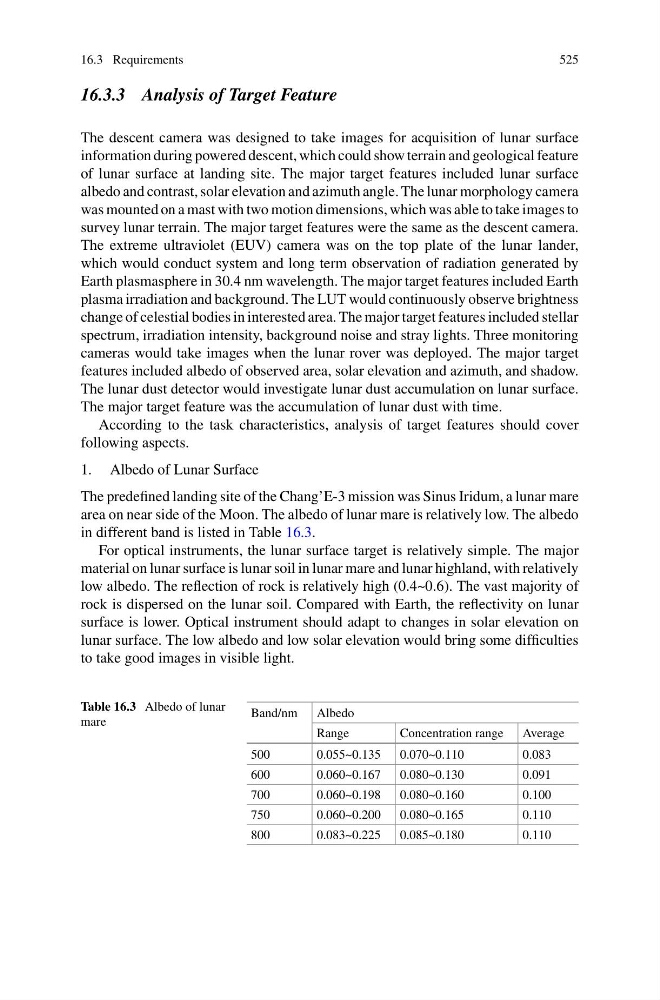
The predefined landing site of the Chang’E-3 mission was Sinus Iridum, a lunar mare
area on near side of the Moon. The albedo of lunar mare is relatively low. The albedo
in different band is listed in Table 16.3.
For optical instruments, the lunar surface target is relatively simple. The major
material on lunar surface is lunar soil in lunar mare and lunar highland, with relatively
low albedo. The reflection of rock is relatively high (0.4~0.6). The vast majority of
rock is dispersed on the lunar soil. Compared with Earth, the reflectivity on lunar
surface is lower. Optical instrument should adapt to changes in solar elevation on
lunar surface. The low albedo and low solar elevation would bring some difficulties
to take good images in visible light.
Table 16.3 Albedo of lunar
mare
Band/nm
Albedo
Range
Concentration range
Average
500
0.055~0.135
0.070~0.110
0.083
600
0.060~0.167
0.080~0.130
0.091
700
0.060~0.198
0.080~0.160
0.100
750
0.060~0.200
0.080~0.165
0.110
800
0.083~0.225
0.085~0.180
0.110
525
16.3.3 Analysis of Target Feature
The descent camera was designed to take images for acquisition of lunar surface
information during powered descent, which could show terrain and geological feature
of lunar surface at landing site. The major target features included lunar surface
albedo and contrast, solar elevation and azimuth angle. The lunar morphology camera
was mounted on a mast with two motion dimensions, which was able to take images to
survey lunar terrain. The major target features were the same as the descent camera.
The extreme ultraviolet (EUV) camera was on the top plate of the lunar lander,
which would conduct system and long term observation of radiation generated by
Earth plasmasphere in 30.4 nm wavelength. The major target features included Earth
plasma irradiation and background. The LUT would continuously observe brightness
change of celestial bodies in interested area. The major target features included stellar
spectrum, irradiation intensity, background noise and stray lights. Three monitoring
cameras would take images when the lunar rover was deployed. The major target
features included albedo of observed area, solar elevation and azimuth, and shadow.
The lunar dust detector would investigate lunar dust accumulation on lunar surface.
The major target feature was the accumulation of lunar dust with time.
According to the task characteristics, analysis of target features should cover
following aspects.
1. Albedo of Lunar Surface
The predefined landing site of the Chang’E-3 mission was Sinus Iridum, a lunar mare
area on near side of the Moon. The albedo of lunar mare is relatively low. The albedo
in different band is listed in Table 16.3.
For optical instruments, the lunar surface target is relatively simple. The major
material on lunar surface is lunar soil in lunar mare and lunar highland, with relatively
low albedo. The reflection of rock is relatively high (0.4~0.6). The vast majority of
rock is dispersed on the lunar soil. Compared with Earth, the reflectivity on lunar
surface is lower. Optical instrument should adapt to changes in solar elevation on
lunar surface. The low albedo and low solar elevation would bring some difficulties
to take good images in visible light.
Table 16.3 Albedo of lunar
mare
Band/nm
Albedo
Range
Concentration range
Average
500
0.055~0.135
0.070~0.110
0.083
600
0.060~0.167
0.080~0.130
0.091
700
0.060~0.198
0.080~0.160
0.100
750
0.060~0.200
0.080~0.165
0.110
800
0.083~0.225
0.085~0.180
0.110