

526
16 Scientific Instrument Technology of Lunar Lander
Compared with lunar highland, the contrast of lunar mare area is relatively low.
Therefore, the sensitivity of camera should be high enough, or the image quality
would be poor.
2. Solar Incident Angle
The light cycle is about 28 days on most area of lunar surface, i.e., there will be
continuous 14 days in lunar day, and the rest of the time in lunar night. The maximum
of solar incident angle (angle between sunlight and the normal of lunar surface) is
about 90°, and the minimum of solar incident angle is up to the local latitude. The
smaller the solar incident angle is, the more sufficient sunlight there is. The minimum
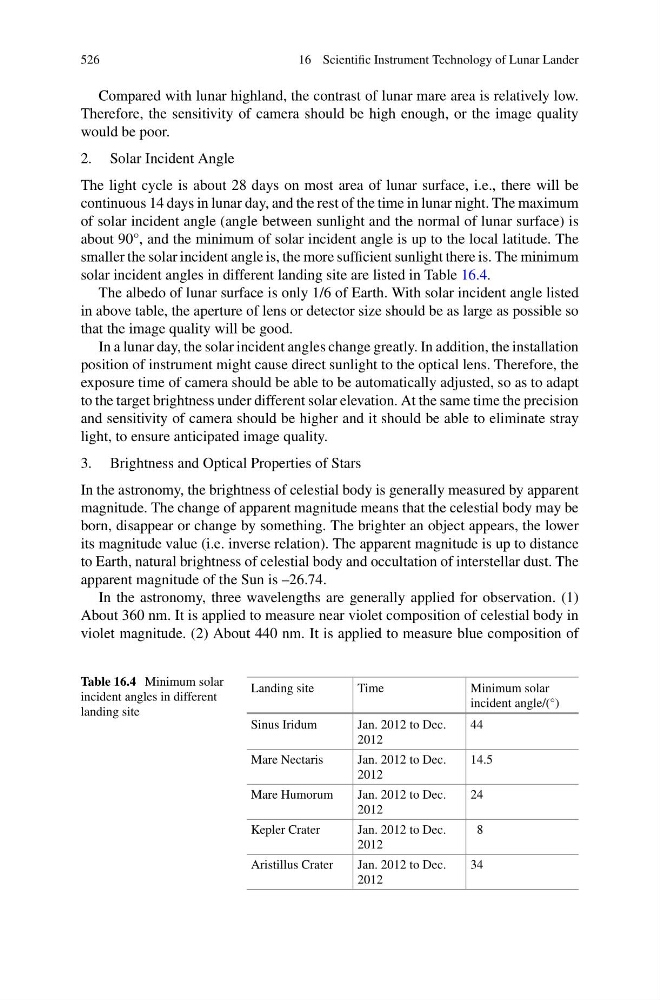
solar incident angles in different landing site are listed in Table 16.4.
The albedo of lunar surface is only 1/6 of Earth. With solar incident angle listed
in above table, the aperture of lens or detector size should be as large as possible so
that the image quality will be good.
In a lunar day, the solar incident angles change greatly. In addition, the installation
position of instrument might cause direct sunlight to the optical lens. Therefore, the
exposure time of camera should be able to be automatically adjusted, so as to adapt
to the target brightness under different solar elevation. At the same time the precision
and sensitivity of camera should be higher and it should be able to eliminate stray
light, to ensure anticipated image quality.
3. Brightness and Optical Properties of Stars
In the astronomy, the brightness of celestial body is generally measured by apparent
magnitude. The change of apparent magnitude means that the celestial body may be
born, disappear or change by something. The brighter an object appears, the lower
its magnitude value (i.e. inverse relation). The apparent magnitude is up to distance
to Earth, natural brightness of celestial body and occultation of interstellar dust. The
apparent magnitude of the Sun is –26.74.
In the astronomy, three wavelengths are generally applied for observation. (1)
About 360 nm. It is applied to measure near violet composition of celestial body in
violet magnitude. (2) About 440 nm. It is applied to measure blue composition of
Table 16.4 Minimum solar
incident angles in different
landing site
Landing site
Time
Minimum solar
incident angle/(°)
Sinus Iridum
Jan. 2012 to Dec.
2012
44
Mare Nectaris
Jan. 2012 to Dec.
2012
14.5
Mare Humorum
Jan. 2012 to Dec.
2012
24
Kepler Crater
Jan. 2012 to Dec.
2012
8
Aristillus Crater
Jan. 2012 to Dec.
2012
34
16 Scientific Instrument Technology of Lunar Lander
Compared with lunar highland, the contrast of lunar mare area is relatively low.
Therefore, the sensitivity of camera should be high enough, or the image quality
would be poor.
2. Solar Incident Angle
The light cycle is about 28 days on most area of lunar surface, i.e., there will be
continuous 14 days in lunar day, and the rest of the time in lunar night. The maximum
of solar incident angle (angle between sunlight and the normal of lunar surface) is
about 90°, and the minimum of solar incident angle is up to the local latitude. The
smaller the solar incident angle is, the more sufficient sunlight there is. The minimum
solar incident angles in different landing site are listed in Table 16.4.
The albedo of lunar surface is only 1/6 of Earth. With solar incident angle listed
in above table, the aperture of lens or detector size should be as large as possible so
that the image quality will be good.
In a lunar day, the solar incident angles change greatly. In addition, the installation
position of instrument might cause direct sunlight to the optical lens. Therefore, the
exposure time of camera should be able to be automatically adjusted, so as to adapt
to the target brightness under different solar elevation. At the same time the precision
and sensitivity of camera should be higher and it should be able to eliminate stray
light, to ensure anticipated image quality.
3. Brightness and Optical Properties of Stars
In the astronomy, the brightness of celestial body is generally measured by apparent
magnitude. The change of apparent magnitude means that the celestial body may be
born, disappear or change by something. The brighter an object appears, the lower
its magnitude value (i.e. inverse relation). The apparent magnitude is up to distance
to Earth, natural brightness of celestial body and occultation of interstellar dust. The
apparent magnitude of the Sun is –26.74.
In the astronomy, three wavelengths are generally applied for observation. (1)
About 360 nm. It is applied to measure near violet composition of celestial body in
violet magnitude. (2) About 440 nm. It is applied to measure blue composition of
Table 16.4 Minimum solar
incident angles in different
landing site
Landing site
Time
Minimum solar
incident angle/(°)
Sinus Iridum
Jan. 2012 to Dec.
2012
44
Mare Nectaris
Jan. 2012 to Dec.
2012
14.5
Mare Humorum
Jan. 2012 to Dec.
2012
24
Kepler Crater
Jan. 2012 to Dec.
2012
8
Aristillus Crater
Jan. 2012 to Dec.
2012
34