

486
15 System Testing and Validation Technology of Lunar Lander
15.2 Development Status
Before implementation of the Chang’E-3 mission, only the United States and the
Soviet Union had succeeded in lunar soft landing and conducted systematic test
and validation on the ground. Therefore, in this section, the system-level validation
test programs by the United States and the Soviet Union in lunar exploration are
introduced.
15.2.1 System Test Implemented in the United States
In the 1960s and 1970s, during development of Apollo lunar exploration program,
systematic and comprehensive ground test and validation for lunar landing mission
were conducted, including the Lunar Landing Research Facility (LLRF), the Lunar
Landing Research Vehicle (LLRV), landing stability test, landing impact test and
plume impact test.
1. LLRF
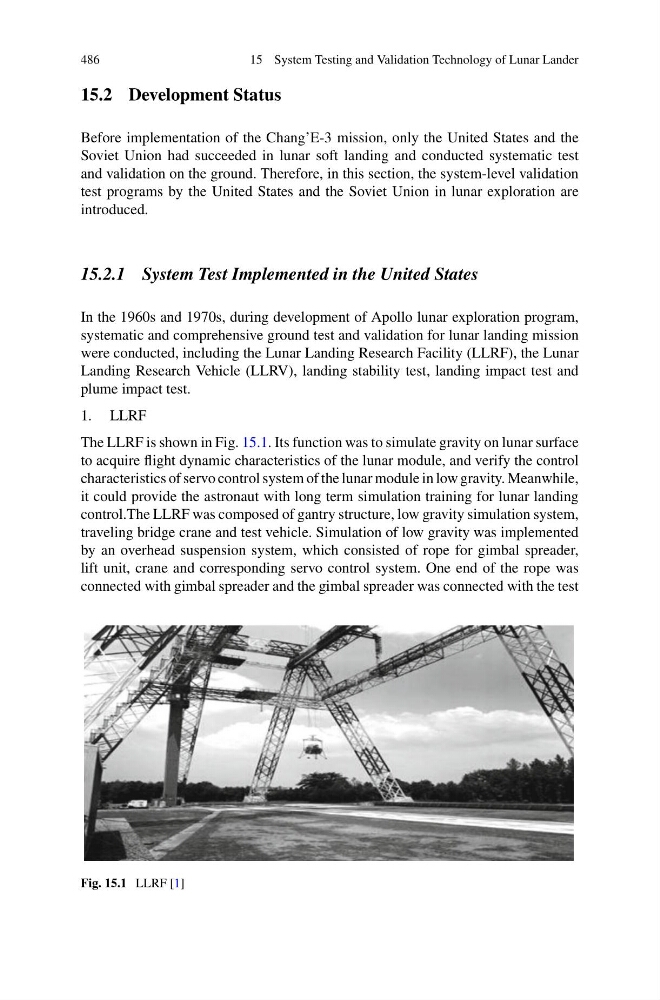
The LLRF is shown in Fig. 15.1. Its function was to simulate gravity on lunar surface
to acquire flight dynamic characteristics of the lunar module, and verify the control
characteristics of servo control system of the lunar module in low gravity. Meanwhile,
it could provide the astronaut with long term simulation training for lunar landing
control.The LLRF was composed of gantry structure, low gravity simulation system,
traveling bridge crane and test vehicle. Simulation of low gravity was implemented
by an overhead suspension system, which consisted of rope for gimbal spreader,
lift unit, crane and corresponding servo control system. One end of the rope was
connected with gimbal spreader and the gimbal spreader was connected with the test
Fig. 15.1 LLRF [1]
15 System Testing and Validation Technology of Lunar Lander
15.2 Development Status
Before implementation of the Chang’E-3 mission, only the United States and the
Soviet Union had succeeded in lunar soft landing and conducted systematic test
and validation on the ground. Therefore, in this section, the system-level validation
test programs by the United States and the Soviet Union in lunar exploration are
introduced.
15.2.1 System Test Implemented in the United States
In the 1960s and 1970s, during development of Apollo lunar exploration program,
systematic and comprehensive ground test and validation for lunar landing mission
were conducted, including the Lunar Landing Research Facility (LLRF), the Lunar
Landing Research Vehicle (LLRV), landing stability test, landing impact test and
plume impact test.
1. LLRF
The LLRF is shown in Fig. 15.1. Its function was to simulate gravity on lunar surface
to acquire flight dynamic characteristics of the lunar module, and verify the control
characteristics of servo control system of the lunar module in low gravity. Meanwhile,
it could provide the astronaut with long term simulation training for lunar landing
control.The LLRF was composed of gantry structure, low gravity simulation system,
traveling bridge crane and test vehicle. Simulation of low gravity was implemented
by an overhead suspension system, which consisted of rope for gimbal spreader,
lift unit, crane and corresponding servo control system. One end of the rope was
connected with gimbal spreader and the gimbal spreader was connected with the test
Fig. 15.1 LLRF [1]