

478
14 Electrical Testing Technology of Lunar Lander
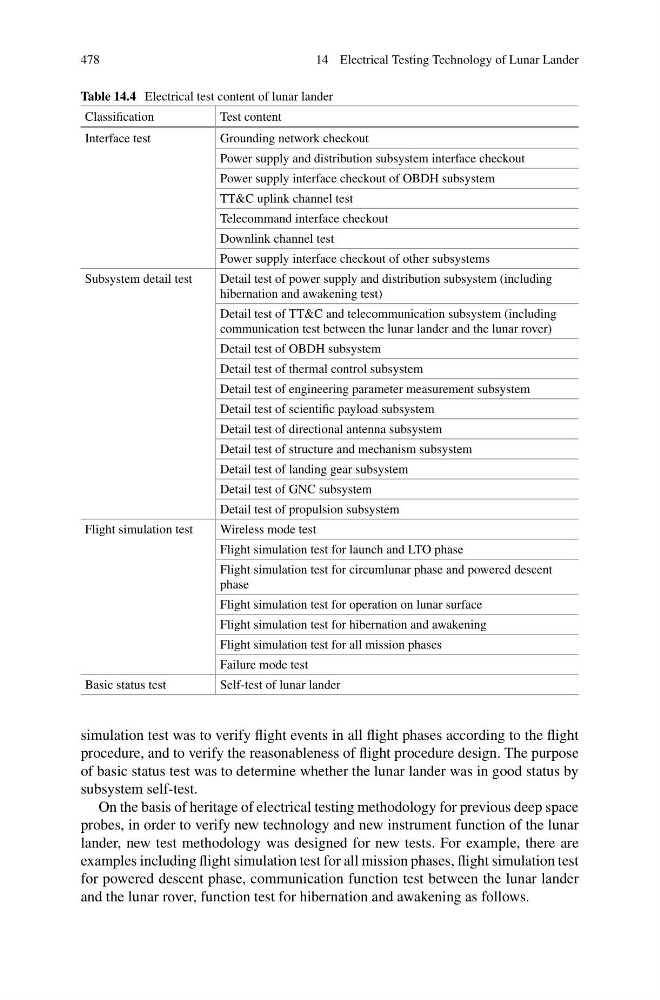
Table 14.4 Electrical test content of lunar lander
Classification
Test content
Interface test
Grounding network checkout
Power supply and distribution subsystem interface checkout
Power supply interface checkout of OBDH subsystem
TT&C uplink channel test
Telecommand interface checkout
Downlink channel test
Power supply interface checkout of other subsystems
Subsystem detail test
Detail test of power supply and distribution subsystem (including
hibernation and awakening test)
Detail test of TT&C and telecommunication subsystem (including
communication test between the lunar lander and the lunar rover)
Detail test of OBDH subsystem
Detail test of thermal control subsystem
Detail test of engineering parameter measurement subsystem
Detail test of scientific payload subsystem
Detail test of directional antenna subsystem
Detail test of structure and mechanism subsystem
Detail test of landing gear subsystem
Detail test of GNC subsystem
Detail test of propulsion subsystem
Flight simulation test
Wireless mode test
Flight simulation test for launch and LTO phase
Flight simulation test for circumlunar phase and powered descent
phase
Flight simulation test for operation on lunar surface
Flight simulation test for hibernation and awakening
Flight simulation test for all mission phases
Failure mode test
Basic status test
Self-test of lunar lander
simulation test was to verify flight events in all flight phases according to the flight
procedure, and to verify the reasonableness of flight procedure design. The purpose
of basic status test was to determine whether the lunar lander was in good status by
subsystem self-test.
On the basis of heritage of electrical testing methodology for previous deep space
probes, in order to verify new technology and new instrument function of the lunar
lander, new test methodology was designed for new tests. For example, there are
examples including flight simulation test for all mission phases, flight simulation test
for powered descent phase, communication function test between the lunar lander
and the lunar rover, function test for hibernation and awakening as follows.
14 Electrical Testing Technology of Lunar Lander
Table 14.4 Electrical test content of lunar lander
Classification
Test content
Interface test
Grounding network checkout
Power supply and distribution subsystem interface checkout
Power supply interface checkout of OBDH subsystem
TT&C uplink channel test
Telecommand interface checkout
Downlink channel test
Power supply interface checkout of other subsystems
Subsystem detail test
Detail test of power supply and distribution subsystem (including
hibernation and awakening test)
Detail test of TT&C and telecommunication subsystem (including
communication test between the lunar lander and the lunar rover)
Detail test of OBDH subsystem
Detail test of thermal control subsystem
Detail test of engineering parameter measurement subsystem
Detail test of scientific payload subsystem
Detail test of directional antenna subsystem
Detail test of structure and mechanism subsystem
Detail test of landing gear subsystem
Detail test of GNC subsystem
Detail test of propulsion subsystem
Flight simulation test
Wireless mode test
Flight simulation test for launch and LTO phase
Flight simulation test for circumlunar phase and powered descent
phase
Flight simulation test for operation on lunar surface
Flight simulation test for hibernation and awakening
Flight simulation test for all mission phases
Failure mode test
Basic status test
Self-test of lunar lander
simulation test was to verify flight events in all flight phases according to the flight
procedure, and to verify the reasonableness of flight procedure design. The purpose
of basic status test was to determine whether the lunar lander was in good status by
subsystem self-test.
On the basis of heritage of electrical testing methodology for previous deep space
probes, in order to verify new technology and new instrument function of the lunar
lander, new test methodology was designed for new tests. For example, there are
examples including flight simulation test for all mission phases, flight simulation test
for powered descent phase, communication function test between the lunar lander
and the lunar rover, function test for hibernation and awakening as follows.