

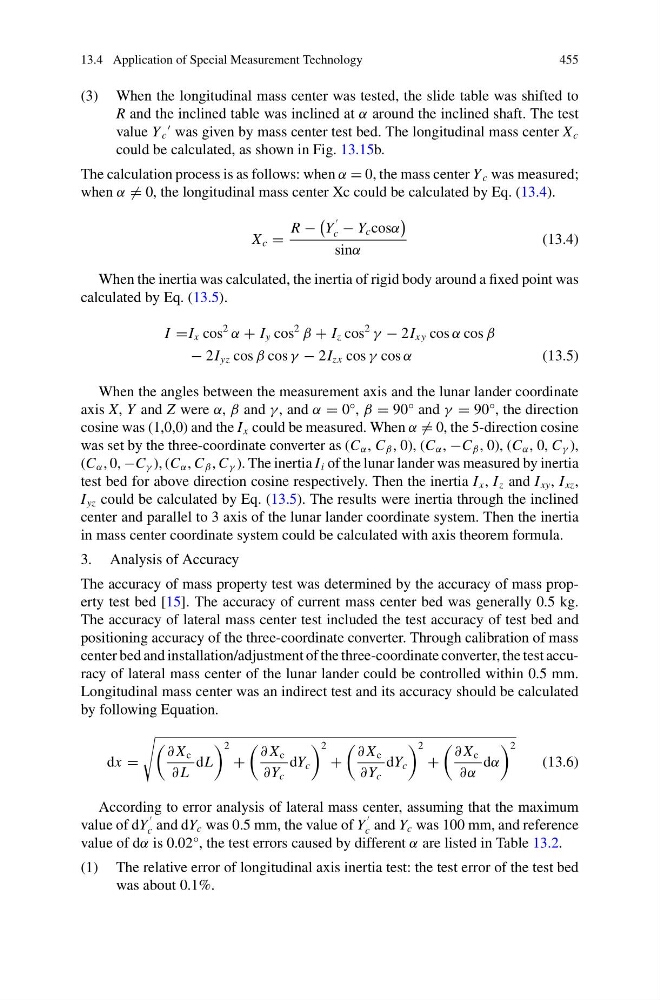
13.4 Application of Special Measurement Technology
455
(3) When the longitudinal mass center was tested, the slide table was shifted to
R and the inclined table was inclined at α around the inclined shaft. The test
value Y c
was given by mass center test bed. The longitudinal mass center X c
could be calculated, as shown in Fig. 13.15b.
The calculation process is as follows: when α = 0, the mass center Y c was measured;
when α = 0, the longitudinal mass center Xc could be calculated by Eq. (13.4).
X c =
R −
Y
c − Y c cosα
sinα
(13.4)
When the inertia was calculated, the inertia of rigid body around a fixed point was
calculated by Eq. (13.5).
I =I x cos
2
α + I y cos
2
β + I z cos
2
γ − 2I xy cos α cos β
− 2I yz cos β cos γ − 2I zx cos γ cos α
(13.5)
When the angles between the measurement axis and the lunar lander coordinate
axis X, Y and Z were α, β and γ , and α = 0°, β = 90° and γ = 90°, the direction
cosine was (1,0,0) and the I x could be measured. When α = 0, the 5-direction cosine
was set by the three-coordinate converter as (C α , C β , 0), (C α , −C β , 0), (C α , 0, C γ ),
(C α , 0, −C γ ), (C α , C β , C γ ). The inertia I i of the lunar lander was measured by inertia
test bed for above direction cosine respectively. Then the inertia I x , I z and I xy , I xz ,
I yz could be calculated by Eq. (13.5). The results were inertia through the inclined
center and parallel to 3 axis of the lunar lander coordinate system. Then the inertia
in mass center coordinate system could be calculated with axis theorem formula.
3. Analysis of Accuracy
The accuracy of mass property test was determined by the accuracy of mass property test bed [15]. The accuracy of current mass center bed was generally 0.5 kg.
The accuracy of lateral mass center test included the test accuracy of test bed and
positioning accuracy of the three-coordinate converter. Through calibration of mass
center bed and installation/adjustment of the three-coordinate converter, the test accuracy of lateral mass center of the lunar lander could be controlled within 0.5 mm.
Longitudinal mass center was an indirect test and its accuracy should be calculated
by following Equation.
dx =
∂ X c
∂ L
dL
2
+
∂ X c
∂Y c
dY c
2
+
∂ X c
∂Y c
dY c
2
+
∂ X c
∂α
dα
2
(13.6)
According to error analysis of lateral mass center, assuming that the maximum
value of dY
c and dY c was 0.5 mm, the value of Y
c and Y c was 100 mm, and reference
value of dα is 0.02°, the test errors caused by different α are listed in Table 13.2.
(1) The relative error of longitudinal axis inertia test: the test error of the test bed
was about 0.1%.
455
(3) When the longitudinal mass center was tested, the slide table was shifted to
R and the inclined table was inclined at α around the inclined shaft. The test
value Y c
was given by mass center test bed. The longitudinal mass center X c
could be calculated, as shown in Fig. 13.15b.
The calculation process is as follows: when α = 0, the mass center Y c was measured;
when α = 0, the longitudinal mass center Xc could be calculated by Eq. (13.4).
X c =
R −
Y
c − Y c cosα
sinα
(13.4)
When the inertia was calculated, the inertia of rigid body around a fixed point was
calculated by Eq. (13.5).
I =I x cos
2
α + I y cos
2
β + I z cos
2
γ − 2I xy cos α cos β
− 2I yz cos β cos γ − 2I zx cos γ cos α
(13.5)
When the angles between the measurement axis and the lunar lander coordinate
axis X, Y and Z were α, β and γ , and α = 0°, β = 90° and γ = 90°, the direction
cosine was (1,0,0) and the I x could be measured. When α = 0, the 5-direction cosine
was set by the three-coordinate converter as (C α , C β , 0), (C α , −C β , 0), (C α , 0, C γ ),
(C α , 0, −C γ ), (C α , C β , C γ ). The inertia I i of the lunar lander was measured by inertia
test bed for above direction cosine respectively. Then the inertia I x , I z and I xy , I xz ,
I yz could be calculated by Eq. (13.5). The results were inertia through the inclined
center and parallel to 3 axis of the lunar lander coordinate system. Then the inertia
in mass center coordinate system could be calculated with axis theorem formula.
3. Analysis of Accuracy
The accuracy of mass property test was determined by the accuracy of mass property test bed [15]. The accuracy of current mass center bed was generally 0.5 kg.
The accuracy of lateral mass center test included the test accuracy of test bed and
positioning accuracy of the three-coordinate converter. Through calibration of mass
center bed and installation/adjustment of the three-coordinate converter, the test accuracy of lateral mass center of the lunar lander could be controlled within 0.5 mm.
Longitudinal mass center was an indirect test and its accuracy should be calculated
by following Equation.
dx =
∂ X c
∂ L
dL
2
+
∂ X c
∂Y c
dY c
2
+
∂ X c
∂Y c
dY c
2
+
∂ X c
∂α
dα
2
(13.6)
According to error analysis of lateral mass center, assuming that the maximum
value of dY
c and dY c was 0.5 mm, the value of Y
c and Y c was 100 mm, and reference
value of dα is 0.02°, the test errors caused by different α are listed in Table 13.2.
(1) The relative error of longitudinal axis inertia test: the test error of the test bed
was about 0.1%.