

456
13 Metrology Technology of Lunar Lander
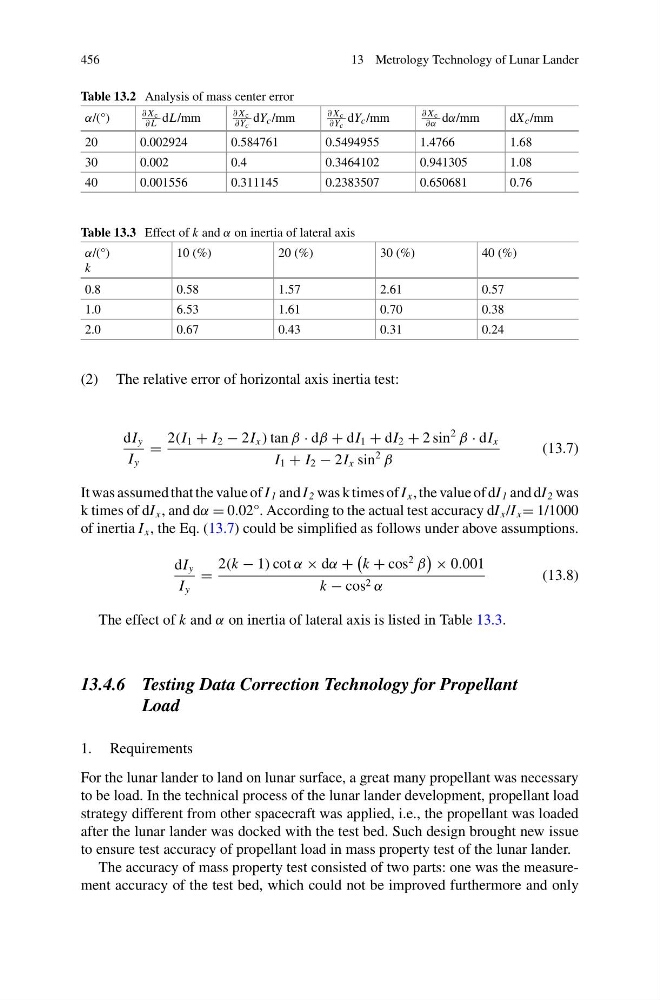
Table 13.2 Analysis of mass center error
α/(°)
∂ Xc
∂ L dL/mm
∂ Xc
∂Yc dY c /mm
∂ Xc
∂Yc dY c /mm
∂ Xc
∂α dα/mm
dX c /mm
20
0.002924
0.584761
0.5494955
1.4766
1.68
30
0.002
0.4
0.3464102
0.941305
1.08
40
0.001556
0.311145
0.2383507
0.650681
0.76
Table 13.3 Effect of k and α on inertia of lateral axis
α/(°)
k
10 (%)
20 (%)
30 (%)
40 (%)
0.8
0.58
1.57
2.61
0.57
1.0
6.53
1.61
0.70
0.38
2.0
0.67
0.43
0.31
0.24
(2) The relative error of horizontal axis inertia test:
dI y
I y
=
2(I 1 + I 2 − 2I x ) tan β · dβ + dI 1 + dI 2 + 2 sin
2
β · dI x
I 1 + I 2 − 2I x sin
2
β
(13.7)
It was assumed that the value of I 1 and I 2 was k times of I x , the value of dI 1 and dI 2 was
k times of dI x , and dα = 0.02°. According to the actual test accuracy dI x /I x = 1/1000
of inertia I x , the Eq. (13.7) could be simplified as follows under above assumptions.
dI y
I y
=
2(k − 1) cot α × dα +
k + cos
2
β
× 0.001
k − cos 2 α
(13.8)
The effect of k and α on inertia of lateral axis is listed in Table 13.3.
13.4.6 Testing Data Correction Technology for Propellant
Load
1. Requirements
For the lunar lander to land on lunar surface, a great many propellant was necessary
to be load. In the technical process of the lunar lander development, propellant load
strategy different from other spacecraft was applied, i.e., the propellant was loaded
after the lunar lander was docked with the test bed. Such design brought new issue
to ensure test accuracy of propellant load in mass property test of the lunar lander.
The accuracy of mass property test consisted of two parts: one was the measurement accuracy of the test bed, which could not be improved furthermore and only
13 Metrology Technology of Lunar Lander
Table 13.2 Analysis of mass center error
α/(°)
∂ Xc
∂ L dL/mm
∂ Xc
∂Yc dY c /mm
∂ Xc
∂Yc dY c /mm
∂ Xc
∂α dα/mm
dX c /mm
20
0.002924
0.584761
0.5494955
1.4766
1.68
30
0.002
0.4
0.3464102
0.941305
1.08
40
0.001556
0.311145
0.2383507
0.650681
0.76
Table 13.3 Effect of k and α on inertia of lateral axis
α/(°)
k
10 (%)
20 (%)
30 (%)
40 (%)
0.8
0.58
1.57
2.61
0.57
1.0
6.53
1.61
0.70
0.38
2.0
0.67
0.43
0.31
0.24
(2) The relative error of horizontal axis inertia test:
dI y
I y
=
2(I 1 + I 2 − 2I x ) tan β · dβ + dI 1 + dI 2 + 2 sin
2
β · dI x
I 1 + I 2 − 2I x sin
2
β
(13.7)
It was assumed that the value of I 1 and I 2 was k times of I x , the value of dI 1 and dI 2 was
k times of dI x , and dα = 0.02°. According to the actual test accuracy dI x /I x = 1/1000
of inertia I x , the Eq. (13.7) could be simplified as follows under above assumptions.
dI y
I y
=
2(k − 1) cot α × dα +
k + cos
2
β
× 0.001
k − cos 2 α
(13.8)
The effect of k and α on inertia of lateral axis is listed in Table 13.3.
13.4.6 Testing Data Correction Technology for Propellant
Load
1. Requirements
For the lunar lander to land on lunar surface, a great many propellant was necessary
to be load. In the technical process of the lunar lander development, propellant load
strategy different from other spacecraft was applied, i.e., the propellant was loaded
after the lunar lander was docked with the test bed. Such design brought new issue
to ensure test accuracy of propellant load in mass property test of the lunar lander.
The accuracy of mass property test consisted of two parts: one was the measurement accuracy of the test bed, which could not be improved furthermore and only