

442
13 Metrology Technology of Lunar Lander
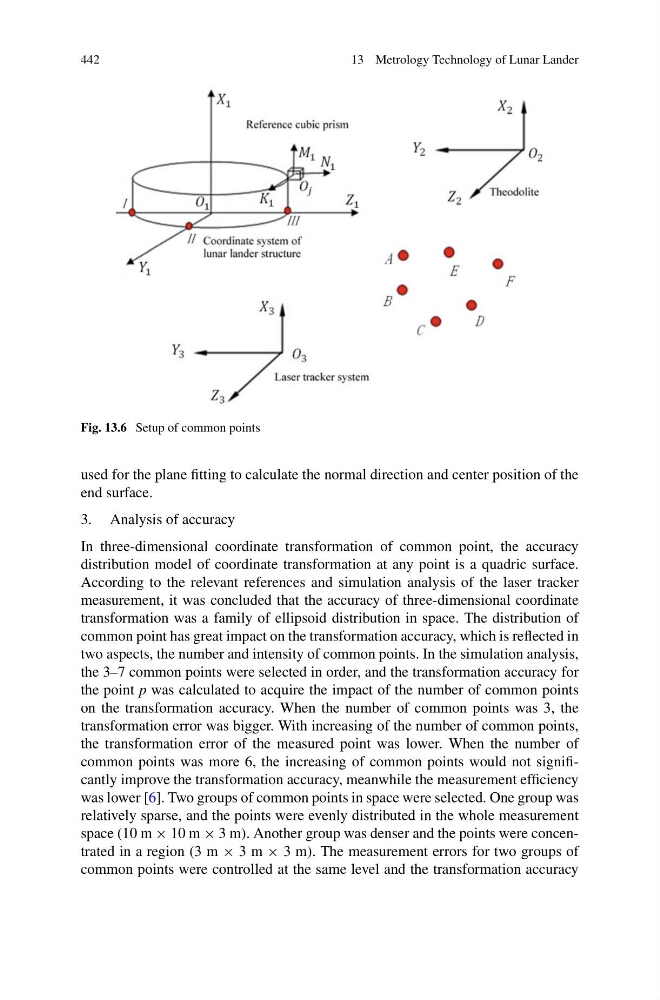
Fig. 13.6 Setup of common points
used for the plane fitting to calculate the normal direction and center position of the
end surface.
3. Analysis of accuracy
In three-dimensional coordinate transformation of common point, the accuracy
distribution model of coordinate transformation at any point is a quadric surface.
According to the relevant references and simulation analysis of the laser tracker
measurement, it was concluded that the accuracy of three-dimensional coordinate
transformation was a family of ellipsoid distribution in space. The distribution of
common point has great impact on the transformation accuracy, which is reflected in
two aspects, the number and intensity of common points. In the simulation analysis,
the 3–7 common points were selected in order, and the transformation accuracy for
the point p was calculated to acquire the impact of the number of common points
on the transformation accuracy. When the number of common points was 3, the
transformation error was bigger. With increasing of the number of common points,
the transformation error of the measured point was lower. When the number of
common points was more 6, the increasing of common points would not significantly improve the transformation accuracy, meanwhile the measurement efficiency
was lower [6]. Two groups of common points in space were selected. One group was
relatively sparse, and the points were evenly distributed in the whole measurement
space (10 m × 10 m × 3 m). Another group was denser and the points were concentrated in a region (3 m × 3 m × 3 m). The measurement errors for two groups of
common points were controlled at the same level and the transformation accuracy
13 Metrology Technology of Lunar Lander
Fig. 13.6 Setup of common points
used for the plane fitting to calculate the normal direction and center position of the
end surface.
3. Analysis of accuracy
In three-dimensional coordinate transformation of common point, the accuracy
distribution model of coordinate transformation at any point is a quadric surface.
According to the relevant references and simulation analysis of the laser tracker
measurement, it was concluded that the accuracy of three-dimensional coordinate
transformation was a family of ellipsoid distribution in space. The distribution of
common point has great impact on the transformation accuracy, which is reflected in
two aspects, the number and intensity of common points. In the simulation analysis,
the 3–7 common points were selected in order, and the transformation accuracy for
the point p was calculated to acquire the impact of the number of common points
on the transformation accuracy. When the number of common points was 3, the
transformation error was bigger. With increasing of the number of common points,
the transformation error of the measured point was lower. When the number of
common points was more 6, the increasing of common points would not significantly improve the transformation accuracy, meanwhile the measurement efficiency
was lower [6]. Two groups of common points in space were selected. One group was
relatively sparse, and the points were evenly distributed in the whole measurement
space (10 m × 10 m × 3 m). Another group was denser and the points were concentrated in a region (3 m × 3 m × 3 m). The measurement errors for two groups of
common points were controlled at the same level and the transformation accuracy