

394
11 Landing Gear Technology of Lunar Lander
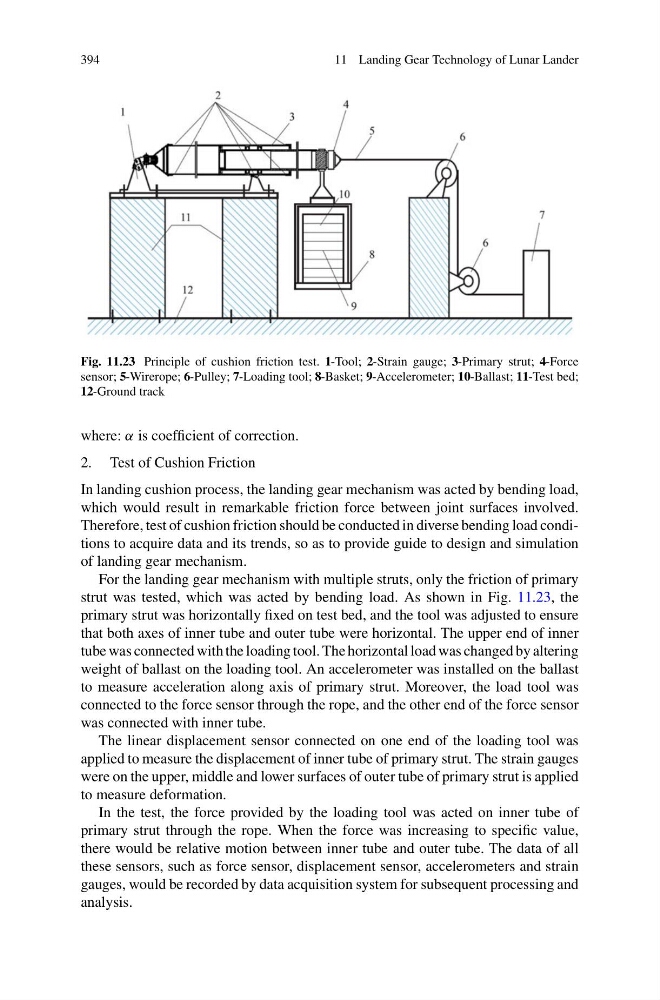
Fig. 11.23 Principle of cushion friction test. 1-Tool; 2-Strain gauge; 3-Primary strut; 4-Force
sensor; 5-Wirerope; 6-Pulley; 7-Loading tool; 8-Basket; 9-Accelerometer; 10-Ballast; 11-Test bed;
12-Ground track
where: α is coefficient of correction.
2. Test of Cushion Friction
In landing cushion process, the landing gear mechanism was acted by bending load,
which would result in remarkable friction force between joint surfaces involved.
Therefore, test of cushion friction should be conducted in diverse bending load conditions to acquire data and its trends, so as to provide guide to design and simulation
of landing gear mechanism.
For the landing gear mechanism with multiple struts, only the friction of primary
strut was tested, which was acted by bending load. As shown in Fig. 11.23, the
primary strut was horizontally fixed on test bed, and the tool was adjusted to ensure
that both axes of inner tube and outer tube were horizontal. The upper end of inner
tube was connected with the loading tool. The horizontal load was changed by altering
weight of ballast on the loading tool. An accelerometer was installed on the ballast
to measure acceleration along axis of primary strut. Moreover, the load tool was
connected to the force sensor through the rope, and the other end of the force sensor
was connected with inner tube.
The linear displacement sensor connected on one end of the loading tool was
applied to measure the displacement of inner tube of primary strut. The strain gauges
were on the upper, middle and lower surfaces of outer tube of primary strut is applied
to measure deformation.
In the test, the force provided by the loading tool was acted on inner tube of
primary strut through the rope. When the force was increasing to specific value,
there would be relative motion between inner tube and outer tube. The data of all
these sensors, such as force sensor, displacement sensor, accelerometers and strain
gauges, would be recorded by data acquisition system for subsequent processing and
analysis.
11 Landing Gear Technology of Lunar Lander
Fig. 11.23 Principle of cushion friction test. 1-Tool; 2-Strain gauge; 3-Primary strut; 4-Force
sensor; 5-Wirerope; 6-Pulley; 7-Loading tool; 8-Basket; 9-Accelerometer; 10-Ballast; 11-Test bed;
12-Ground track
where: α is coefficient of correction.
2. Test of Cushion Friction
In landing cushion process, the landing gear mechanism was acted by bending load,
which would result in remarkable friction force between joint surfaces involved.
Therefore, test of cushion friction should be conducted in diverse bending load conditions to acquire data and its trends, so as to provide guide to design and simulation
of landing gear mechanism.
For the landing gear mechanism with multiple struts, only the friction of primary
strut was tested, which was acted by bending load. As shown in Fig. 11.23, the
primary strut was horizontally fixed on test bed, and the tool was adjusted to ensure
that both axes of inner tube and outer tube were horizontal. The upper end of inner
tube was connected with the loading tool. The horizontal load was changed by altering
weight of ballast on the loading tool. An accelerometer was installed on the ballast
to measure acceleration along axis of primary strut. Moreover, the load tool was
connected to the force sensor through the rope, and the other end of the force sensor
was connected with inner tube.
The linear displacement sensor connected on one end of the loading tool was
applied to measure the displacement of inner tube of primary strut. The strain gauges
were on the upper, middle and lower surfaces of outer tube of primary strut is applied
to measure deformation.
In the test, the force provided by the loading tool was acted on inner tube of
primary strut through the rope. When the force was increasing to specific value,
there would be relative motion between inner tube and outer tube. The data of all
these sensors, such as force sensor, displacement sensor, accelerometers and strain
gauges, would be recorded by data acquisition system for subsequent processing and
analysis.