

11.5 Design of Landing Gear Mechanism
385
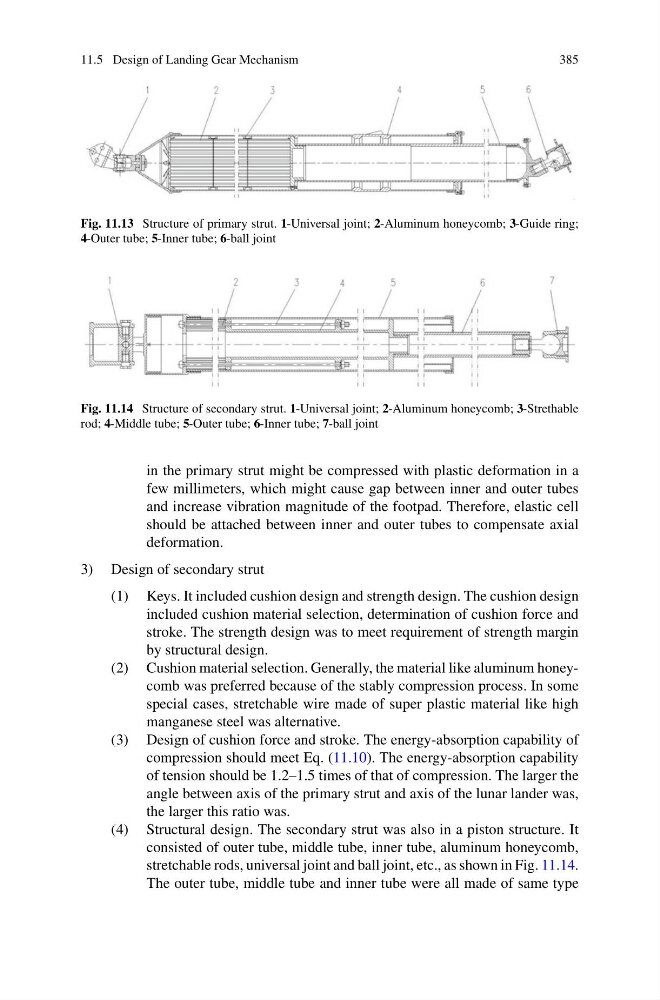
Fig. 11.13 Structure of primary strut. 1-Universal joint; 2-Aluminum honeycomb; 3-Guide ring;
4-Outer tube; 5-Inner tube; 6-ball joint
Fig. 11.14 Structure of secondary strut. 1-Universal joint; 2-Aluminum honeycomb; 3-Strethable
rod; 4-Middle tube; 5-Outer tube; 6-Inner tube; 7-ball joint
in the primary strut might be compressed with plastic deformation in a
few millimeters, which might cause gap between inner and outer tubes
and increase vibration magnitude of the footpad. Therefore, elastic cell
should be attached between inner and outer tubes to compensate axial
deformation.
3) Design of secondary strut
(1) Keys. It included cushion design and strength design. The cushion design
included cushion material selection, determination of cushion force and
stroke. The strength design was to meet requirement of strength margin
by structural design.
(2) Cushion material selection. Generally, the material like aluminum honeycomb was preferred because of the stably compression process. In some
special cases, stretchable wire made of super plastic material like high
manganese steel was alternative.
(3) Design of cushion force and stroke. The energy-absorption capability of
compression should meet Eq. (11.10). The energy-absorption capability
of tension should be 1.2–1.5 times of that of compression. The larger the
angle between axis of the primary strut and axis of the lunar lander was,
the larger this ratio was.
(4) Structural design. The secondary strut was also in a piston structure. It
consisted of outer tube, middle tube, inner tube, aluminum honeycomb,
stretchable rods, universal joint and ball joint, etc., as shown in Fig. 11.14.
The outer tube, middle tube and inner tube were all made of same type
385
Fig. 11.13 Structure of primary strut. 1-Universal joint; 2-Aluminum honeycomb; 3-Guide ring;
4-Outer tube; 5-Inner tube; 6-ball joint
Fig. 11.14 Structure of secondary strut. 1-Universal joint; 2-Aluminum honeycomb; 3-Strethable
rod; 4-Middle tube; 5-Outer tube; 6-Inner tube; 7-ball joint
in the primary strut might be compressed with plastic deformation in a
few millimeters, which might cause gap between inner and outer tubes
and increase vibration magnitude of the footpad. Therefore, elastic cell
should be attached between inner and outer tubes to compensate axial
deformation.
3) Design of secondary strut
(1) Keys. It included cushion design and strength design. The cushion design
included cushion material selection, determination of cushion force and
stroke. The strength design was to meet requirement of strength margin
by structural design.
(2) Cushion material selection. Generally, the material like aluminum honeycomb was preferred because of the stably compression process. In some
special cases, stretchable wire made of super plastic material like high
manganese steel was alternative.
(3) Design of cushion force and stroke. The energy-absorption capability of
compression should meet Eq. (11.10). The energy-absorption capability
of tension should be 1.2–1.5 times of that of compression. The larger the
angle between axis of the primary strut and axis of the lunar lander was,
the larger this ratio was.
(4) Structural design. The secondary strut was also in a piston structure. It
consisted of outer tube, middle tube, inner tube, aluminum honeycomb,
stretchable rods, universal joint and ball joint, etc., as shown in Fig. 11.14.
The outer tube, middle tube and inner tube were all made of same type