

10.4 Design of Telemetry/Telecommand and Telecommunication Technology
355
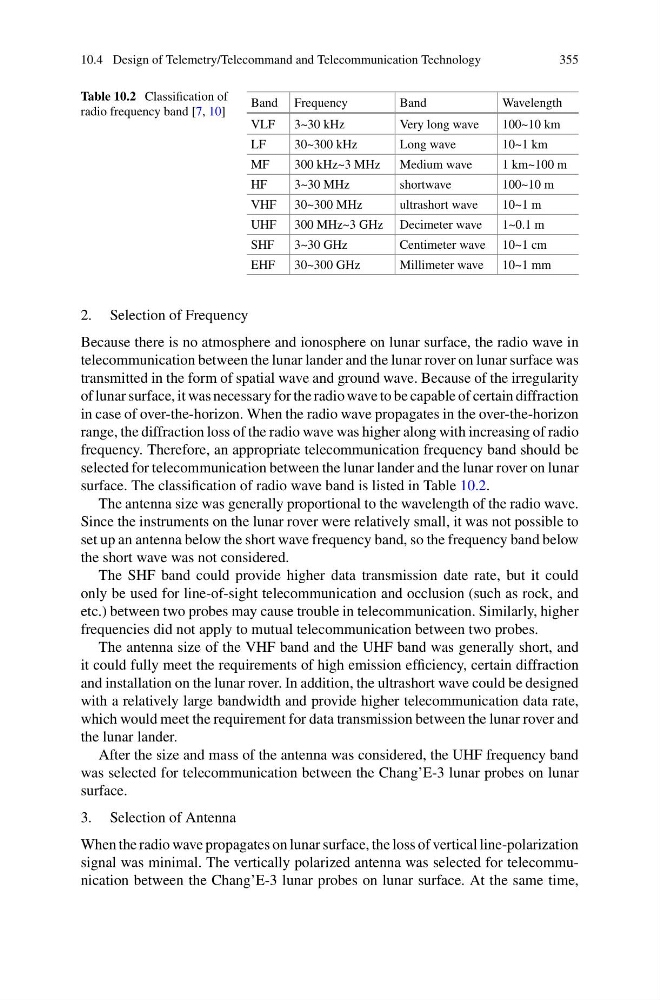
Table 10.2 Classification of
radio frequency band [7, 10]
Band Frequency
Band
Wavelength
VLF
3~30 kHz
Very long wave
100~10 km
LF
30~300 kHz
Long wave
10~1 km
MF
300 kHz~3 MHz
Medium wave
1 km~100 m
HF
3~30 MHz
shortwave
100~10 m
VHF 30~300 MHz
ultrashort wave
10~1 m
UHF 300 MHz~3 GHz Decimeter wave
1~0.1 m
SHF
3~30 GHz
Centimeter wave 10~1 cm
EHF
30~300 GHz
Millimeter wave 10~1 mm
2. Selection of Frequency
Because there is no atmosphere and ionosphere on lunar surface, the radio wave in
telecommunication between the lunar lander and the lunar rover on lunar surface was
transmitted in the form of spatial wave and ground wave. Because of the irregularity
of lunar surface, it was necessary for the radio wave to be capable of certain diffraction
in case of over-the-horizon. When the radio wave propagates in the over-the-horizon
range, the diffraction loss of the radio wave was higher along with increasing of radio
frequency. Therefore, an appropriate telecommunication frequency band should be
selected for telecommunication between the lunar lander and the lunar rover on lunar
surface. The classification of radio wave band is listed in Table 10.2.
The antenna size was generally proportional to the wavelength of the radio wave.
Since the instruments on the lunar rover were relatively small, it was not possible to
set up an antenna below the short wave frequency band, so the frequency band below
the short wave was not considered.
The SHF band could provide higher data transmission date rate, but it could
only be used for line-of-sight telecommunication and occlusion (such as rock, and
etc.) between two probes may cause trouble in telecommunication. Similarly, higher
frequencies did not apply to mutual telecommunication between two probes.
The antenna size of the VHF band and the UHF band was generally short, and
it could fully meet the requirements of high emission efficiency, certain diffraction
and installation on the lunar rover. In addition, the ultrashort wave could be designed
with a relatively large bandwidth and provide higher telecommunication data rate,
which would meet the requirement for data transmission between the lunar rover and
the lunar lander.
After the size and mass of the antenna was considered, the UHF frequency band
was selected for telecommunication between the Chang’E-3 lunar probes on lunar
surface.
3. Selection of Antenna
When the radio wave propagates on lunar surface, the loss of vertical line-polarization
signal was minimal. The vertically polarized antenna was selected for telecommunication between the Chang’E-3 lunar probes on lunar surface. At the same time,
355
Table 10.2 Classification of
radio frequency band [7, 10]
Band Frequency
Band
Wavelength
VLF
3~30 kHz
Very long wave
100~10 km
LF
30~300 kHz
Long wave
10~1 km
MF
300 kHz~3 MHz
Medium wave
1 km~100 m
HF
3~30 MHz
shortwave
100~10 m
VHF 30~300 MHz
ultrashort wave
10~1 m
UHF 300 MHz~3 GHz Decimeter wave
1~0.1 m
SHF
3~30 GHz
Centimeter wave 10~1 cm
EHF
30~300 GHz
Millimeter wave 10~1 mm
2. Selection of Frequency
Because there is no atmosphere and ionosphere on lunar surface, the radio wave in
telecommunication between the lunar lander and the lunar rover on lunar surface was
transmitted in the form of spatial wave and ground wave. Because of the irregularity
of lunar surface, it was necessary for the radio wave to be capable of certain diffraction
in case of over-the-horizon. When the radio wave propagates in the over-the-horizon
range, the diffraction loss of the radio wave was higher along with increasing of radio
frequency. Therefore, an appropriate telecommunication frequency band should be
selected for telecommunication between the lunar lander and the lunar rover on lunar
surface. The classification of radio wave band is listed in Table 10.2.
The antenna size was generally proportional to the wavelength of the radio wave.
Since the instruments on the lunar rover were relatively small, it was not possible to
set up an antenna below the short wave frequency band, so the frequency band below
the short wave was not considered.
The SHF band could provide higher data transmission date rate, but it could
only be used for line-of-sight telecommunication and occlusion (such as rock, and
etc.) between two probes may cause trouble in telecommunication. Similarly, higher
frequencies did not apply to mutual telecommunication between two probes.
The antenna size of the VHF band and the UHF band was generally short, and
it could fully meet the requirements of high emission efficiency, certain diffraction
and installation on the lunar rover. In addition, the ultrashort wave could be designed
with a relatively large bandwidth and provide higher telecommunication data rate,
which would meet the requirement for data transmission between the lunar rover and
the lunar lander.
After the size and mass of the antenna was considered, the UHF frequency band
was selected for telecommunication between the Chang’E-3 lunar probes on lunar
surface.
3. Selection of Antenna
When the radio wave propagates on lunar surface, the loss of vertical line-polarization
signal was minimal. The vertically polarized antenna was selected for telecommunication between the Chang’E-3 lunar probes on lunar surface. At the same time,