

356
10 TT&C and Telecommunication Technology …
the antenna gain pattern should cover the variation in relative position of the lunar
lander and the lunar rover under nominal condition, i.e., the horizontal plane was
non-directional (360° coverage) and the vertical direction was insensitive to the axial
deviation of the antenna.
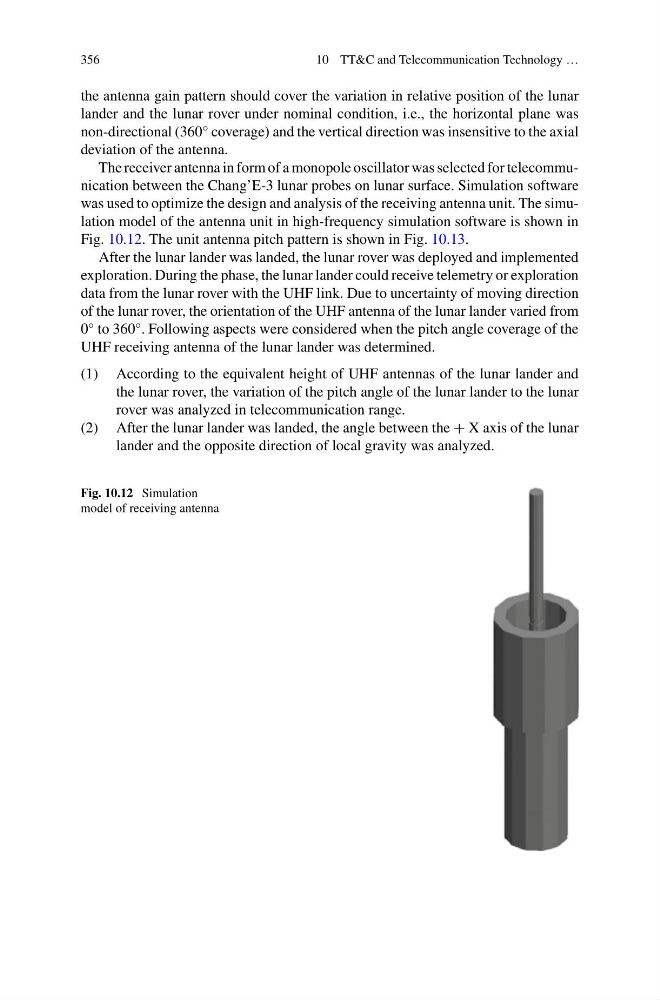
The receiver antenna in form of a monopole oscillator was selected for telecommunication between the Chang’E-3 lunar probes on lunar surface. Simulation software
was used to optimize the design and analysis of the receiving antenna unit. The simulation model of the antenna unit in high-frequency simulation software is shown in
Fig. 10.12. The unit antenna pitch pattern is shown in Fig. 10.13.
After the lunar lander was landed, the lunar rover was deployed and implemented
exploration. During the phase, the lunar lander could receive telemetry or exploration
data from the lunar rover with the UHF link. Due to uncertainty of moving direction
of the lunar rover, the orientation of the UHF antenna of the lunar lander varied from
0° to 360°. Following aspects were considered when the pitch angle coverage of the
UHF receiving antenna of the lunar lander was determined.
(1) According to the equivalent height of UHF antennas of the lunar lander and
the lunar rover, the variation of the pitch angle of the lunar lander to the lunar
rover was analyzed in telecommunication range.
(2) After the lunar lander was landed, the angle between the + X axis of the lunar
lander and the opposite direction of local gravity was analyzed.
Fig. 10.12 Simulation
model of receiving antenna
10 TT&C and Telecommunication Technology …
the antenna gain pattern should cover the variation in relative position of the lunar
lander and the lunar rover under nominal condition, i.e., the horizontal plane was
non-directional (360° coverage) and the vertical direction was insensitive to the axial
deviation of the antenna.
The receiver antenna in form of a monopole oscillator was selected for telecommunication between the Chang’E-3 lunar probes on lunar surface. Simulation software
was used to optimize the design and analysis of the receiving antenna unit. The simulation model of the antenna unit in high-frequency simulation software is shown in
Fig. 10.12. The unit antenna pitch pattern is shown in Fig. 10.13.
After the lunar lander was landed, the lunar rover was deployed and implemented
exploration. During the phase, the lunar lander could receive telemetry or exploration
data from the lunar rover with the UHF link. Due to uncertainty of moving direction
of the lunar rover, the orientation of the UHF antenna of the lunar lander varied from
0° to 360°. Following aspects were considered when the pitch angle coverage of the
UHF receiving antenna of the lunar lander was determined.
(1) According to the equivalent height of UHF antennas of the lunar lander and
the lunar rover, the variation of the pitch angle of the lunar lander to the lunar
rover was analyzed in telecommunication range.
(2) After the lunar lander was landed, the angle between the + X axis of the lunar
lander and the opposite direction of local gravity was analyzed.
Fig. 10.12 Simulation
model of receiving antenna