

352
10 TT&C and Telecommunication Technology …
carrier modulation architecture had no residual carrier. In case of certain transmitting
power, it was more effective to improve the transmission energy of unit code and
increase the transmission code rate.
2) Telecommunications Antenna
Compared with the telemetry/telecommand antenna, the telecommunication antenna
had a higher antenna gain and a narrower antenna beam, which could achieve higher
effective total radiation power and improve the channel capacity. Generally there
were two types of telecommunication antennas in the lunar lander: one was fixed
antenna for telecommunication during powered descent; another was an antenna
with a driving mechanism for telecommunication during operation on lunar surface.
For example, there were one mid-gain antenna and one high gain antenna in the
Chang’E-3 lunar lander.
The mid-gain antenna was used when the Chang’E-3 lunar lander was at about
1 km altitude from lunar surface during powered descent until landing on the Moon.
At the phase, the +X axis of the lunar lander was roughly perpendicular to the Y’Z’
plane of the northeast coordinate system (O’ −X’Y’Z’) at landing site, and the −Z
axis was pointed to local south (to lunar equator).
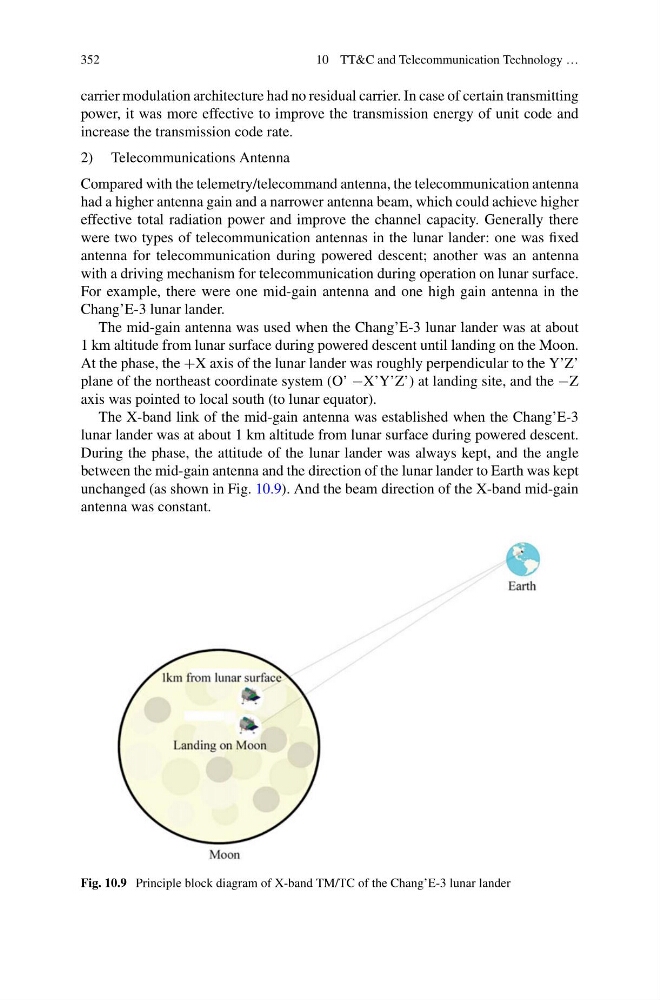
The X-band link of the mid-gain antenna was established when the Chang’E-3
lunar lander was at about 1 km altitude from lunar surface during powered descent.
During the phase, the attitude of the lunar lander was always kept, and the angle
between the mid-gain antenna and the direction of the lunar lander to Earth was kept
unchanged (as shown in Fig. 10.9). And the beam direction of the X-band mid-gain
antenna was constant.
Fig. 10.9 Principle block diagram of X-band TM/TC of the Chang’E-3 lunar lander
10 TT&C and Telecommunication Technology …
carrier modulation architecture had no residual carrier. In case of certain transmitting
power, it was more effective to improve the transmission energy of unit code and
increase the transmission code rate.
2) Telecommunications Antenna
Compared with the telemetry/telecommand antenna, the telecommunication antenna
had a higher antenna gain and a narrower antenna beam, which could achieve higher
effective total radiation power and improve the channel capacity. Generally there
were two types of telecommunication antennas in the lunar lander: one was fixed
antenna for telecommunication during powered descent; another was an antenna
with a driving mechanism for telecommunication during operation on lunar surface.
For example, there were one mid-gain antenna and one high gain antenna in the
Chang’E-3 lunar lander.
The mid-gain antenna was used when the Chang’E-3 lunar lander was at about
1 km altitude from lunar surface during powered descent until landing on the Moon.
At the phase, the +X axis of the lunar lander was roughly perpendicular to the Y’Z’
plane of the northeast coordinate system (O’ −X’Y’Z’) at landing site, and the −Z
axis was pointed to local south (to lunar equator).
The X-band link of the mid-gain antenna was established when the Chang’E-3
lunar lander was at about 1 km altitude from lunar surface during powered descent.
During the phase, the attitude of the lunar lander was always kept, and the angle
between the mid-gain antenna and the direction of the lunar lander to Earth was kept
unchanged (as shown in Fig. 10.9). And the beam direction of the X-band mid-gain
antenna was constant.
Fig. 10.9 Principle block diagram of X-band TM/TC of the Chang’E-3 lunar lander