

116
4 Structure and Mechanism Technology of Lunar Lander
for static analysis. The determination of load should be taken into account all critical
load cases.
Prediction analysis of static test as also an important part of structural static
analysis. The prediction analysis of static test could verify the rationality of test plan
on the one hand and guide the test on the other hand.
The force transfer path and bearing characteristics of the structure should be
analyzed in the static analysis modeling, and the structural parts of the detailed
stress analysis should be determined, and the element mesh was refined in the stress
concentration area.
The landing load in landing state used as structural design was simplified to
quasi-static load, which was given by system design output. The load was acted on
the support of landing cushion mechanisms of the lander structure. The analysis of
the force transfer path showed that the structural components such as the support
of landing cushion mechanisms and its adjacent structural components should be
specially considered. Compared with launch state, the static analysis model of landing
state should only adjust the fuel tanks mass (part of propellant used during landing),
and the rest was the same as the model of the launch state. It was necessary to explain
that the element mesh should be refined in the stress concentration area (such as the
support of landing cushion mechanisms) according to analysis results of the load
transfer path and bearing characteristics of the lander structure in landing state.
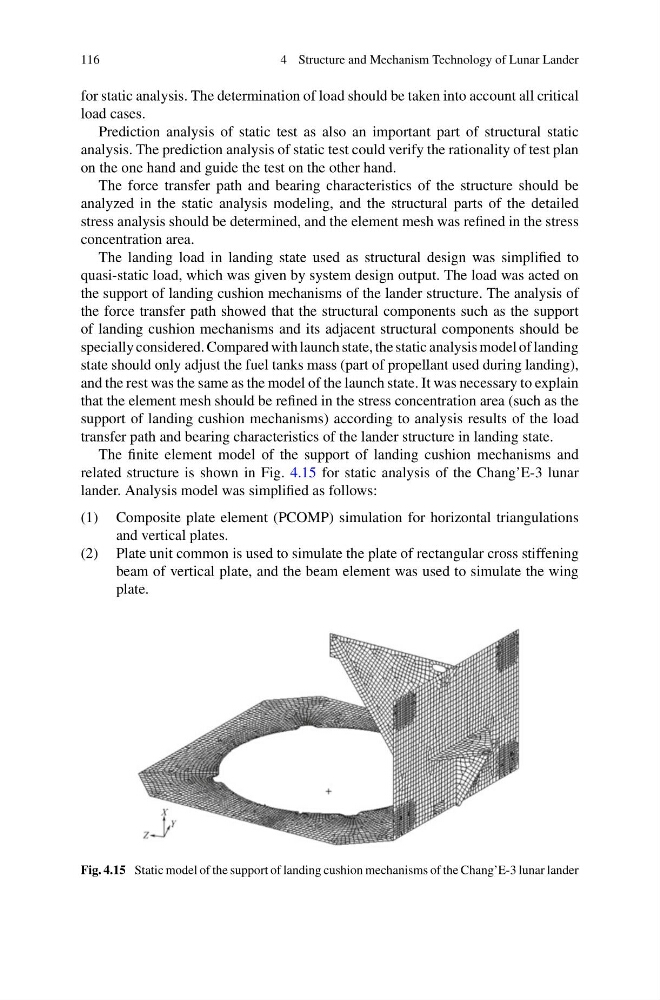
The finite element model of the support of landing cushion mechanisms and
related structure is shown in Fig. 4.15 for static analysis of the Chang’E-3 lunar
lander. Analysis model was simplified as follows:
(1) Composite plate element (PCOMP) simulation for horizontal triangulations
and vertical plates.
(2) Plate unit common is used to simulate the plate of rectangular cross stiffening
beam of vertical plate, and the beam element was used to simulate the wing
plate.
Fig. 4.15 Static model of the support of landing cushion mechanisms of the Chang’E-3 lunar lander
4 Structure and Mechanism Technology of Lunar Lander
for static analysis. The determination of load should be taken into account all critical
load cases.
Prediction analysis of static test as also an important part of structural static
analysis. The prediction analysis of static test could verify the rationality of test plan
on the one hand and guide the test on the other hand.
The force transfer path and bearing characteristics of the structure should be
analyzed in the static analysis modeling, and the structural parts of the detailed
stress analysis should be determined, and the element mesh was refined in the stress
concentration area.
The landing load in landing state used as structural design was simplified to
quasi-static load, which was given by system design output. The load was acted on
the support of landing cushion mechanisms of the lander structure. The analysis of
the force transfer path showed that the structural components such as the support
of landing cushion mechanisms and its adjacent structural components should be
specially considered. Compared with launch state, the static analysis model of landing
state should only adjust the fuel tanks mass (part of propellant used during landing),
and the rest was the same as the model of the launch state. It was necessary to explain
that the element mesh should be refined in the stress concentration area (such as the
support of landing cushion mechanisms) according to analysis results of the load
transfer path and bearing characteristics of the lander structure in landing state.
The finite element model of the support of landing cushion mechanisms and
related structure is shown in Fig. 4.15 for static analysis of the Chang’E-3 lunar
lander. Analysis model was simplified as follows:
(1) Composite plate element (PCOMP) simulation for horizontal triangulations
and vertical plates.
(2) Plate unit common is used to simulate the plate of rectangular cross stiffening
beam of vertical plate, and the beam element was used to simulate the wing
plate.
Fig. 4.15 Static model of the support of landing cushion mechanisms of the Chang’E-3 lunar lander