

4.3 Design and Verification of Lunar Lander Structure
115
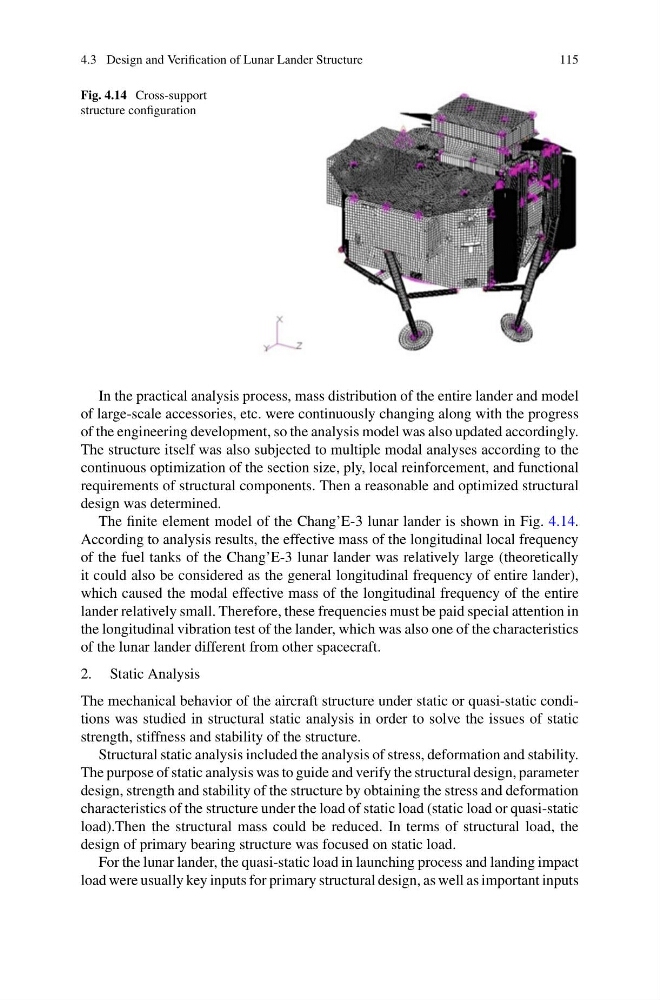
Fig. 4.14 Cross-support
structure configuration
In the practical analysis process, mass distribution of the entire lander and model
of large-scale accessories, etc. were continuously changing along with the progress
of the engineering development, so the analysis model was also updated accordingly.
The structure itself was also subjected to multiple modal analyses according to the
continuous optimization of the section size, ply, local reinforcement, and functional
requirements of structural components. Then a reasonable and optimized structural
design was determined.
The finite element model of the Chang’E-3 lunar lander is shown in Fig. 4.14.
According to analysis results, the effective mass of the longitudinal local frequency
of the fuel tanks of the Chang’E-3 lunar lander was relatively large (theoretically
it could also be considered as the general longitudinal frequency of entire lander),
which caused the modal effective mass of the longitudinal frequency of the entire
lander relatively small. Therefore, these frequencies must be paid special attention in
the longitudinal vibration test of the lander, which was also one of the characteristics
of the lunar lander different from other spacecraft.
2. Static Analysis
The mechanical behavior of the aircraft structure under static or quasi-static conditions was studied in structural static analysis in order to solve the issues of static
strength, stiffness and stability of the structure.
Structural static analysis included the analysis of stress, deformation and stability.
The purpose of static analysis was to guide and verify the structural design, parameter
design, strength and stability of the structure by obtaining the stress and deformation
characteristics of the structure under the load of static load (static load or quasi-static
load).Then the structural mass could be reduced. In terms of structural load, the
design of primary bearing structure was focused on static load.
For the lunar lander, the quasi-static load in launching process and landing impact
load were usually key inputs for primary structural design, as well as important inputs
115
Fig. 4.14 Cross-support
structure configuration
In the practical analysis process, mass distribution of the entire lander and model
of large-scale accessories, etc. were continuously changing along with the progress
of the engineering development, so the analysis model was also updated accordingly.
The structure itself was also subjected to multiple modal analyses according to the
continuous optimization of the section size, ply, local reinforcement, and functional
requirements of structural components. Then a reasonable and optimized structural
design was determined.
The finite element model of the Chang’E-3 lunar lander is shown in Fig. 4.14.
According to analysis results, the effective mass of the longitudinal local frequency
of the fuel tanks of the Chang’E-3 lunar lander was relatively large (theoretically
it could also be considered as the general longitudinal frequency of entire lander),
which caused the modal effective mass of the longitudinal frequency of the entire
lander relatively small. Therefore, these frequencies must be paid special attention in
the longitudinal vibration test of the lander, which was also one of the characteristics
of the lunar lander different from other spacecraft.
2. Static Analysis
The mechanical behavior of the aircraft structure under static or quasi-static conditions was studied in structural static analysis in order to solve the issues of static
strength, stiffness and stability of the structure.
Structural static analysis included the analysis of stress, deformation and stability.
The purpose of static analysis was to guide and verify the structural design, parameter
design, strength and stability of the structure by obtaining the stress and deformation
characteristics of the structure under the load of static load (static load or quasi-static
load).Then the structural mass could be reduced. In terms of structural load, the
design of primary bearing structure was focused on static load.
For the lunar lander, the quasi-static load in launching process and landing impact
load were usually key inputs for primary structural design, as well as important inputs