

112
4 Structure and Mechanism Technology of Lunar Lander
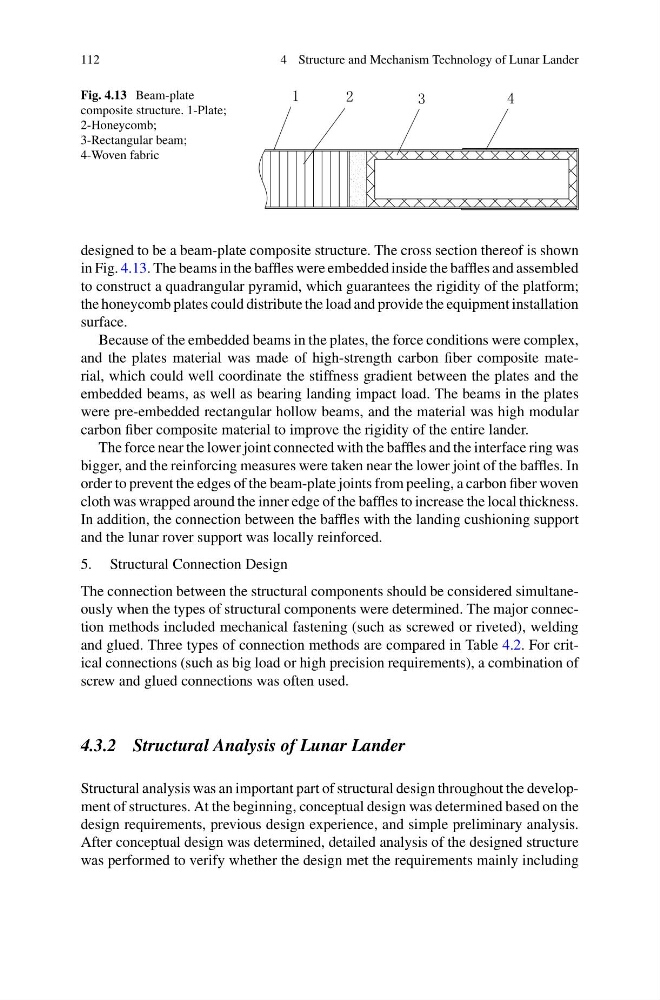
Fig. 4.13 Beam-plate
composite structure. 1-Plate;
2-Honeycomb;
3-Rectangular beam;
4-Woven fabric
designed to be a beam-plate composite structure. The cross section thereof is shown
in Fig. 4.13. The beams in the baffles were embedded inside the baffles and assembled
to construct a quadrangular pyramid, which guarantees the rigidity of the platform;
the honeycomb plates could distribute the load and provide the equipment installation
surface.
Because of the embedded beams in the plates, the force conditions were complex,
and the plates material was made of high-strength carbon fiber composite material, which could well coordinate the stiffness gradient between the plates and the
embedded beams, as well as bearing landing impact load. The beams in the plates
were pre-embedded rectangular hollow beams, and the material was high modular
carbon fiber composite material to improve the rigidity of the entire lander.
The force near the lower joint connected with the baffles and the interface ring was
bigger, and the reinforcing measures were taken near the lower joint of the baffles. In
order to prevent the edges of the beam-plate joints from peeling, a carbon fiber woven
cloth was wrapped around the inner edge of the baffles to increase the local thickness.
In addition, the connection between the baffles with the landing cushioning support
and the lunar rover support was locally reinforced.
5. Structural Connection Design
The connection between the structural components should be considered simultaneously when the types of structural components were determined. The major connection methods included mechanical fastening (such as screwed or riveted), welding
and glued. Three types of connection methods are compared in Table 4.2. For critical connections (such as big load or high precision requirements), a combination of
screw and glued connections was often used.
4.3.2 Structural Analysis of Lunar Lander
Structural analysis was an important part of structural design throughout the development of structures. At the beginning, conceptual design was determined based on the
design requirements, previous design experience, and simple preliminary analysis.
After conceptual design was determined, detailed analysis of the designed structure
was performed to verify whether the design met the requirements mainly including
4 Structure and Mechanism Technology of Lunar Lander
Fig. 4.13 Beam-plate
composite structure. 1-Plate;
2-Honeycomb;
3-Rectangular beam;
4-Woven fabric
designed to be a beam-plate composite structure. The cross section thereof is shown
in Fig. 4.13. The beams in the baffles were embedded inside the baffles and assembled
to construct a quadrangular pyramid, which guarantees the rigidity of the platform;
the honeycomb plates could distribute the load and provide the equipment installation
surface.
Because of the embedded beams in the plates, the force conditions were complex,
and the plates material was made of high-strength carbon fiber composite material, which could well coordinate the stiffness gradient between the plates and the
embedded beams, as well as bearing landing impact load. The beams in the plates
were pre-embedded rectangular hollow beams, and the material was high modular
carbon fiber composite material to improve the rigidity of the entire lander.
The force near the lower joint connected with the baffles and the interface ring was
bigger, and the reinforcing measures were taken near the lower joint of the baffles. In
order to prevent the edges of the beam-plate joints from peeling, a carbon fiber woven
cloth was wrapped around the inner edge of the baffles to increase the local thickness.
In addition, the connection between the baffles with the landing cushioning support
and the lunar rover support was locally reinforced.
5. Structural Connection Design
The connection between the structural components should be considered simultaneously when the types of structural components were determined. The major connection methods included mechanical fastening (such as screwed or riveted), welding
and glued. Three types of connection methods are compared in Table 4.2. For critical connections (such as big load or high precision requirements), a combination of
screw and glued connections was often used.
4.3.2 Structural Analysis of Lunar Lander
Structural analysis was an important part of structural design throughout the development of structures. At the beginning, conceptual design was determined based on the
design requirements, previous design experience, and simple preliminary analysis.
After conceptual design was determined, detailed analysis of the designed structure
was performed to verify whether the design met the requirements mainly including