

74
3 System Design of Lunar Lander
3.3.5 Analysis of Payload Configuration
Lunar soft landing exploration extended depth and breadth of scientific research.
Scientific exploration on lunar surface might be summarized as three categories.
(1) To the Moon: survey of lunar terrain and geological structure, research on
chemical composition and material on lunar surface, subsurface structure of
shallow lunar internal structure.
(2) To the Earth: observation of the Earth’s ionosphere on near side of the Moon
that always faces the Earth for research on variation mode of space weather of
the Earth and the Sun.
(3) To space: lunar base observatory as a dream of astronomers which is ideal for
astronomy because there is no atmosphere and induced twinkling and flickering
of stars as well as slow rotation rate of the Moon relative to the Earth.
During powered descent of lunar lander, descent camera and other scientific instruments could obtain images of large area of lunar surface when approaching the Moon
in high definition.
3.4 Trajectory Design
The aim of trajectory design for lunar lander was: to satisfy requirements of launch
and telecommunication constraints, the start point of powered descent satisfying
requirement of soft landing, the end of powered descent at predefined landing site,
illumination condition after landing satisfying requirement of operation on lunar
surface, and all crucial flight events in access time of ground station inside China.
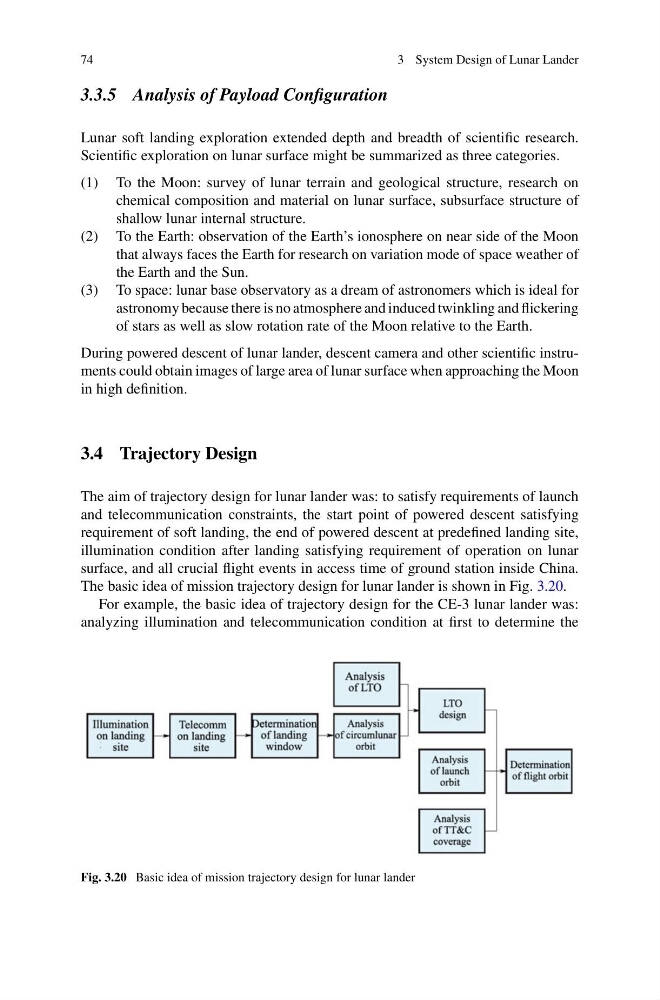
The basic idea of mission trajectory design for lunar lander is shown in Fig. 3.20.
For example, the basic idea of trajectory design for the CE-3 lunar lander was:
analyzing illumination and telecommunication condition at first to determine the
Fig. 3.20 Basic idea of mission trajectory design for lunar lander
3 System Design of Lunar Lander
3.3.5 Analysis of Payload Configuration
Lunar soft landing exploration extended depth and breadth of scientific research.
Scientific exploration on lunar surface might be summarized as three categories.
(1) To the Moon: survey of lunar terrain and geological structure, research on
chemical composition and material on lunar surface, subsurface structure of
shallow lunar internal structure.
(2) To the Earth: observation of the Earth’s ionosphere on near side of the Moon
that always faces the Earth for research on variation mode of space weather of
the Earth and the Sun.
(3) To space: lunar base observatory as a dream of astronomers which is ideal for
astronomy because there is no atmosphere and induced twinkling and flickering
of stars as well as slow rotation rate of the Moon relative to the Earth.
During powered descent of lunar lander, descent camera and other scientific instruments could obtain images of large area of lunar surface when approaching the Moon
in high definition.
3.4 Trajectory Design
The aim of trajectory design for lunar lander was: to satisfy requirements of launch
and telecommunication constraints, the start point of powered descent satisfying
requirement of soft landing, the end of powered descent at predefined landing site,
illumination condition after landing satisfying requirement of operation on lunar
surface, and all crucial flight events in access time of ground station inside China.
The basic idea of mission trajectory design for lunar lander is shown in Fig. 3.20.
For example, the basic idea of trajectory design for the CE-3 lunar lander was:
analyzing illumination and telecommunication condition at first to determine the
Fig. 3.20 Basic idea of mission trajectory design for lunar lander