

3.4 Trajectory Design
75
window of landing; defining the initial condition for the powered descent to get
parameters of LLO then; analyzing characteristics of LTO to determine the range
of key trajectory parameters; determining the launch window under constraints of
launch vehicle and ground telecommunication finally.
3.4.1 Overview of Flight Profile
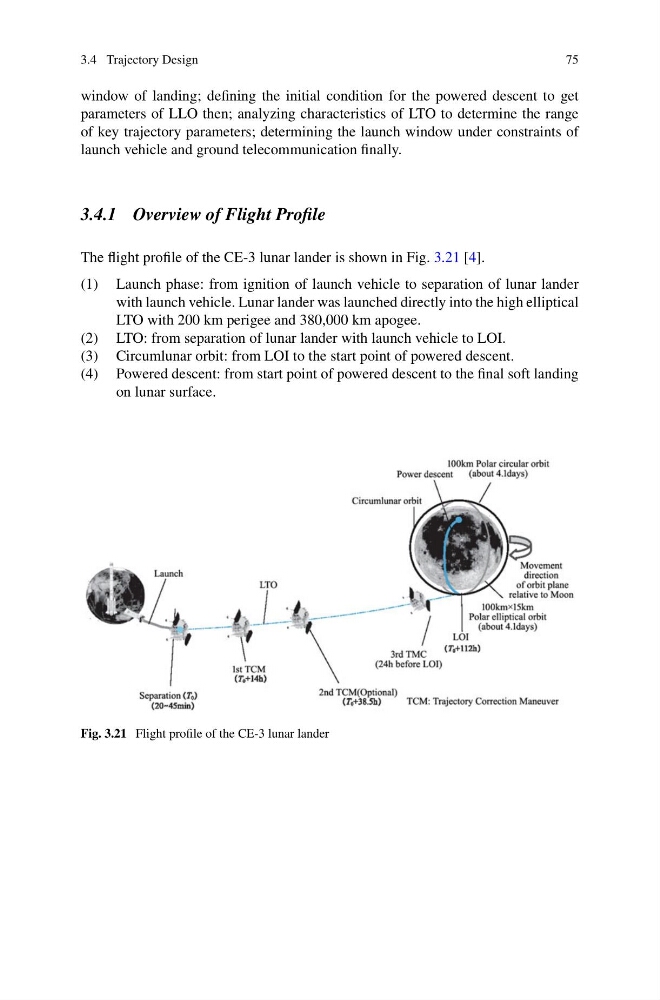
The flight profile of the CE-3 lunar lander is shown in Fig. 3.21 [4].
(1) Launch phase: from ignition of launch vehicle to separation of lunar lander
with launch vehicle. Lunar lander was launched directly into the high elliptical
LTO with 200 km perigee and 380,000 km apogee.
(2) LTO: from separation of lunar lander with launch vehicle to LOI.
(3) Circumlunar orbit: from LOI to the start point of powered descent.
(4) Powered descent: from start point of powered descent to the final soft landing
on lunar surface.
Fig. 3.21 Flight profile of the CE-3 lunar lander
75
window of landing; defining the initial condition for the powered descent to get
parameters of LLO then; analyzing characteristics of LTO to determine the range
of key trajectory parameters; determining the launch window under constraints of
launch vehicle and ground telecommunication finally.
3.4.1 Overview of Flight Profile
The flight profile of the CE-3 lunar lander is shown in Fig. 3.21 [4].
(1) Launch phase: from ignition of launch vehicle to separation of lunar lander
with launch vehicle. Lunar lander was launched directly into the high elliptical
LTO with 200 km perigee and 380,000 km apogee.
(2) LTO: from separation of lunar lander with launch vehicle to LOI.
(3) Circumlunar orbit: from LOI to the start point of powered descent.
(4) Powered descent: from start point of powered descent to the final soft landing
on lunar surface.
Fig. 3.21 Flight profile of the CE-3 lunar lander