

interests are in the properties of the interstellar medium and the processes of star
formation and galaxy evolution. His research includes far-infrared spectroscopic
observations of the interstellar medium in the Milky Way and nearby galaxies. He
has been a research scientist at the Caltech Jet Propulsion Laboratory since 2008.
He is Principal Investigator of the Astrophysics Stratospheric Telescope for High
Spectral Resolution Observations at Submillimeter-wavelengths (ASTHROS)
balloon mission that is scheduled to launch from Antarctica in December 2023.
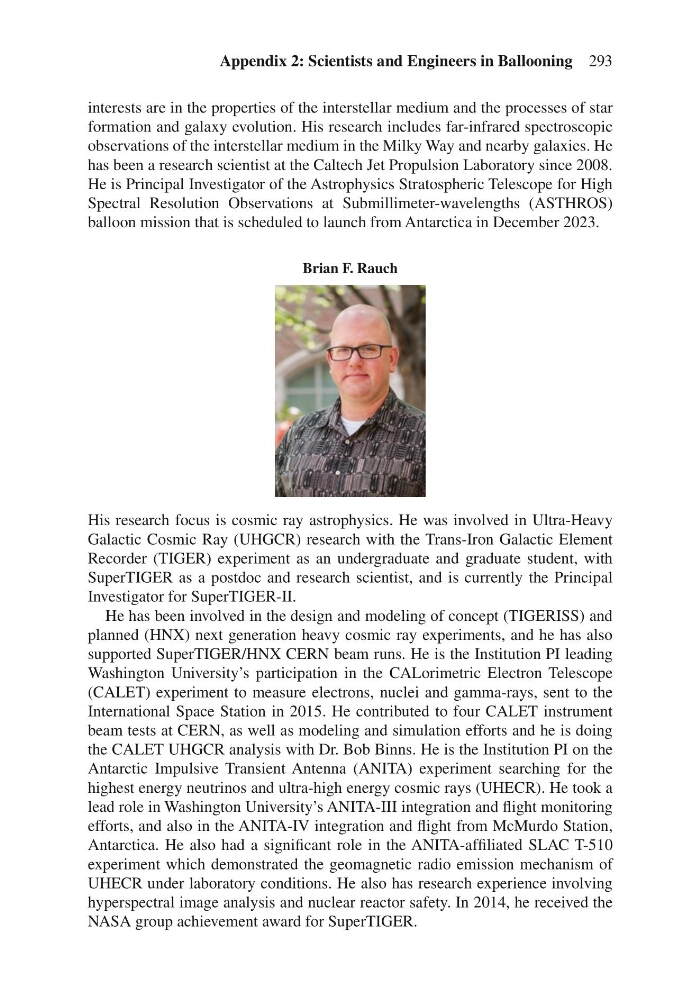
Brian F. Rauch
His research focus is cosmic ray astrophysics. He was involved in Ultra-Heavy
Galactic Cosmic Ray (UHGCR) research with the Trans-Iron Galactic Element
Recorder (TIGER) experiment as an undergraduate and graduate student, with
SuperTIGER as a postdoc and research scientist, and is currently the Principal
Investigator for SuperTIGER-II.
He has been involved in the design and modeling of concept (TIGERISS) and
planned (HNX) next generation heavy cosmic ray experiments, and he has also
supported SuperTIGER/HNX CERN beam runs. He is the Institution PI leading
Washington University’s participation in the CALorimetric Electron Telescope
(CALET) experiment to measure electrons, nuclei and gamma-rays, sent to the
International Space Station in 2015. He contributed to four CALET instrument
beam tests at CERN, as well as modeling and simulation efforts and he is doing
the CALET UHGCR analysis with Dr. Bob Binns. He is the Institution PI on the
Antarctic Impulsive Transient Antenna (ANITA) experiment searching for the
highest energy neutrinos and ultra-high energy cosmic rays (UHECR). He took a
lead role in Washington University’s ANITA-III integration and flight monitoring
efforts, and also in the ANITA-IV integration and flight from McMurdo Station,
Antarctica. He also had a significant role in the ANITA-affiliated SLAC T-510
experiment which demonstrated the geomagnetic radio emission mechanism of
UHECR under laboratory conditions. He also has research experience involving
hyperspectral image analysis and nuclear reactor safety. In 2014, he received the
NASA group achievement award for SuperTIGER.
Appendix 2: Scientists and Engineers in Ballooning 293
formation and galaxy evolution. His research includes far-infrared spectroscopic
observations of the interstellar medium in the Milky Way and nearby galaxies. He
has been a research scientist at the Caltech Jet Propulsion Laboratory since 2008.
He is Principal Investigator of the Astrophysics Stratospheric Telescope for High
Spectral Resolution Observations at Submillimeter-wavelengths (ASTHROS)
balloon mission that is scheduled to launch from Antarctica in December 2023.
Brian F. Rauch
His research focus is cosmic ray astrophysics. He was involved in Ultra-Heavy
Galactic Cosmic Ray (UHGCR) research with the Trans-Iron Galactic Element
Recorder (TIGER) experiment as an undergraduate and graduate student, with
SuperTIGER as a postdoc and research scientist, and is currently the Principal
Investigator for SuperTIGER-II.
He has been involved in the design and modeling of concept (TIGERISS) and
planned (HNX) next generation heavy cosmic ray experiments, and he has also
supported SuperTIGER/HNX CERN beam runs. He is the Institution PI leading
Washington University’s participation in the CALorimetric Electron Telescope
(CALET) experiment to measure electrons, nuclei and gamma-rays, sent to the
International Space Station in 2015. He contributed to four CALET instrument
beam tests at CERN, as well as modeling and simulation efforts and he is doing
the CALET UHGCR analysis with Dr. Bob Binns. He is the Institution PI on the
Antarctic Impulsive Transient Antenna (ANITA) experiment searching for the
highest energy neutrinos and ultra-high energy cosmic rays (UHECR). He took a
lead role in Washington University’s ANITA-III integration and flight monitoring
efforts, and also in the ANITA-IV integration and flight from McMurdo Station,
Antarctica. He also had a significant role in the ANITA-affiliated SLAC T-510
experiment which demonstrated the geomagnetic radio emission mechanism of
UHECR under laboratory conditions. He also has research experience involving
hyperspectral image analysis and nuclear reactor safety. In 2014, he received the
NASA group achievement award for SuperTIGER.
Appendix 2: Scientists and Engineers in Ballooning 293